How to Write a Cover Letter for a Career Change in 2026
October 7, 2026

You’ve switched career paths, completed training, or developed a concrete plan, but your resume still reflects your previous career. When applying for a new role, recruiters may wonder why you’re making the change and what you can actually bring to the new position. A cover letter for a career change isn’t just a recap of your past experience. It should clearly explain your transition and demonstrate that it’s already underway.
Motivation alone isn’t enough. What sets you apart is visible preparation, transferable skills, and your ability to connect your past experience to the needs of the new role.
Why the Cover Letter Matters More When Your Resume Doesn’t Fit
The paradox is simple. While cover letters are requested less often than before, they become more important when your resume doesn’t clearly match the job. A chronological resume lists your previous roles, dates, and qualifications, but it doesn’t explain why you’re changing careers or what value this change brings to the company.
In the UK, around 50% of employers requested a cover letter for at least one senior role in 2023, down from nearly 70% in 2021, according to data shared by HelloWork on cover letter trends. Cover letters are no longer expected with every application but should be used strategically when your background requires explanation.
Resume Shows, Cover Letter Explains
A career change often creates an apparent gap between your old and new roles. Your cover letter must build the missing bridge without trying to hide this gap. You need to explain why this new career, why now, and why this company.
A phrase like “I want to give my career a fresh start” doesn’t answer these questions. In contrast, mentioning a specific project, training completed, or hands-on experience gives the recruiter something concrete to grasp.
Practical rule: If the recruiter can discard your cover letter without losing any information, it’s not fulfilling its purpose.
Generic applications also create friction. In 2024, 23% of young UK job seekers had abandoned an application because a cover letter was required, according to HelloWork’s summary. This doesn’t condemn cover letters but highlights the problem with long, generic, and irrelevant texts.
Your cover letter should be selective. Use it for roles where your career change needs explanation, focusing mainly on your preparation. In 2025, 18% of UK workers reported preparing for a career change, with 29% of 18-24 year olds and 30% of 25-34 year olds considering a transition, according to a government report on career transition programs. You’re not alone — you just need to show what makes your project credible.
The Perfect Structure for a Career Change Cover Letter
A strong cover letter follows a clear progression. The recruiter should first understand your project, then identify your strengths, see your preparation, and finally understand what you can bring to the role.
A four-part structure is enough. It avoids long justifications and prevents your letter from becoming a rewritten resume.
1. Introduce Your Career Change Project in the Opening
Don’t wait until the third paragraph to reveal your career change. Name the target role and your active steps right away.
“After several years in administration, I am transitioning to project coordination and eager to bring my organizational skills to your team.”
This sentence works better than a vague introduction about your “strong motivation” because it immediately frames your application.
2. Select Transferable Skills
Don’t list all your qualities. Choose two or three skills that directly relate to the job duties, then illustrate them with a real example.
You might write: “In my role as an administrative assistant, I managed complex case tracking and coordinated communication among multiple stakeholders. This experience prepares me to handle operational project follow-ups as part of your coordination team.”
The key isn’t to claim your old job was the same as the new one, but to show what you already master and what you’re currently learning. The UK government’s career transition guide describes this as a process that can include certified training, possible leave, and salary support during training.
3. Prove Your Preparation
This is the most important part of a career change cover letter. Mention the training name, certification, dates, projects completed, internships, portfolio, or practical experience.
Ongoing training isn’t a weakness if you clearly explain what you can already do. Instead of saying “I’m currently training in digital,” say: “I am completing a certified digital project management course and have applied its methods to planning a personal project, from goal setting to deliverable tracking.”
The UK labor statistics detail training participation among job seekers. Your letter should show that your training is part of an active process with identifiable skills and concrete outputs.
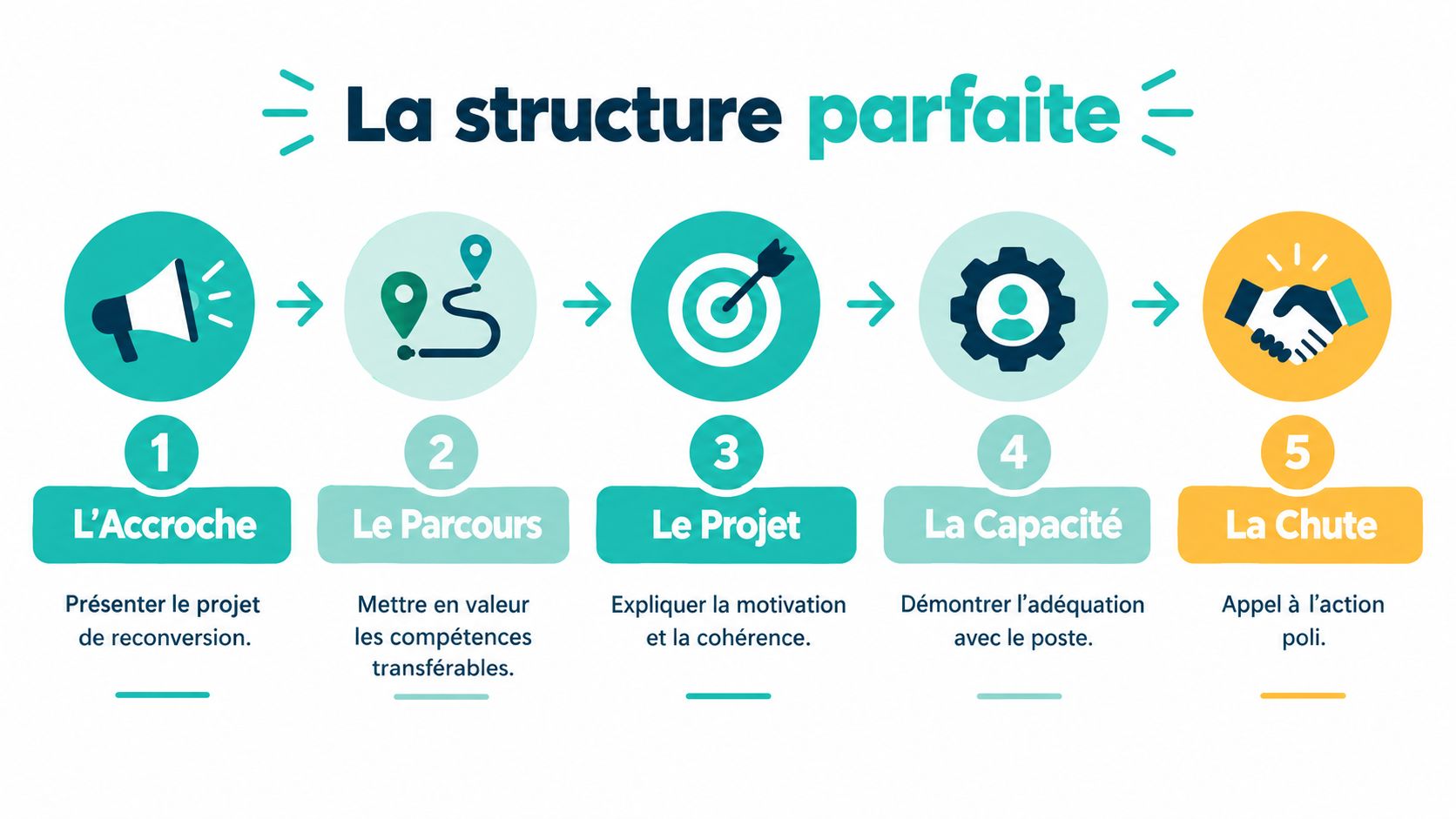
4. Connect Your Profile to the Company
End with the contribution you expect to make, not another motivation statement. Refer to a job duty, team challenge, or specific company feature.
For more on writing and avoiding generic phrases, see this Jobshift guide on writing convincing cover letters. Your closing can be simple: express your availability for an interview to discuss your project and supporting evidence.
Identify and Articulate Your Transferable Skills
The challenge is usually not a lack of skills but the inability to translate them into the language of the new role.
UK career services define transferable skills as those usable across different jobs within the same sector or company. Customer relations, analysis, organization, or prioritization only convince if you explain where, how, and with what results you used them.
The Three-Question Method
Start with a real task from your previous job. Then identify the skill involved. Finally, link it to a task in the new role.
| Past Experience | Demonstrated Skill | Usefulness in New Role |
|---|---|---|
| Managing administrative requests | Prioritization and attention to detail | Handling multiple tasks within deadlines |
| Responding to complaints | Active listening and paraphrasing | Understanding client needs |
| Coordinating suppliers | Organization and communication | Managing project stakeholders |
The difference between a weak statement and proof often lies in detail. “I am organized” is a vague quality. “I managed 40 cases per month and updated their status to avoid missed follow-ups” is verifiable, following advice from UK career services on skills-based resumes.
Translate Without Exaggerating
Don’t claim mastery of the new role if you don’t have it yet. Present a solid foundation and ongoing learning instead.
A former customer advisor doesn’t automatically become a project manager but can highlight coordination, request tracking, prioritization, and communication skills. The UK career service definition of transferable skills encourages starting from a specific experience and showing its relevance in the new context.
To build your paragraph, use this formula:
- Situation: “In my role as…”
- Action: “I took responsibility for…”
- Skill: “This experience taught me to…”
- Link: “I can now apply this to…”
This approach replaces vague words like “versatile,” “dynamic,” or “motivated” when unsupported by examples.
Annotated Example of a Career Change Cover Letter
Consider a candidate moving from administrative assistant to digital project manager. She hasn’t held the new role yet but has coordination experience and is pursuing targeted training.
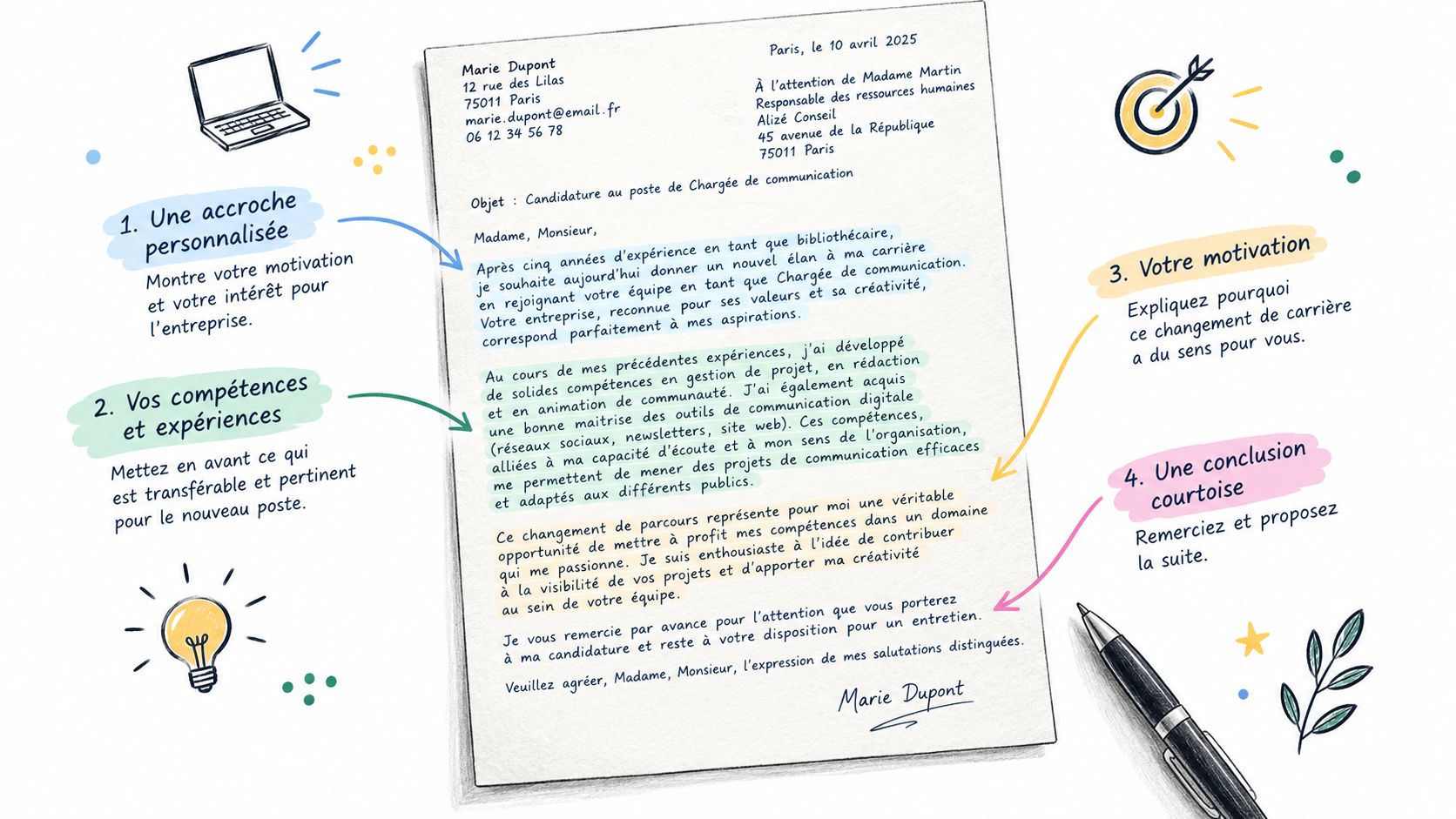
Subject: Application for Digital Project Manager Role – Career Change
Dear Hiring Manager,
After several years in administrative support, I am transitioning to digital project management. Your job posting caught my attention because it combines team coordination, deliverable tracking, and client interaction—three areas I am eager to develop further in a digital environment.
This opening announces the change confidently without apologizing. It references concrete job duties rather than vague statements about wanting new challenges.
In my current role, I coordinate communication among internal teams, suppliers, and clients, while managing deadlines for multiple cases. This experience has taught me to prioritize urgent tasks, formalize useful information, and follow up with stakeholders at the right time. I aim to transfer these skills to managing digital projects and coordinating diverse stakeholders.
This paragraph doesn’t claim administrative support is the same as digital project management but shows credible continuity between mastered methods and job requirements.
To prepare for this transition, I have completed a digital project management course, where I worked on goal definition, task planning, and deliverable tracking. I also led a personal website redesign project, from drafting the specifications to coordinating production stages. This hands-on experience allowed me to test my skills against real digital project constraints.
This is where the application gains credibility. The candidate specifies what she studied and what she produced.
I would be delighted to bring my coordination skills and technical preparation to your projects. I am available for an interview to discuss my background and explain how my career change aligns with your team’s needs.
The conclusion projects the candidate’s potential contribution and naturally invites further conversation.
Common Mistakes and How to Avoid Them
Career change cover letters rarely fail due to a single stylistic error. They fail because they leave essential questions unanswered or raise more doubts than confidence.
| Mistake | Recommended Alternative |
|---|---|
| Rewriting the entire resume in paragraphs | Select experiences that illuminate the targeted project |
| Writing “I am very motivated” without examples | Describe training, immersion, projects, or achievements |
| Presenting the career change as an escape | Show what your previous job taught you and why you’re applying it differently |
| Being vague about the targeted role | Name the job title and key responsibilities upfront |
| Using phrases like “your reputation” or “your values” | Reference a specific project, product, activity, or company need |
| Apologizing for lack of direct experience | Acknowledge the gap, then provide proof of preparation and adaptability |
| Copying an online template verbatim | Keep the structure but rewrite each sentence with your own facts |
The Tone to Adopt
Don’t disparage your former employer. A sentence like “I couldn’t stand my old job” immediately puts your application on negative ground. Recruiters may worry you’ll speak similarly about their company after hiring.
Choose constructive phrasing: “My experience confirmed my interest in coordination and communication, which I now wish to pursue in the training sector.”
Also, avoid turning the letter into a full personal narrative. Recruiters don’t need every twist of your thought process. They want to understand your decision, see evidence, and identify your potential contribution.
A convincing career change letter doesn’t just explain what you’re leaving behind. It shows what you’re already building.
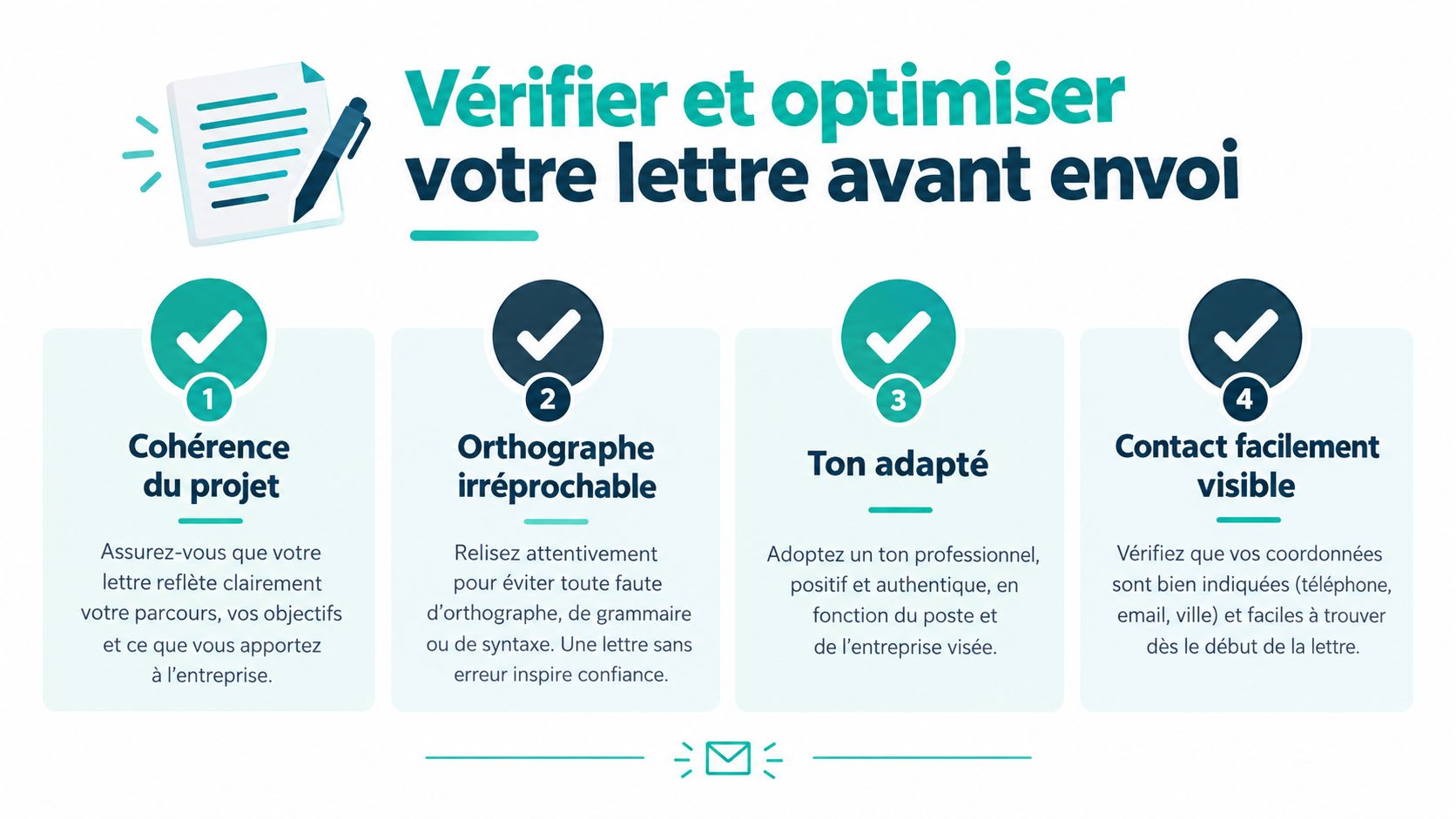
Review and Optimize Your Cover Letter Before Sending
Effective proofreading isn’t just about catching typos. It should verify coherence between the targeted role, your evidence, and the promise you make to the employer.
Start by comparing your letter to the job description. Highlight the main duties, then check that your letter addresses only those you can fulfill. If your letter talks about your background but not the job’s needs, rewrite it.
The Checklist in Under Ten Minutes
- Clear project: The targeted role and career change appear in the first lines.
- Evidence included: The letter mentions training, certification, immersion, project, or achievement.
- Skills linked: Each key skill corresponds to a job duty.
- Company targeted: The company name and a specific element appear in the text.
- Professional style: Sentences are short, personal, and free of clichés.
- Proper format: Contact details, subject line, closing, and PDF formatting are checked.
A length between 250 and 400 words usually allows you to develop your argument without diluting the message. The exact count matters less than the density of useful information. A short letter with concrete proof beats a page full of general qualities.
Jobshift’s cover letter generator can help tailor your text to keywords in a job posting and spot vocabulary gaps. Use such tools to speed up personalization but review every sentence to keep your voice and ensure the suggestions truly fit your background.
Frequently Asked Questions About Career Change Cover Letters
Should I Mention "Career Change" in the Letter?
Yes, if your path clearly shifts direction. The recruiter should understand this choice within the first lines, without having to piece together your project from dates and job titles. Name the target role, explain what triggered your change, and cite proof of preparation such as training, a project, or immersion. A short, concrete explanation beats a long personal justification.
What’s the Ideal Length for a Career Change Cover Letter?
One page is usually enough. Between 250 and 400 words, you can present your project, two or three transferable skills, proof of preparation, and connection to the company. Beyond that, remove resume repetitions and general qualities before cutting elements that demonstrate your ability to succeed in the transition.
How to Discuss Ongoing Training?
Mention the course title, skills already learned, and work completed. Describe what you can already apply without presenting the training as full mastery. Phrases like “This training has already allowed me to work on…” or “I am currently applying…” make your progress verifiable.
What If My Previous Job Has No Obvious Link to the New One?
Compare duties rather than job titles. Prioritization, client relations, analysis, coordination, or writing can apply to many roles. Select a specific situation from your past, explain your action, and link it to a requirement of the new job. An illustrated skill convinces more than a list of qualities.
Should I Discuss Current Salary or Salary Expectations?
No, unless the job posting or application form asks for it. Your letter should show project coherence and your ability to contribute quickly. Salary can be discussed in the application form or interview.
Should I Send the Cover Letter Before the Resume?
Send both documents together when the job posting requests them. The resume lists your experience and dates. The cover letter explains the meaning of your change and provides proof the resume can’t. Then check that job titles, dates, training, and skills are consistent across both files.
Jobshift helps you find jobs, tailor your resume, and personalize cover letters according to each role’s requirements. Explore Jobshift to prepare applications based on concrete facts rather than general phrases.
À propos de l'auteur
Chris Massie, cofondateur de l'appli Jobshift. Il travaille sur l'outil depuis sa première version : analyse du CV face à l'offre, réécriture automatique des blocs faibles, candidatures envoyées en mode swipe. Profil LinkedIn