How to Customize Your Resume for a Specific Job Offer
October 9, 2026

You’ve probably heard the advice everywhere: match the keywords from the job posting in your resume. That’s only half the story. In the UK and US job markets, the real challenge isn’t making your resume look like the job ad; it’s creating a resume that convinces the recruiter within thirty seconds.
A good resume customization isn’t about repainting a generic document. It’s about highlighting what matters for the role, proving your skills, and avoiding anything that clouds the message or weakens your interview chances. If your resume only changes the job title, it’s not truly customized.
Why Most Customized Resumes Don’t Make a Difference
A common example: a candidate changes “Project Manager” to “Digital Project Manager,” adds a couple of words from the job ad, and calls it customization. On the recruiter’s desk, it doesn’t last two seconds. The document changed on the surface, but not in substance.
A resume that works doesn’t just repeat the job ad; it proves that the profile fits the role. In the UK and US, the resume remains central—according to a 2023 survey by the Chartered Institute of Personnel and Development (CIPD), over 85% of employers request a resume—but what they look at first is relevant experience for over 70% of them. The message is clear: your resume must quickly show why you’re credible, not just recycle the job description’s vocabulary.
Simple rule: if your resume doesn’t make the recruiter want to call you, it’s not customized—it’s just decorated.
The Three Key Areas That Matter
Recruiters first scan three elements.
- The job title, which should immediately indicate the role you’re targeting.
- The summary, which should connect your profile to the job.
- The highlighted experience, which provides the proof.
The rest matters too, but later. The UK’s National Careers Service recommends building a CV from your profile and focusing mainly on these visible areas first, rather than rewriting everything for each application. This is the smart approach. Keep a clean base, then steer the document toward the role.
The trap is spending time making it look pretty but ending with a flat result. Worse, you get used to embellishing instead of demonstrating. Over time, you end up with a resume that sounds right to an ATS but feels false to a recruiter.
Reading a Job Ad Like a Recruiter
Before changing your resume, read the ad like someone who has to quickly sort applications. Separate what’s mandatory from what’s just desirable. Many get this wrong by copying everything without prioritizing.
Distinguishing the Layers of a Job Ad
Take a job ad and highlight four types of elements.
- Elimination criteria: degree, minimum experience, language skills, licenses, availability.
- Technical skills: software, methods, tools, specific tasks.
- Behavioral skills: organization, autonomy, adaptability, teamwork.
- Company vocabulary: words that recur about the mission, priorities, culture.
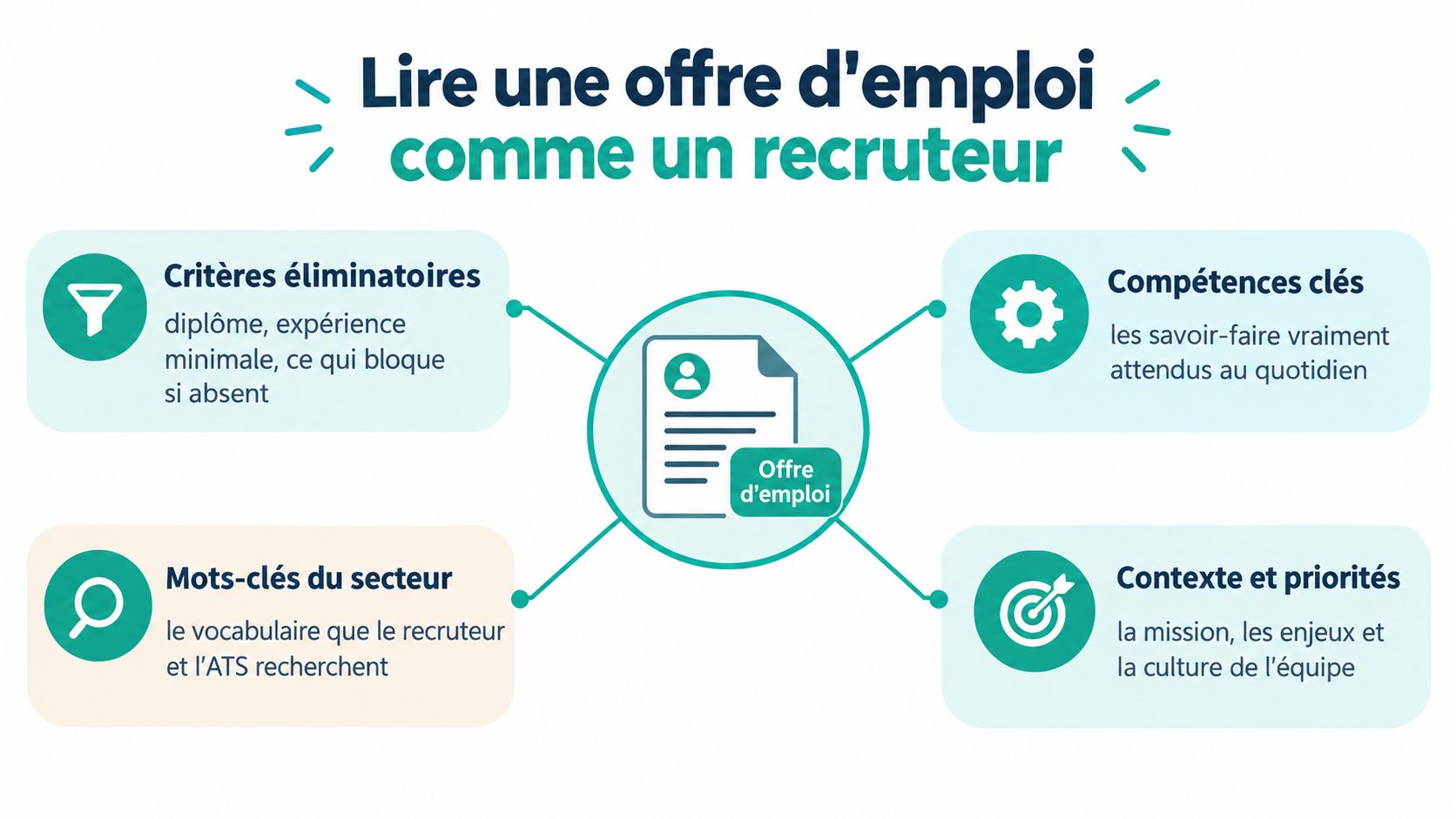
The goal isn’t to include everything. It’s to identify terms you can back up with proof. This is also how you prepare an ATS-friendly resume, as the UK’s Recruitment and Employment Confederation explains that these systems extract contact info, experience, education, skills, keywords, qualifications, and years of experience. ATS software is widely used, with around 80% of recruiters using or planning to use them, according to a 2024 Hellowork study (ATS recruitment software).
Quick Reading Example
Take a “Junior Communications Officer” job ad. If you see “social media management,” “writing,” “content planning,” and “team spirit,” you already know what to look for in your background. If the ad also mentions “initiative” and “autonomy,” don’t just add those words; find real examples where you demonstrated them.
Good practice: if you can’t prove a requirement from your experience, don’t put it in your resume.
This approach helps you avoid decorative customization. It also provides a useful framework for any role, whether you’re a student, recent graduate, or career changer.
Rewriting the Title, Summary, and Section Order
The top of your resume is read in three seconds. If it stays generic, you lose the recruiter immediately. A title like “Digital Marketing Assistant – Internship” or “Sales Support Intern” gives clear direction. A plain “Curriculum Vitae” guides no one.
Making the Top of the Resume Speak
Your summary should say three things without fluff: the role you want, your key strength, and what you bring. Forget “motivated and dynamic”—that proves nothing. Write a sentence that fits the job and makes sense for you.
For a marketing student seeking an internship, it might be: “Marketing student aiming for an internship focused on content and social media. Experienced in scheduling posts and crafting short messages. Ready to manage content production and editorial organization quickly.” This shows level, focus, and concrete value.
UK career services recommend the same: highlight what truly matches the job. If you want to save time without losing control, a resume builder can help you test different titles and summaries, then keep the one that sounds right.
Prioritizing What Really Matters
Section order should follow usefulness, not habit. If your internship is more relevant than your most recent part-time job, put it first. Recruiters don’t open resumes to admire chronology; they look for useful content first.
For a career change into data analysis, for example, highlight education, analysis projects, tools used, then less relevant experience. If you have solid Python or Excel projects, they should come before unrelated jobs. Your resume then tells a coherent story instead of stacking lines without hierarchy.
Turning Experience into Measurable Proof
This is where your resume gets serious. A line like “Helped redesign website” says almost nothing. A line that explains what you did, in what context, and with what impact completely changes the recruiter’s perception.
The Requirement-Proof-Result Matrix
Take each job requirement and filter it through this matrix.
- Requirement: what the ad really asks for.
- Proof: a real action from your experience.
- Result: an observable outcome, scope, tool, deadline, or improvement.
The principle is straightforward. If you claim “project management,” show the project, your role, and what happened next. If you write “autonomy,” give an example where you worked without constant supervision, not just an empty adjective.
This method’s core is linking each skill to a verifiable scene. Recruiters in English-speaking markets look for coherence before style. And since 60% of employers value behavioral skills more than technical ones, while 57% focus first on those listed on the resume, treat these skills as proof, not just qualities (skills employers expect).
Technical vs Behavioral Skills Need Different Proof
For a technical skill, show the tool, method, or context. For example, “Created tracking spreadsheets in Excel to organize project team requests” or “Used Canva to prepare communication materials.” The software or method reassures about your ability to deliver.
For a behavioral skill, show a situation. “Coordinated multiple files simultaneously during a peak period” proves organization better than the word “organized.” “Managed a client portfolio independently” says more about autonomy than an adjective at the bottom of the page.
Good habit: write the action first, then the context, and finally the visible result.
This logic avoids school-like resumes. It also helps you talk about modest experiences without overselling. A summer job, a student project, or volunteering can become credible if the line is built as proof.
For a resume with little professional experience, this method remains the best foundation because it turns little into useful, not decorative. How to write a resume without professional experience
Pitfalls That Ruin Good Customization
The biggest pitfall is lazy customization. You change the title, add three words from the ad, then send a document that falls apart in the interview. The recruiter sees it immediately.
What to Avoid Without Question
The first mistake is pasted keywords. If you list a skill without being able to illustrate it, you risk the simple question, “Show me where you did that.” Then the resume collapses.
The second mistake is letting AI rewrite your resume unchecked. According to Apec data from 2025, 77% of job seekers have used AI in their search and 40% to improve applications, while half of French companies received AI-generated resumes with false information (recruitment practices and AI). The right use is not to invent but to verify, correct, and remove anything you can’t defend.
The third mistake is cluttering your resume with irrelevant info. UK equality laws recommend removing details unrelated to skills, such as age, marital status, or photo, when not relevant to the role (guide to discrimination-free recruitment). Recruitment questions should focus on evaluating skills, not private life.
What a Resume Should Keep and Lose
Keep contact details needed to be reached. Keep achievements, tools, qualifications, languages, certifications. Remove anything that clouds judgment or exposes you unnecessarily.
Discrimination can happen at every recruitment stage, from resume screening to tests. In a study covering 2,400 job ads, applications suggesting a North African background had 31.5% less chance of being contacted with equal quality, with disparities in 37% of tested ads (discrimination testing in hiring). This means your resume must be defensible, sober, and focused on proof.
Passing ATS filters properly isn’t about text manipulation. It’s about aligning vocabulary, structure, and proof without losing profile truthfulness.
Final Checklist Before Sending Your Resume
Take five minutes, not twenty. A good resume is checked with a real checklist, not instinct.
- Requirement covered: every skill from the job ad has proof in the resume.
- Job terms present: key terms appear when they match your real experience.
- Clear sections: “Work Experience,” “Education,” “Skills” are visible.
- Unnecessary info removed: no personal details irrelevant to the role.
- Clean readability: file opens well, text stays legible, formatting doesn’t break on other devices.
- Defensible statements: if you read each line aloud, you can explain it in an interview.
The final test is simple. Open your resume and ask yourself, within thirty seconds, what this candidate brings to the role. If the answer is unclear, your customization is too.
Frequently Asked Questions About Resume Customization
Should I Keep a Master Resume?
Yes, keep a complete base. But never send the raw version everywhere; adapt the title, summary, and experience order for each job.
How Many Versions Should I Make?
As many as needed to stay consistent with the roles you target. UK career advisors also recommend creating multiple CVs from one profile to target different recruiters.
What If the Job Ad Is Unclear?
Don’t force keywords. Focus on clearly stated duties, then highlight skills you can prove without overinterpreting the ad.
Should I Customize for Mass Applications?
No, not really. If you send applications en masse without reading the ad, you lose the point of customization. Better to apply less but with a resume that holds up.
Can Jobshift Help?
Yes, if you want to adapt your resume faster to a job offer while keeping control over what’s true and defensible.
Jobshift helps you tailor your resume to a job offer without empty packaging. You keep control over proof, keywords, and profile coherence—the exact right approach when you want to customize without lying. If you’re looking for a tool to speed up without losing control, check out Jobshift.
À propos de l'auteur
Chris Massie, cofondateur de l'appli Jobshift. Il travaille sur l'outil depuis sa première version : analyse du CV face à l'offre, réécriture automatique des blocs faibles, candidatures envoyées en mode swipe. Profil LinkedIn