How to Write a Resume Without Professional Experience
September 27, 2026
In the UK, many recent graduates face the challenge of entering the job market without extensive professional experience. Recruiters don’t expect a detailed career history from beginners; instead, they look for evidence of potential, clarity, and logical presentation.
If you need to write a resume without professional experience, your goal is not to hide the gaps but to compensate smartly with your education, projects, volunteering, summer jobs, and any activities that demonstrate your ability to work methodically. This approach transforms a fragile application into a credible profile.
Understanding Recruiters’ Expectations for Entry-Level Candidates
As a recent graduate, you are not assessed like an experienced professional. Recruiters first check if your profile is clear, coherent, and concrete enough to envision your growth in the role. In a competitive market, being “motivated” is not enough; you must show you are already employable.
The key is to stop thinking in terms of lack. An entry-level resume should serve as a proof of potential, not as an empty summary. The question is not “what jobs have you held?” but “what have you done that resembles the work expected?”
Helpful tip: recruiters forgive the absence of employment but not the absence of structure or logic.
In the UK, early career phases can be challenging, so your document must help recruiters decide quickly. This is where readability becomes strategic, and why tools like Jobshift for Juniors can assist in organizing more targeted applications without wasting effort.
What Recruiters Really Want to See
They want to see three things first: your education level, the transferable skills you have already used, and concrete elements proving your seriousness, even outside paid employment.
Don’t try to appear more experienced than you are. Instead, prove you can learn quickly, work neatly, and understand job expectations. This is more credible and useful.
Structuring Your Resume by Reversing the Classic Order
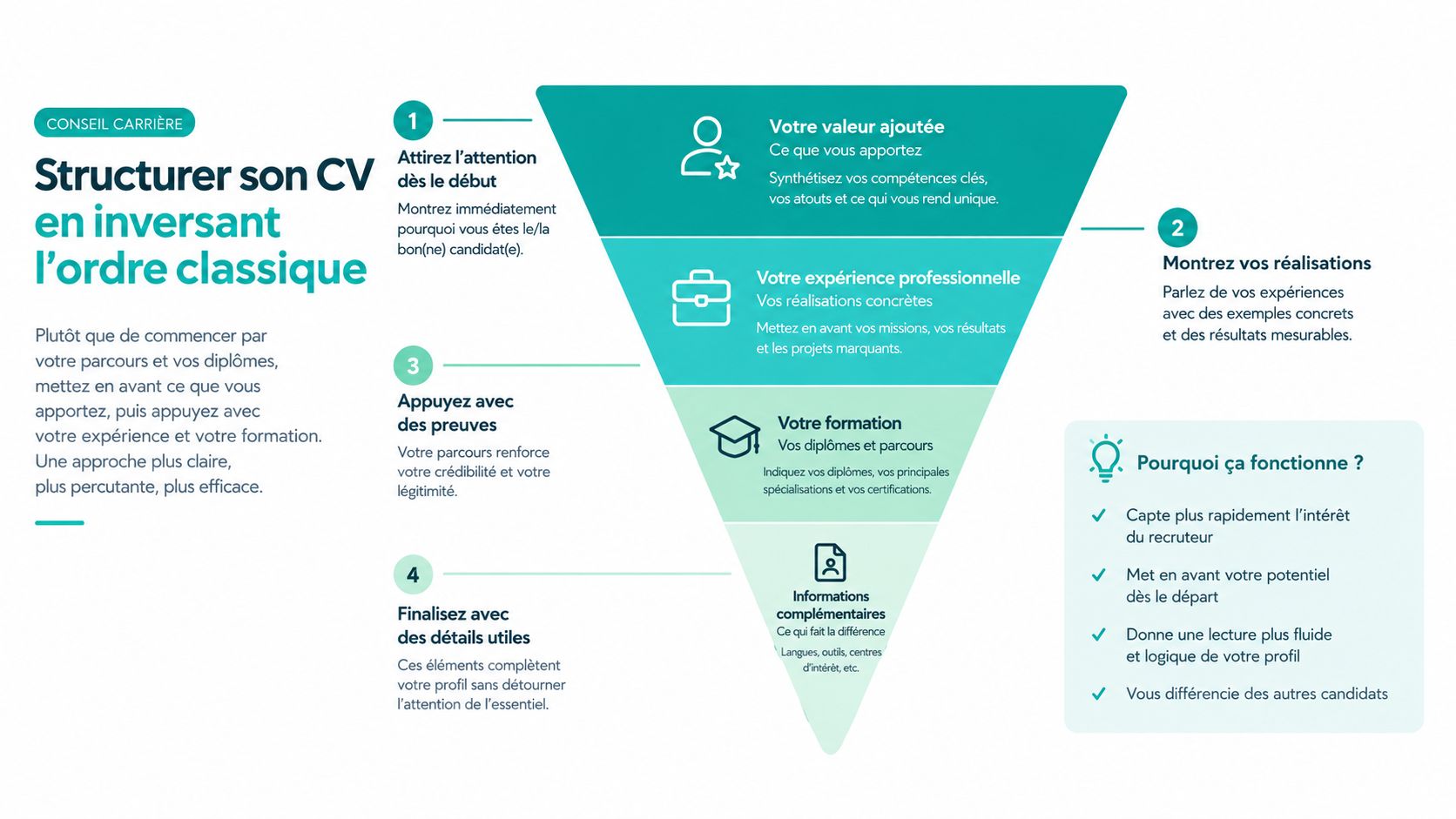
An entry-level resume should immediately highlight what matters. If the “Work Experience” section is empty, don’t let it dominate. Lead with your education, then list skills, projects, internships, volunteering, and languages.
UK job centres and career services recommend this approach for candidates without extensive experience, emphasizing education and concrete examples from studies, internships, or volunteering (UK Government CV Advice). For a first resume, this order works best. Recruiters first see your qualifications, then what you can already do.
A Specific Title, Not a Vague Slogan
Your title should match the job you’re applying for. Write “Junior Marketing Assistant”, “Entry-Level Web Developer”, or “Communications Intern” if it fits the role. Vague phrases like “Seeking Opportunities” or “Versatile Profile” add no value.
The summary or objective goes just below your contact details, in 2 to 3 lines. It should state who you are, what you can do, and the type of role you want.
Simple example without flair:
Recent graduate in communications, eager to apply skills in writing, project coordination, and editorial monitoring within a marketing team. Experienced in group work and delivering concise outputs, I work quickly and accurately.
Keep It to One Page
The safest format for a first resume is a single page. UK career advisors recommend a compact document with a clear title and a structure based on academic and extracurricular activities (Target Jobs). This simplicity helps recruiters read quickly and understand your profile effortlessly.
If you hesitate between keeping a weak section or trimming the document, remove anything that doesn’t provide proof. A short, neat, and logical resume is better than a full page of filler.
Turn Projects and Activities into Real Experience
The real challenge for a resume without professional experience is not the lack of contracts but your ability to turn unpaid activities into proofs of skills. Group projects, volunteering, summer jobs, or charity work can all become credible experiences if described properly.
UK job advice sites suggest mentioning part-time jobs, summer work, volunteering, and internships, highlighting aspects relevant to the role (Prospects UK). Don’t just list tasks; show what you learned and what it proves.
Shift from “I Did” to “I Achieved”
A strong resume line starts with an action, result, or impact—not a weak phrase. Instead of “helped organise an event,” write what you actually led, coordinated, or improved.
- Academic project: turn it into a deliverable, tool, or concrete result.
- Volunteering: describe responsibilities, organisation, or management you handled.
- Summer job: emphasise customer relations, discipline, deadlines, or workflow management.
- Student society: mention budgeting, communication, coordination, or reporting if relevant.
For example, managing a student society’s finances is not just “keeping accounts.” It’s budget management, monitoring, reliability, and sometimes reporting. Running a society’s Instagram page is not just “posting,” but editorial coordination and distribution.
Speak the Language of Business
Recruiters don’t want to read your intentions; they want to understand your value. Use simple, professional, results-oriented language. If you worked in a team, say what you coordinated. If you delivered a project on time, say so. If you managed a tool, audience, or budget, mention it.
An experience without visible results is just an activity. An experience described with facts becomes proof.
For roles in management, communication, sales, or HR, this reframing makes all the difference. It also helps build a more coherent application, especially if you follow a structured approach like the one offered by Jobshift for spontaneous applications.
Optimise Layout for Recruitment Software
A poorly formatted resume can be discarded before it’s even read. Recruitment software first reads structure, then keywords. Using multiple columns, graphic blocks, or decorative elements makes sorting harder, not easier.
UK job centres recommend a simple format without tables or complex images, with keywords matching the job description and easy-to-find contact details (UK Government CV Advice). To understand how these tools filter applications, see our guide on how to pass ATS filters.
Non-Negotiable Rules
Your resume should remain clean. Use spacious layout, clear headings, readable bullet points, and a classic font. Save your file as a text-based PDF, not an image, to avoid reading issues.
If the job mentions customer service, project management, or web writing, only use these terms if they truly reflect your experience. Don’t invent. Align your vocabulary with the role to ease initial screening.
Keep It Simple, Not Empty
A simple resume shouldn’t feel empty. It should demonstrate real mastery. Margins, spacing, and heading hierarchy help the page breathe, not overload it.
The recruiter should grasp your profile within seconds. If they do, your presentation works for you instead of against you.
Common Mistakes That Disqualify Entry-Level Candidates
Entry-level resumes often fail for the same reasons: too generic, too flat, or not concrete enough. Career experts highlight incoherent timelines, unquantified non-professional experiences, and lack of impact (Target Jobs).
The problem isn’t just cosmetic. A vague document suggests you haven’t yet understood what recruiters expect. It’s fixable but requires directness.
What to Fix Immediately
- Generic resume, because it speaks to no one.
- Empty phrases, because they explain nothing.
- Experiences without results, because they provide no proof.
- Confusing chronology, because it clouds your story.
- Overlong document, because it tires before convincing.
The solution is simple. Remove anything that doesn’t help show concrete potential, then strengthen sections that prove your seriousness. If a line doesn’t serve the targeted role, cut it.
Recruitment rule: anything that doesn’t help the recruiter picture you in the role weakens you.
An entry-level resume must be brief, targeted, and confident. If you lack paid experience, compensate with precision. It’s far more effective than filler.
Frequently Asked Questions About the First Resume
Should I include a photo? Yes, only if it’s clear, recent, and professional. Otherwise, leave it out.
Should I explain a gap year? Yes, briefly, with a useful fact, project, job, volunteering, or training—avoid lengthy excuses. Recruiters want to know what you did, not read justifications.
Should I create multiple resumes? Yes, if you’re targeting different roles. One for summer jobs, another for internships, another for apprenticeships. Keep the same base but tailor the proofs, especially projects, tasks, and results relevant to each role.
A first resume should reassure. Clear, concrete, and tailored—that’s what counts.
À propos de l'auteur
Chris Massie, cofondateur de l'appli Jobshift. Il travaille sur l'outil depuis sa première version : analyse du CV face à l'offre, réécriture automatique des blocs faibles, candidatures envoyées en mode swipe. Profil LinkedIn