Swiss resume: the specific rules, the differences with France, and a template to copy
 Chris Massie
Jobshift
November 11, 2026 · 19 min read
Partager l'article
A Swiss resume looks like a French one, but it is more complete about your identity: it usually includes a photo, your date of birth, your nationality and, for foreign candidates, the type of permit (B, C, G…). It also comes with a fuller application file than in France, with the cover letter, the diplomas and, above all, the work certificates (certificats de travail) from your former employers.
This guide follows the recommendations of official Swiss sources (the Confederation’s employment portal arbeit.swiss, the cantons of Geneva and Vaud, orientation.ch), explains what changes compared with a French resume, how to present your situation if you are a cross-border commuter or if you are coming from France, and then gives you a Swiss resume template to copy.
In short
- More complete personal details: name, contact details, date of birth, nationality, and a residence or work permit if you are not Swiss. A professional photo is customary, even though no law requires one.
- Length: 1 to 2 pages in most cases. The canton of Geneva recommends a maximum of 2 pages; arbeit.swiss sets the limit at 3 pages.
- Order: reverse chronological (most recent first), with no unexplained gaps in your career.
- Languages: a central section in Switzerland. Give your level according to the Common European Framework (CEFR: A1 to C2), starting with your mother tongue.
- The complete file matters as much as the resume: cover letter, resume, work certificates and diplomas, in PDF, from most recent to oldest.
- Cross-border commuters and French candidates: state clearly your place of residence and your status (for example “EU national, cross-border commuter, G permit to be obtained”), and translate your diplomas into understandable titles rather than “Bac+X”.
- Before you send it: create your resume with the free resume generator, then check that it can be read by applicant tracking software with the free ATS test.
Contents
- What makes a Swiss resume different
- Swiss resume and French resume: the table of differences
- The sections of a Swiss resume, in order
- Photo, date of birth, permit: personal details
- The Swiss application file: work certificates, diplomas, references
- Cross-border commuter or candidate coming from France: adapting your resume
- A Swiss resume template to copy (French-speaking Switzerland)
- Common mistakes on a resume for Switzerland
What makes a Swiss resume different
In Switzerland, the resume is not a stand-alone document: it is the central piece of an application file. The arbeit.swiss portal, run by the State Secretariat for Economic Affairs (SECO), describes it as “the central element of your application”, which must be “complete, clear and carefully prepared”. Three things set it apart from a classic French resume.
1. It says more about you. Where many candidates in France remove the photo, their age and their nationality, a Swiss resume generally includes them in the personal-details block. The reason is practical: a Swiss employer needs to know quickly whether they can hire you, which depends on your nationality and your permit.
2. It must have no gaps. arbeit.swiss explicitly asks you to “avoid gaps in your career”. A period of job search, a sabbatical year or a training course should be mentioned, in one line, rather than leaving a blank that the recruiter will interpret on their own.
3. It is verifiable. Each role on the resume should be traceable to a work certificate in the file. The canton of Vaud also asks for “correct and verifiable information”. Inventing or rounding a date is immediately visible when the certificates are attached.
For the rest, good practice is the same as elsewhere: a clear job title, skills linked to the posting, and experience described with concrete achievements. If you want to revisit those basics, our guide to adapting your resume to a job posting sets out the method.

Swiss resume and French resume: the table of differences
| Item | Resume in France | Resume in Switzerland |
|---|---|---|
| Photo | Optional, often left out | Customary, mentioned by arbeit.swiss and the canton of Geneva; attach one if the posting asks for it |
| Date of birth / age | Rarely given | Usually given (full date, or year and age according to the canton of Vaud) |
| Nationality | Rarely given | Given; residence or work permit if you are a foreign national |
| Length | 1 page recommended, 2 if you have experience | 1 to 2 pages; up to 3 pages according to arbeit.swiss |
| Languages | Secondary section | Important section, CEFR level for each language |
| References | Rarely mentioned | “On request”, or a separate list handed over at the interview |
| Attachments | Resume + letter (sometimes) | Complete file: letter, resume, work certificates, diplomas |
| Work certificate | A factual document issued at the end of the contract, rarely attached | A key piece of the file, with an assessment of the work and of conduct |
| File format | PDF, clearly named files, certificates grouped in a single PDF |
This table summarises the usage described by the official sources listed at the bottom of the page. A posting can always ask for something else (a resume without a photo, an online form, a resume in English): in that case, the posting takes precedence.
The sections of a Swiss resume, in order
The canton of Geneva suggests a precise order for the sections of a resume, which is found in almost the same form at arbeit.swiss:
- Personal information and contact details: first name, last name, address, telephone, email.
- Photo, recent and professional, centred on the face.
- Title or professional objective: the title of the role you are targeting, ideally the one in the posting.
- Professional and personal skills, adapted to the employer’s needs.
- Experience, from the most recent role to the oldest.
- Education, including continuing education.
- IT and office skills.
- Languages, with the level according to the CEFR.
arbeit.swiss adds two usual sections: interests and leisure activities, and references. The canton of Vaud also mentions a “Miscellaneous” section for concrete assets such as a driving licence, a car or a general public-transport pass.
The title and the opening pitch
The canton of Vaud advises a header with a few keywords that sum up your qualities and skills in relation to the role, and a clear objective. In practice, a title line (“Accountant – 6 years of experience in a fiduciary”) and two to three lines of pitch are enough. To find the right wording, start from the skills asked for in the posting: our guide to hard skills gives examples by sector.
Languages, a decisive section
Switzerland has four national languages, and the same posting may ask for several languages. For each language, give a level that everyone can understand, preferably according to the CEFR (Common European Framework of Reference for Languages: A1-A2 beginner, B1-B2 independent, C1-C2 proficient). orientation.ch recommends starting with your mother tongue.
Example (wording for a French-language resume):
LANGUES
Français : langue maternelle
Anglais : C1 (usage professionnel quotidien)
Allemand : B1 (en cours de formation, cours du soir)
Avoid vague mentions such as “school German” or “fluent English” without a level: they do not let the recruiter compare applications.
Experience
For each role: dates (month and year), title, company, location, then 3 to 5 lines of duties and concrete results. The canton of Vaud recalls that volunteer work, internships and side jobs have their place, with the skills acquired. If you work part-time, you can indicate the activity rate (for example “80 %”), the expression used in Switzerland for working time.
Photo, date of birth, permit: personal details
This is the part that surprises candidates coming from France the most. Here is what the official sources say, point by point.
The photo
arbeit.swiss lists “personal details with a photo that shows you to advantage” among the usual elements of a resume. The canton of Geneva includes the photo among the resume sections (“recent and professional, focused on your face”), and the canton of Vaud guide describes it as “usually required”. No law requires it, though: it is a matter of usage.
In practice:
- Include a photo if the posting asks for one or if you are applying to a traditional Swiss company.
- Leave it off if the posting asks for an anonymous file or if you apply through a form that refuses one.
- Choose a real professional photo: neutral background, appropriate clothing, no selfie (orientation.ch says so). A poor photo does more harm than no photo at all.
For framing, clothing and background, our guide to which photo to use on a resume sets out the right settings.
Date of birth and nationality
orientation.ch advises giving your full date of birth, your place of origin (commune of origin for Swiss citizens, place of birth for people born abroad) and your nationality or nationalities. The canton of Vaud is satisfied with the year of birth and your age. Both options are accepted.
Marital status does not appear in any of the section lists of the sources cited here: there is therefore no need to mention it.
The residence or work permit
If you are not a Swiss national, state your status: orientation.ch asks you to specify the type of residence permit, “for example a B or C permit”. The main authorisations for European Union and EFTA nationals, according to the State Secretariat for Migration (SEM), are:
- L permit: short-term authorisation;
- B permit: residence permit;
- C permit: settlement permit;
- G permit: cross-border commuter permit, for people who work in Switzerland but live in an EU/EFTA country.
If you do not yet have a permit because you are applying from France, do not leave the line blank: write your nationality and the exact situation (see the cross-border section below).
The Swiss application file: work certificates, diplomas, references
What a complete file contains
According to arbeit.swiss and orientation.ch, a classic application file includes:
- The cover letter, with the formal elements of a letter: sender’s address, recipient’s address, date, subject, salutation, complimentary close and signature;
- The resume;
- The work certificates, grouped in a single PDF, from most recent to oldest;
- The diplomas and training certificates, presented in the same way.
The canton of Geneva notes that the cover letter is “read less and less” but is “still very often requested”: you should therefore still plan for one. To save time, you can draft a first version with the free cover-letter generator, then adapt it to the company and the region.
The work certificate, a Swiss specific
In Switzerland, article 330a of the Code of Obligations allows the employee to request a work certificate from their employer at any time. According to the SECO FAQ, the full certificate covers the nature and duration of the employment relationship, but also the quality of the work and the employee’s conduct. It can be an interim certificate (during the contract) or a final one (at the end). At the employee’s express request, it can be limited to the nature and duration of the employment: that is a work attestation.
What this changes for your application:
- Ask for your certificates as you go. arbeit.swiss advises submitting the certificates from every role you have held, “without exception”, and therefore requesting them from your employers in good time.
- If you are coming from France, your French certificat de travail is a factual document (dates and role held). Attach it, and if possible add a letter of recommendation from your former manager, which plays a role close to the assessment in a Swiss certificate.
- Take care with the copies: the canton of Geneva asks for clean, legible, colour copies, presented from most recent to oldest.
References
arbeit.swiss recommends stating on the resume that your references are available “on request”, and handing over a separate list at the interview. The canton of Vaud and orientation.ch also accept citing one or two people directly, provided you have told them beforehand. Choose a former manager or an internship supervisor who can speak concretely about your work.
Sending the file
Everything is sent as a PDF, with clear file names (for example CV-Firstname-Lastname-Accountant.pdf), from a serious email address that preferably contains your first name and last name, as arbeit.swiss recommends. Reread the whole file before sending: spelling, layout, complete documents and in the right order.
If you send a lot of applications, in Switzerland and in France in parallel, note each sending, the date and the planned follow-up. arbeit.swiss specifically advises keeping an up-to-date list of applications sent and of replies expected: the free application tracker is made for that.
Cross-border commuter or candidate coming from France: adapting your resume
State your situation clearly
The recruiter must understand in one line where you live and whether hiring you requires a procedure. A few possible formulations, to adapt to your real situation (keep this wording on a French-language resume):
Nationalité française – résidence à Annemasse (74), frontalier, permis G à établir
Nationalité française – installation prévue à Lausanne en mars 2027
Nationalité française – titulaire d'un permis B (Genève)
According to the SEM, the cross-border authorisation (EU/EFTA G permit) concerns EU/EFTA nationals who live in an EU/EFTA state, work in Switzerland and return to their main home abroad in principle every day or at least once a week. It is issued by the cantonal authorities of the place of work and its duration depends on the contract: five years for a permanent contract or a contract of at least one year, and the duration of the contract for a shorter engagement. The rules evolve: always check your situation on the SEM website or with the canton concerned.
Translate your diplomas and job titles
French abbreviations (“Bac+3”, “BTS”, “DUT”, “M2”) do not necessarily mean anything to a Swiss recruiter. Write the full name of the diploma and the institution, and if needed specify the level (“Licence – 3 years of study after the baccalauréat”). For some regulated professions (health, teaching, certain technical trades), official recognition of your diploma may be required: the State Secretariat for Education, Research and Innovation (SERI / SEFRI) explains the procedure and distinguishes recognition (regulated professions) from a level attestation (non-regulated professions).
Adapt the language of the resume to the region
- French-speaking Switzerland (Geneva, Vaud, Neuchâtel, Jura, and the French-speaking parts of Fribourg and Valais): resume in French, with local vocabulary when it exists (“postuler”, “taux d'occupation”, “certificat de travail”).
- German-speaking Switzerland: resume in German, unless the posting is in English.
- International companies: resume in English if the posting is written in English. The free English resume translator gives you a base to reread, and our guide to a job application in English covers the email and the letter.
In every case, keep the same structure and the same dates from one version to the next: a bilingual recruiter will compare them.
A Swiss resume template to copy (French-speaking Switzerland)
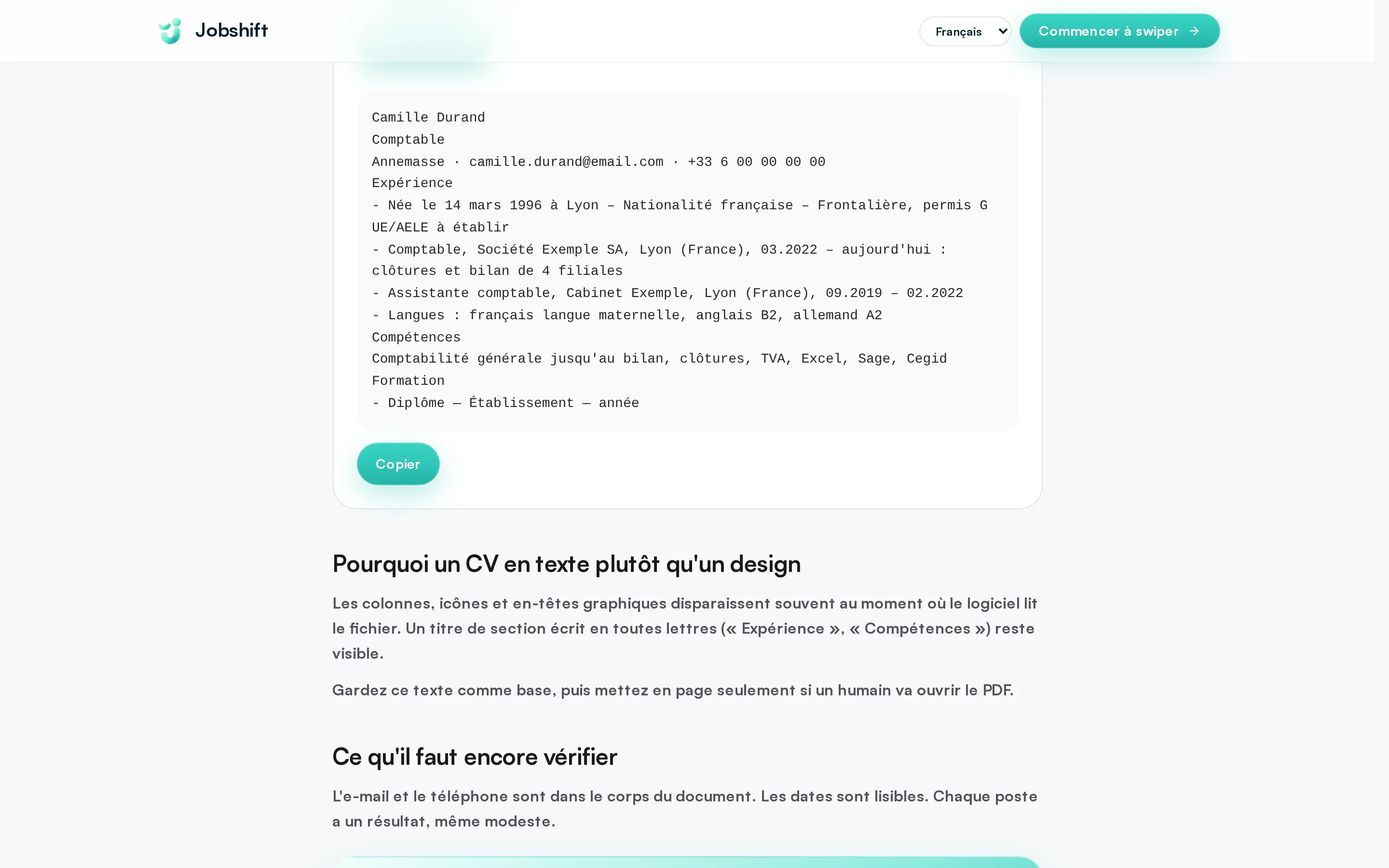
Here is a Swiss resume template in text, with fictional data, to adapt to your profile. It follows the section order recommended by the canton of Geneva and fits on two pages. The model is written in French, as it would be sent in French-speaking Switzerland.
CURRICULUM VITAE

Camille DURAND
Rue des Alpes 12, 74100 Annemasse (France)
+33 6 00 00 00 00 – camille.durand@email.com – linkedin.com/in/camille-durand
Née le 14 mars 1996 à Lyon – Nationalité française
Frontalière, permis G UE/AELE à établir – Disponible dès le 1er février 2027
[Photo professionnelle, fond neutre]

COMPTABLE – 6 ANS D'EXPÉRIENCE EN CABINET ET EN ENTREPRISE
Comptable généraliste habituée aux clôtures mensuelles et annuelles,
à l'aise avec les PME multi-entités. Recherche un poste à 100 %
dans une fiduciaire ou une PME de la région genevoise.

COMPÉTENCES
- Tenue de la comptabilité générale jusqu'au bilan
- Clôtures mensuelles et annuelles, rapprochements bancaires
- Déclarations de TVA, suivi des débiteurs et créanciers
- Préparation des salaires et des charges sociales
- Reporting mensuel pour la direction

EXPÉRIENCE PROFESSIONNELLE
03.2022 – aujourd'hui   Comptable, Société Exemple SA, Lyon (France)
- Gestion de la comptabilité de 4 filiales, de la saisie au bilan
- Mise en place d'un tableau de bord mensuel pour la direction
- Interlocutrice des commissaires aux comptes lors des clôtures

09.2019 – 02.2022   Assistante comptable, Cabinet Exemple, Lyon (France)
- Tenue de portefeuille clients (artisans, commerçants, professions libérales)
- Préparation des déclarations fiscales et des liasses

FORMATION
2019   Master Comptabilité, contrôle, audit – Université Exemple, Lyon
       (5 ans d'études après le baccalauréat)
2017   Licence Économie et gestion – Université Exemple, Lyon

INFORMATIQUE
Excel (tableaux croisés dynamiques, RECHERCHEX), logiciels comptables
(Sage, Cegid), suite Microsoft 365

LANGUES
Français : langue maternelle
Anglais : B2
Allemand : A2 (cours en ligne en cours)

CENTRES D'INTÉRÊT
Trail en montagne, trésorière bénévole d'un club sportif depuis 2020

DIVERS
Permis de conduire B, véhicule personnel

RÉFÉRENCES
Disponibles sur demande

Annexes : certificats de travail, diplômes
This template is deliberately in a single column and in plain text: it remains readable by the applicant tracking software (ATS) that often sits behind online forms. To understand what blocks these tools, read our guide ATS resume: getting through the filters or start directly from the ATS-friendly resume template.
Common mistakes on a resume for Switzerland
- Sending your French resume as it is, with no nationality, no permit and no place of residence: the recruiter cannot tell whether hiring you is possible.
- Forgetting the work certificates or sending them in a jumble: group them in a single PDF, from most recent to oldest.
- Leaving gaps in your career with no explanation, even though arbeit.swiss asks you to avoid them.
- Giving a vague language level (“good level”, “notions”) instead of a CEFR level.
- Using French abbreviations (“Bac+5”, “BTS”, “CDI”) without explaining them.
- A holiday photo or a selfie: a professional photo is better, or no photo at all.
- A two-column or image-based resume for an online form: first put it through the free ATS test to check that the text is actually read.
Checklist before you send your Swiss resume
- [ ] Complete personal details: date of birth, nationality, permit or status, place of residence
- [ ] Professional photo (if requested or customary in the company)
- [ ] Job title identical or close to the posting
- [ ] Reverse-chronological career, with no unexplained gaps
- [ ] Languages with a CEFR level
- [ ] 1 to 2 pages, in PDF, with a clear file name
- [ ] Work certificates and diplomas grouped, from most recent to oldest
- [ ] Cover letter adapted to the company
- [ ] Resume tested with the ATS test
Apply faster, in Switzerland as in France, with Jobshift
Preparing a Swiss file takes time. Once your resume is ready, Jobshift saves you time on the sending: openings appear as cards, you swipe right to apply with your resume, and the app keeps a record of each application for your follow-ups.
Create my free Jobshift account
Related articles
- ATS resume: the guide to getting through the filters in 2026
- Job application in English: email, resume, and templates to copy
- Which photo to use on a resume: the complete 2026 guide
- International employment in France: a practical 2026 guide
FAQ
Do you need a photo on a Swiss resume?
It is customary but not required. arbeit.swiss lists “personal details with a photo” among the usual elements of a resume, and the canton of Geneva recommends a recent, professional photo centred on the face. Add one if the job posting asks for it or if the company is traditional; leave it off if the posting asks for an anonymous file.
How long should a resume be in Switzerland?
Aim for 1 to 2 pages. The canton of Geneva recommends a maximum of 2 pages, the canton of Vaud 1 to 2 A4 pages, and arbeit.swiss sets the limit at 3 pages. For a first job or a junior profile, one page is often enough.
Should you include your date of birth and nationality?
Yes, that is the usual practice. orientation.ch advises giving your full date of birth, your place of origin or of birth, and your nationality, and the canton of Vaud the year of birth and your age. If you are not Swiss, add your permit type (L, B, C or G) or your exact situation.
What should you put on your resume as a cross-border commuter?
State your nationality, your place of residence and your status, for example “French nationality, resident in Annemasse, cross-border commuter, G permit to be obtained”. According to the SEM, the EU/EFTA G permit is for people who live in an EU/EFTA country, work in Switzerland and return home at least once a week.
What is a work certificate in Switzerland?
It is a document that any employee can request from their employer at any time (article 330a of the Code of Obligations). The full certificate describes the nature and duration of the employment, as well as the quality of the work and the employee’s conduct. It is part of the Swiss application file, together with the diplomas.
Do you need a resume in German to work in Switzerland?
Only if you are applying in German-speaking Switzerland or if the posting is written in German. In French-speaking Switzerland, the resume is written in French, and in international companies it may be requested in English. Always match the language of the posting.
Sources
- Advice for your applications (arbeit.swiss, SECO)
- Create an impactful application file and resume (Canton of Geneva)
- Create an application file for adults (Canton of Vaud, PDF)
- Create a curriculum vitae (orientation.ch)
- Looking for a job: the application file (orientation.ch)
- FAQ on the work certificate (SECO)
- G permit EU/EFTA, cross-border authorisation (SEM)
- FAQ on the recognition of professional qualifications (SERI / SEFRI)