Which Photo to Use on a Resume: The Complete 2026 Guide
September 28, 2026
Wondering which photo to use on a resume? Let me be clear: the automatic reflex that "a photo is always required" is the wrong answer. In France, the real question isn’t about tradition but whether a photo actually strengthens your application or opens the door to unconscious bias.
A well-chosen photo can enhance your resume. A mediocre photo can hurt it. And in many cases, especially for neutral roles or international contexts, the best choice is simply not to include one.
Should You Really Include a Photo on Your Resume?
The first mistake is thinking a resume without a photo looks "less serious." That’s false. In France, a photo is not mandatory, and candidates can perfectly well send resumes without photos without any legal issues according to French HR advice. The real issue is the effectiveness of the document for the targeted role, not following ready-made templates.
In client-facing roles, a photo can help because it puts a face to the application, which will be exposed to image anyway. In more neutral environments, it often adds little value. And if the photo is average, it takes up space with very limited benefit.
Simple rule: if the photo doesn’t strengthen your positioning, it should be removed from the resume.
Also keep in mind automatic sorting and quick screening of applications. A resume must remain readable, credible, and consistent with the role. If you want to better structure your document for these filters, check out how to pass ATS recruitment filters, because a poorly integrated photo can hinder more than help.
Recruiter Perspective
I prefer a strong resume without a photo over a weak resume with a photo. Many candidates keep a photo out of habit, not strategy. That’s a beginner’s mistake.
The right approach is simple. If you’re applying for a role where image matters, a photo can work in your favor. If the role is primarily about technical skills, experience, or execution, it’s often neutral, sometimes unnecessary, sometimes risky.
Legal Framework for Photos on Resumes in France
In France, the rule is clear. Recruiters cannot require a photo as a condition to review your application according to CV.fr. Selection must be based on skills, and physical appearance is a sensitive criterion regarding discrimination.
The CNIL also reminds, in its recruitment recommendations, that employers should only collect information directly and necessarily related to evaluating professional skills. Practically, a photo only makes sense if it serves the role, not just because it’s traditionally placed at the top of the resume.
Key Rule to Remember
If you add a photo, it must be sober, neutral, and professional. No forced poses, no visible background, no elements distracting from your face. The photo should never become the focal point of the document.
There is a risk. A photo can trigger biases related to age, appearance, perceived origin, attire, or personal style. France allows photos on resumes but does not permit any kind of misuse.
Here’s the line I keep in recruitment: Photo allowed, but never mandatory, ostentatious, or distracting. If you hesitate, choose the option most useful for the role, not tradition.
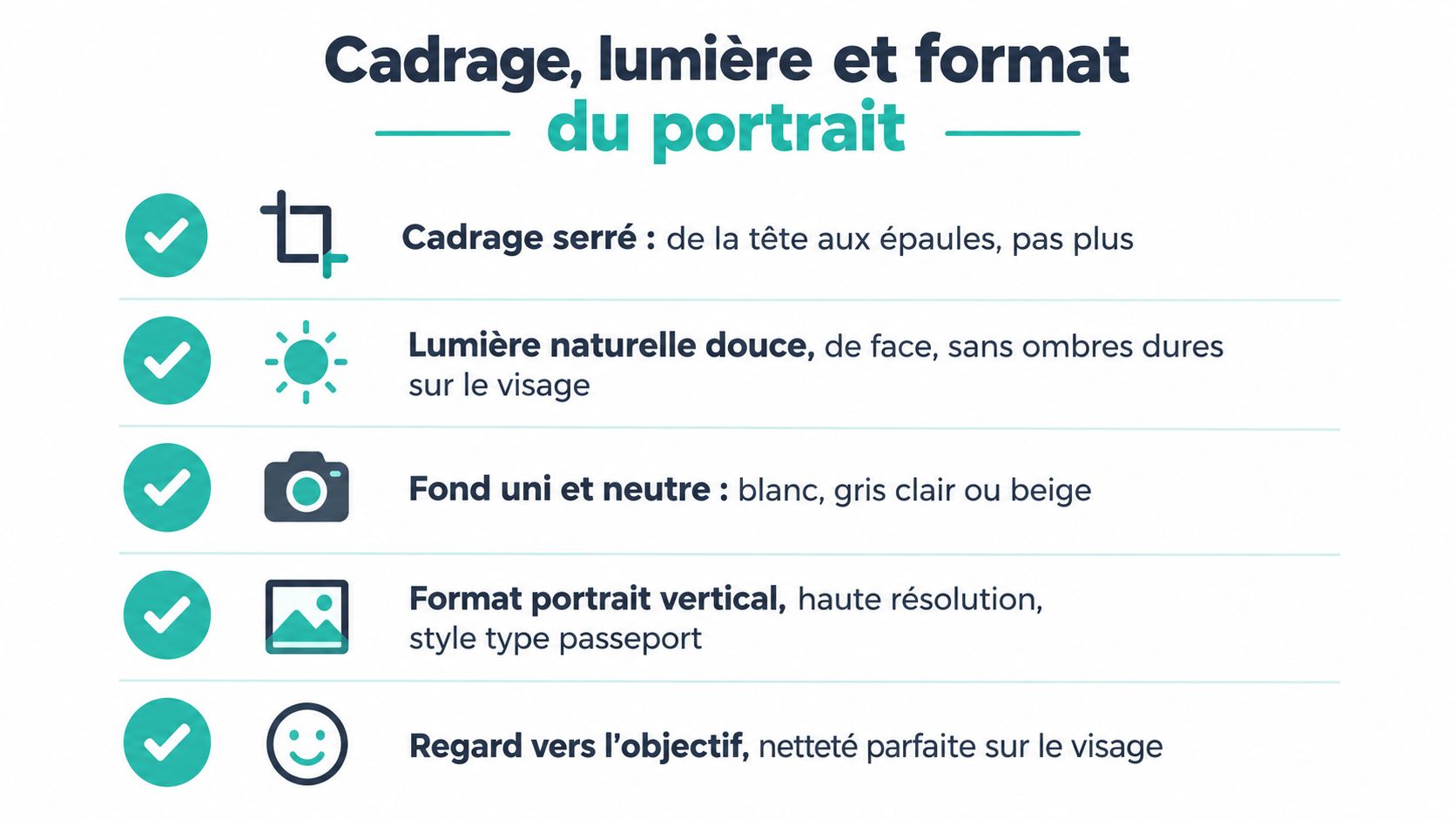
The principle is simple: a resume photo should look like a professional portrait, not a social media snapshot. To go further on visual reading of the document, the video below covers basics of framing and impact of a sober portrait.
Framing, Lighting, and Portrait Format
A resume photo must be sharp, simple, and immediately legible. No need for artistic effects. The face should be clear, the upper body well positioned, and the image should stay clean when reduced in size on the resume.
Effective Framing
The winning framing is head and shoulders, or slight bust. The face should remain dominant, with little unnecessary space above the head. Too much background loses the portrait effect and becomes a "friendly" rather than professional image.
The background should be plain. White, light gray, or neutral beige work well. A busy wall, bookshelf, landscape, or recognizable interior distracts the recruiter’s eye.
Good practice: if the background draws more attention than your face, the photo has failed.
Lighting and Format
Lighting should be soft and even. Natural front light is often easiest to control because it avoids harsh shadows and aggressive reflections. Front flash hardens features and quickly looks amateurish.
Regarding file, technical recommendations converge on a vertical image, good resolution, and a lightweight format so as not to bloat the PDF according to a French technical guide. Common dimensions cited in French guides are close to ID photo size, around 6.5 × 4.5 cm or 35 × 45 mm per Ouest-France Emploi, and layout usually places the photo at the top of the resume, left or right of the identity section also explained by Ouest-France Emploi.
A harsh but effective test: reduce the image to the resume size and check if the face remains easily readable. If the photo becomes blurry, dark, or too small, it doesn’t belong in your application.
Attire, Posture, and Expression That Work
Your attire should support your message, not blur it. In France, the baseline remains simple: a plain shirt or top, neutral colors like navy blue, white, gray, no loud patterns. You’re not posing for a fashion campaign; you’re sending a signal of reliability.
Universal Choices
Your posture should be straight but not stiff. Shoulders relaxed, chin natural, eyes facing the camera. A slight smile is enough because a closed expression often feels distant, while a forced smile sounds fake.
Accessories should be discreet. If you wear glasses daily, keep them on. If you have a beard, long hair, or visible piercing, the real criterion is consistency with the targeted job and sector, not arbitrary moral rules.
Job-Dependent Choices
For banking, law, or consulting, attire tends to be more formal, often with a jacket and sometimes a tie. For sales, communications, or corporate tech, an open shirt and neat presentation usually suffice. In creative roles, you have more latitude but shouldn’t cross into eccentricity.
The recruiter wants to see a professional, not someone trying to "stand out" at all costs.
Posture matters almost as much as attire. A photo taken too much from the side, with the face avoiding the camera or a fixed smile, gives an impression of discomfort. Conversely, a simple head position, direct gaze, and calm expression immediately set a stronger tone.
If you hesitate between two versions, choose the more sober one. In a resume, restraint almost always pays off better than forced style.
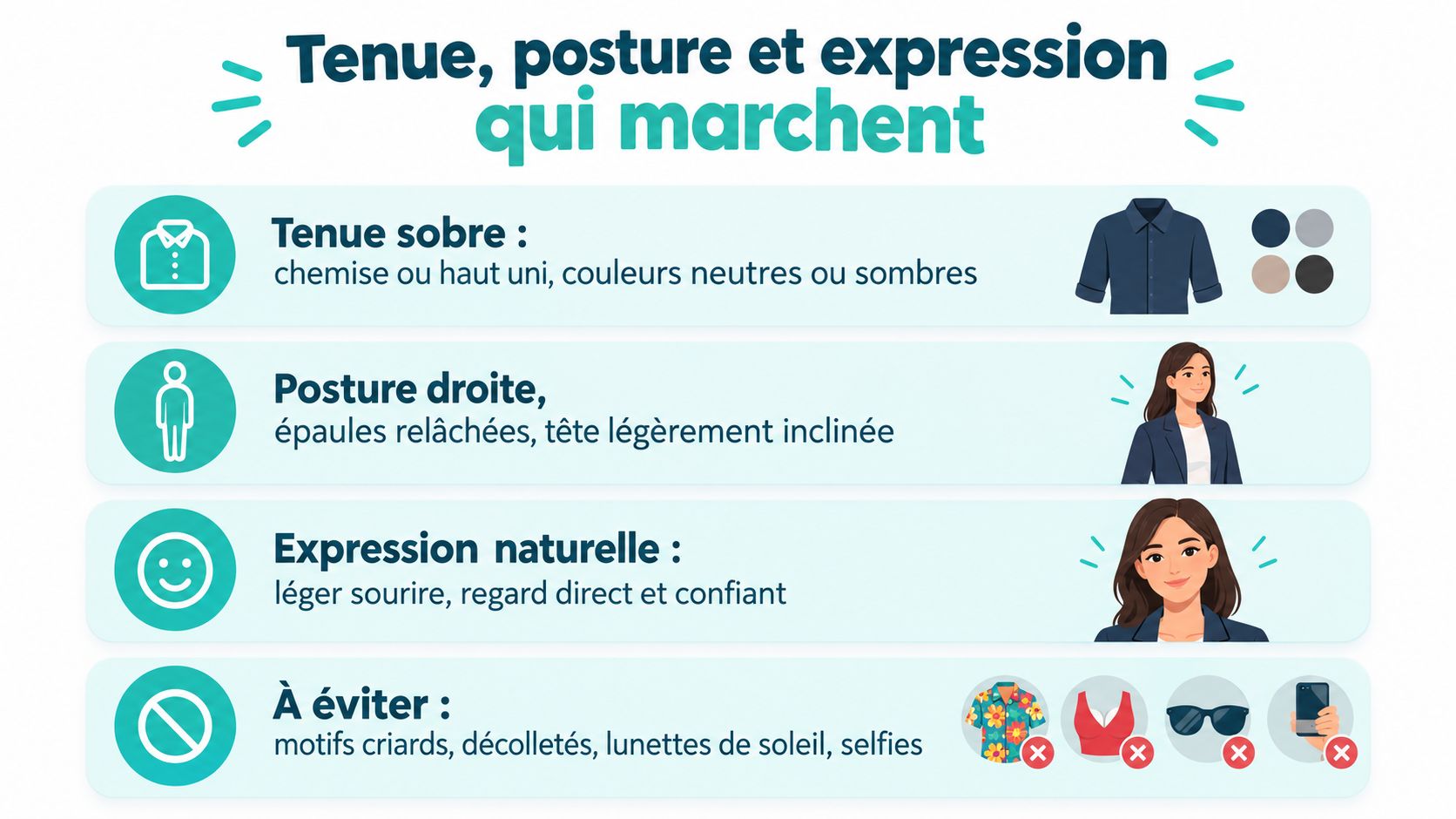
Photo on Resume by Sector and Country
Here’s the real decision grid. If you’re applying in France, Belgium, or French-speaking Switzerland, photos remain common but must be sober and non-discriminatory as the Apec guide reminds. If you’re going international, especially to Anglo-Saxon markets, the logic changes completely.
Decision by Context
| Target Sector | France / Belgium / Switzerland | UK / US / Netherlands | Germany / Spain / Italy / Asia |
|---|---|---|---|
| Customer relations, luxury, hospitality, real estate, retail, fashion, beauty | Photo often relevant if very sober | To avoid unless explicitly requested | Photo generally expected per local customs |
| Consulting, finance, legal | Photo possible but to use cautiously | Generally to remove | Often accepted depending on market |
| Tech, R&D, IT support roles, international consulting | Photo often unnecessary | Remove by default | To evaluate by local usage and offer |
| Creative, media, visual recruitment | Photo possible if it supports positioning | Depends on country and offer | Common if it remains professional |
The logic is simple. If the sector values image and the country accepts it, you can include a photo. If the market advises against it, remove it. It’s not about aesthetics but adaptation.
My Decision Tree
- Does the role involve client contact or representation?
- Does the recruiting country accept resumes with photos?
- Does the photo enhance your credibility without creating bias?
If you answer yes to all three, the photo is defensible. If you answer no to either of the first two, remove it. If you answer no to the third, the photo harms your chances.
French market data shows photos remain common but not always the first thing noticed. One French guide cites 78% of resumes with photos, another reports a firm receiving between 600 and 800 resumes daily with 60% including photos, while a French study indicates only 4% of recruiters look at the photo before the rest of the profile according to the Resufit guide. This confirms one thing: resume content usually weighs more than the image.
Three Candidate Profiles: Real Examples
Amandine, 28, sells B2B in luxury. For her, the photo has a place because image is part of the job and client relationship. I recommend a bust framing, neutral beige background, navy blazer, white shirt, a genuine smile, and direct gaze.
Marc, 35, is a tech manager in a Parisian scale-up focused on international markets. Here, the photo should disappear or remain minimal because the sector values it little and international customs are stricter. If he insists on keeping one, I want a professional portrait, black turtleneck on a light background, neutral expression, tight framing, and no social media effects.
Léa, 26, is a freelance graphic designer applying to a creative agency. For her, the photo helps if it shows character without losing seriousness. A plain colored background, confident hairstyle, natural smile, discreet patterned clothing, and a slightly wider framing than average can work well. If you’re starting from scratch, check our guide on how to write a resume without professional experience to structure your application.
What These Three Cases Show
The same tool doesn’t have the same effect everywhere. For Amandine, the photo supports her commercial positioning. For Marc, it fades away. For Léa, it can take a bit more space without going off track.
The right reading is simple. If the photo serves your credibility, keep it. If it blurs your positioning, remove it. If it adds nothing decisive, it remains neutral, and the resume content must do the work.
Final Checklist Before Sending Your Resume
Before sending your resume, check the photo as a recruiter would. The goal is to avoid details that damage a strong application.
- File format: keep a clean JPG or PNG image, lightweight and well integrated into the PDF.
- Framing: head and shoulders visible, face centered, no unnecessary background.
- Lighting: no harsh shadows, no aggressive flash, no backlighting.
- Attire: sober, neat, consistent with the targeted role.
- Expression: direct gaze, slight smile, no grimaces.
- Legibility: test the photo thumbnail in the resume preview.
- Sector consistency: luxury, client relations, creative, tech, finance — each sector has its tolerance level.
- French context: photo remains optional, never mandatory.
- Currentness: if your photo no longer looks like you, update it.
- Finalization: remove any watermark, then proofread the entire resume.
The right reflex is to treat the photo as a secondary element, never the centerpiece of the application. If the text is weak, the photo won’t save it. If the text is strong, the photo should simply support it.
Frequently Asked Questions About Resume Photos
Should you smile on a resume photo? Yes, but slightly. A natural smile reassures; a fixed or too broad smile breaks the professional effect.
Can you use a selfie? No. A selfie is obvious, especially in framing and lighting, and gives an amateur impression.
What background should you choose? A plain, neutral background: white, light gray, or beige. Avoid visible settings, patterns, and overly personal backgrounds.
Should you wear glasses? If you wear them daily, keep them on. If they’re not part of your usual image, better avoid if they make your face look too harsh.
Can you crop a vacation photo? No, that’s not a good idea. Vacation photos almost always betray the original context, even if cropped.
Square or rectangular resume photo? Both exist, but the rectangular format close to an ID photo remains most common in France. The important thing is the visual balance of the resume.
Should the photo be the same as on LinkedIn? Not mandatory, but preferable if both images are recent and consistent. Visual identity coherence helps recruiters recognize you faster.
How long does it take to redo a photo? As soon as your image no longer looks like you, is outdated, or your posture no longer matches your current level. Don’t wait until it harms you.
Can you keep a heavily retouched photo? No. Slight corrections to lighting or minor temporary flaws are okay. Transforming your face is not.
Jobshift helps you build cleaner, more targeted resumes that are quicker to adapt for each role. If you want to test multiple versions with or without a photo and save time on applications, visit Jobshift and see what the tool can do for you.
Published via
À propos de l'auteur
Chris Massie, cofondateur de l'appli Jobshift. Il travaille sur l'outil depuis sa première version : analyse du CV face à l'offre, réécriture automatique des blocs faibles, candidatures envoyées en mode swipe. Profil LinkedIn