Hard skills: definition, 50 examples by sector and how to put them on your resume
 Chris Massie
Jobshift
November 5, 2026 · 22 min read
Partager l'article
Hard skills are your technical skills: knowledge and know-how that can be learned, checked and tied to a job, such as using Excel, coding in Python, running payroll, reading a blueprint or driving a forklift with the right certificate. On a resume, they are often the exact words that the recruiter, and the screening software they use, look for first in your application.
This guide gives a clear definition, the difference with soft skills, 50 examples of hard skills grouped by sector, then the method to prove them, place them in your resume and its headline, and talk about them in an interview. The goal is to make your real skills visible and verifiable, not to add skills you do not have: everything you write can be checked in an interview or a technical test. The sources and some examples (certificates, software) come from France, where this guide was first written.
In short
- Definition: a hard skill is a technical, measurable skill linked to a tool, a method, a standard or a language. You prove it with a degree, a certification, a level or a piece of work.
- Difference with soft skills: soft skills describe how you work (organization, communication, adaptability). Hard skills describe what you can do technically.
- On the resume: 6 to 10 targeted hard skills in a "Skills" section, repeated in your experience with context, and 1 or 2 in the resume headline.
- For ATS: write skills with the words used in the job ad ("Power BI", "payroll", "SAP"), without loose synonyms or icons.
- Proof matters more than the list: a CEFR level, a test score, a certification, a project or a figure you know beats a progress bar.
Contents
- Hard skills: a simple definition
- Hard skills vs soft skills: the differences
- 50 examples of hard skills by sector
- Languages: how to state your level
- How to prove your hard skills
- Where to put hard skills on your resume (and pass ATS)
- Resume headline: show your hard skills in it
- Talking about your hard skills in an interview
- Common mistakes with hard skills
Hard skills: a simple definition
Hard skills are also called technical skills or job skills. France Travail, the French public employment service, describes them as know-how, in other words professional or technical skills, as opposed to soft skills, which are about how you behave at work. In its guides for employers, France Travail splits skills more broadly into three resources: knowledge (theoretical and technical), know-how (the ability to put that knowledge into practice) and professional behavior.
A hard skill has three features:
- It can be learned: in training, in a work-study program, through self-study or on the job.
- It can be checked: you can be given a technical test, asked for a certification, have a project reviewed or be put in a real situation.
- It can be named precisely: "Excel" is vague, "pivot tables and XLOOKUP in Excel" is a clear hard skill.
Quick examples: a programming language, accounting software, a care technique, an electrical safety certificate, a food hygiene standard, a foreign language with its level, a stock management method.
On the other hand, "rigorous", "dynamic" or "good with people" are not hard skills. They are qualities or soft skills, useful, but proven in a different way (see below).

Hard skills vs soft skills: the differences
The line is not always sharp: in between, people often talk about transferable skills (running a project, tracking a budget, working in a foreign language), useful in many jobs. For a resume, remember the practical difference: a hard skill can be tested, a soft skill is shown through examples.
| Criterion | Hard skills | Soft skills |
|---|---|---|
| Nature | Technical skills, knowledge and know-how | Behavioral skills, how you work |
| Examples | SQL, payroll, AutoCAD, HACCP, English B2 | Organization, communication, adaptability |
| How you get them | Training, certification, practice of a tool or method | Experience, teamwork, real situations |
| How you prove them | Degree, certification, score, portfolio, technical test | Concrete examples in interviews (STAR method), references |
| Facing screening software (ATS) | Precise keywords that are easy to spot (tool, software, standard) | Hard to assess with keywords: they are proven in your experience |
| Shelf life | Can age (software version, renewal of a certificate) | More stable, but needs examples for each role |
The two work together: hard skills show that you can do the job, soft skills show how you will do it, which matters between two technically similar candidates. If you are looking for ideas on the soft side (communication, teamwork, project management, adaptability), our article Idées compétences CV (in French) covers them one by one. Here, we stay technical.
50 examples of hard skills by sector
Do not copy the lists below in one block. Pick the ones you really master and that appear in the job ads you target. The right column gives a way to write it on your resume, more precise than a single keyword. To go further for a given job, the MétierScope job sheets from France Travail (in French) list the expected knowledge and know-how, job by job.
IT and development (1 to 5)
| # | Hard skill | How to write it on your resume |
|---|---|---|
| 1 | Programming language (Python, Java, JavaScript, PHP…) | "Python: automation scripts and REST APIs with FastAPI" |
| 2 | Web framework (React, Angular, Symfony, Django…) | "React + TypeScript: 3 applications in production" (if true) |
| 3 | Version control with Git | "Git / GitHub: branches, pull requests, code reviews" |
| 4 | Containers and deployment (Docker, CI/CD) | "Docker, GitHub Actions: automated deployment pipeline" |
| 5 | Systems and networks (Linux, TCP/IP, Active Directory) | "Linux administration (Debian), Active Directory account management" |
Data and analysis (6 to 10)
| # | Hard skill | How to write it on your resume |
|---|---|---|
| 6 | SQL | "SQL (PostgreSQL): queries, joins, window functions" |
| 7 | Data visualization (Power BI, Tableau, Looker Studio) | "Power BI: sales tracking dashboards for the sales team" |
| 8 | Python for data (pandas, NumPy) | "pandas: cleaning and merging customer files" |
| 9 | Applied statistics | "A/B tests, linear regression, cohort analysis" |
| 10 | Advanced Excel | "Excel: pivot tables, XLOOKUP, Power Query, simple macros" |
Digital marketing and communication (11 to 15)
| # | Hard skill | How to write it on your resume |
|---|---|---|
| 11 | SEO (search engine optimization) | "SEO: technical audit, keyword research, internal linking" |
| 12 | Online advertising (Google Ads, Meta Ads) | "Google Ads: building and optimizing Search campaigns" |
| 13 | Web analytics (Google Analytics 4, Matomo) | "GA4: conversion setup and monthly reports" |
| 14 | CMS and e-commerce (WordPress, Shopify) | "WordPress: building pages, managing plugins" |
| 15 | Graphic design (Figma, Adobe Suite, Canva) | "Figma: landing page mockups; Photoshop: product retouching" |
Sales (16 to 19)
| # | Hard skill | How to write it on your resume |
|---|---|---|
| 16 | CRM (Salesforce, HubSpot) | "HubSpot: pipeline tracking and automated follow-ups" |
| 17 | Tool-based B2B prospecting (LinkedIn Sales Navigator, emailing) | "Sales Navigator: account targeting and prospecting sequences" |
| 18 | Structured sales techniques (needs discovery, handling objections) | "Discovery method and product pitch, internal training" |
| 19 | Pricing and quotes in an ERP | "Creating quotes and tracking orders in an ERP" |
Finance, accounting and management (20 to 24)
| # | Hard skill | How to write it on your resume |
|---|---|---|
| 20 | Bookkeeping and bank reconciliation | "Entering supplier invoices, matching, bank reconciliations" |
| 21 | Accounting software (Sage, Cegid, Pennylane…) | "Sage 100 Accounting, Pennylane" |
| 22 | Tax returns (VAT, annual returns) | "Preparing monthly VAT returns" |
| 23 | Closing and reviewing accounts | "Taking part in monthly and annual closings" |
| 24 | Management control (budget, reporting, variances) | "Building the budget and analyzing monthly variances" |
Human resources and payroll (25 to 28)
| # | Hard skill | How to write it on your resume |
|---|---|---|
| 25 | Payroll (Silae, ADP, Sage Paie…) | "Payroll on Silae: hires, leavers, absences, final pay" |
| 26 | Applied employment law | "Drafting employment contracts, pre-hire declarations, tracking probation periods" |
| 27 | HRIS and recruitment ATS | "Posting job ads and tracking candidates in an ATS" |
| 28 | Training management and career reviews | "Skills development plan, tracking career review meetings" |
Logistics and supply chain (29 to 33)
| # | Hard skill | How to write it on your resume |
|---|---|---|
| 29 | Driving equipment with a certificate (CACES in France) | "CACES R489 category 3 (forklifts), valid" |
| 30 | WMS (warehouse management software) | "Receiving, put-away and picking on WMS Reflex" |
| 31 | Stock management and inventories | "Cycle counts, FIFO method, handling discrepancies" |
| 32 | ERP (SAP, Oracle…) | "SAP MM: creating purchase orders and tracking receipts" |
| 33 | Transport and international trade | "Organizing shipments, Incoterms, basic customs documents" |
Health, social care and personal services (34 to 37)
| # | Hard skill | How to write it on your resume |
|---|---|---|
| 34 | First aid and emergency care (AFGSU, PSC1, SST in France) | "AFGSU level 2" or "Workplace first aider (SST)" |
| 35 | Patient record software | "Entering targeted care notes in an electronic patient record" |
| 36 | Hygiene and infection prevention protocols | "Applying hygiene and bio-cleaning protocols" |
| 37 | Help with daily living / moving patients | "Transfers and mobilization with technical aids (patient lift)" |
Construction, industry and maintenance (38 to 42)
| # | Hard skill | How to write it on your resume |
|---|---|---|
| 38 | Reading plans and diagrams | "Reading construction drawings and wiring diagrams" |
| 39 | Drafting and CAD (AutoCAD, Revit, SolidWorks) | "AutoCAD 2D, SolidWorks: part modeling" |
| 40 | Electrical safety certificate | "Electrical certificate B1V-BR" (state the exact level) |
| 41 | Welding and machining | "TIG and MIG welding on steel; machining on a manual lathe" |
| 42 | Preventive maintenance and CMMS | "Preventive maintenance plans and tracking work orders in a CMMS" |
Hospitality, food service and retail (43 to 46)
| # | Hard skill | How to write it on your resume |
|---|---|---|
| 43 | Food hygiene (HACCP method) | "HACCP food hygiene training, traceability and temperature logs" |
| 44 | Checkout and point of sale software | "Checkout, cash closing, handling returns" |
| 45 | Merchandising and layout | "Shelving to planogram, price labeling, promotion setup" |
| 46 | Ordering and stock management in food service | "Supplier orders, FIFO rotation, recipe sheets" |
Office and digital tools, all jobs (47 to 50)
| # | Hard skill | How to write it on your resume |
|---|---|---|
| 47 | Spreadsheets (Excel, Google Sheets) | "Google Sheets: shared tracking sheets, filters, conditional formulas" |
| 48 | Advanced word processing (Word) | "Word: mail merge, styles and tables of contents" |
| 49 | Collaboration tools (Microsoft 365, Google Workspace, Notion, Teams) | "Microsoft 365: SharePoint, Teams, OneDrive" |
| 50 | Certified digital skills | "Pix certification" (a French digital skills certificate, with your score) |
Foreign languages are hard skills too, and often decisive. They deserve their own section, with a standard level.
Languages: how to state your level
"Fluent English" or "good level" says nothing that can be checked. The common reference in Europe is the Common European Framework of Reference for Languages (CEFR), set up by the Council of Europe. It defines six levels: A1 and A2 (basic user), B1 and B2 (independent user), C1 and C2 (proficient user).
| CEFR level | What it means (summary of the global scale) | Example on the resume |
|---|---|---|
| A1 / A2 | Simple exchanges on familiar topics | "Spanish: A2" |
| B1 | Understand the main points on familiar topics (work, school, leisure), get by when traveling | "German: B1" |
| B2 | Understand a technical discussion in your field, interact with ease | "English: B2 (meetings and client emails in English)" |
| C1 | Express yourself fluently and use the language effectively at work | "English: C1 (state the certification if you have one)" |
| C2 | Understand virtually everything with ease | "English: C2" |
Onisep, the French public guidance agency, advises preferring a certification you hold (TOEIC, TOEFL…) over a simple self-assessment. If you do not have one, state the CEFR level and a real context of use: "English B2, weekly exchanges with suppliers in Germany". If you apply abroad or to an international company, adapt the resume itself too: the Jobshift resume translator gives you a first version to proofread.
How to prove your hard skills
A hard skill without proof is just a claim. The recruiter will look for one of these four elements, and will often give you a technical test or a real situation to confirm it.
1. A recognized degree or certification
In France, degrees, professional titles and qualification certificates listed in the national register of professional certifications (RNCP) are recognized by the State, and France compétences lets you check online that a certification exists, is active and which bodies can prepare it. For a specific technical skill (forklift certificate, electrical certificate, HACCP, vendor certifications such as Microsoft, Google or AWS), write the exact title and, if it must be renewed, its expiry date.
If you plan to train to fill a gap you spotted in job ads in France, the official Mon Compte Formation site (in French) lists the certified courses you can fund with your training account (CPF).
2. A level or a score
CEFR level for languages, Pix score for digital skills, score in a recognized language test. Avoid gauges and stars: "Excel ★★★★☆" does not say what you can do, and screening software does not read stars.
3. A concrete piece of work
This is the strongest proof, especially without a specific degree. Describe what you produced with the skill: "Power BI dashboard used every Monday by the sales team", "40 payslips per month on Silae" (if that is your real figure), "redesign of the product pages of a Shopify store".
4. A portfolio or a link
Developers, designers, writers, data analysts: a GitHub or Behance link, a website or a public notebook lets the recruiter check for themselves. Onisep recommends illustrating your projects with a link to a portfolio.
Where to put hard skills on your resume (and pass ATS)
The same keyword should ideally appear in three places: the skills section, an experience that proves it, and the headline or summary of the resume if it is a core skill for the role.
The "Skills" section
Keep a standard heading, "Skills" or "Technical skills", which ATS software recognizes. Onisep recommends simple bullet points and standard rather than creative section titles. Group by family, in about ten lines at most:
TECHNICAL SKILLS
Data: SQL (PostgreSQL), Power BI, advanced Excel (pivot tables, Power Query)
Programming: Python (pandas), Git
Languages: English B2 (TOEIC), Spanish A2
Certification: Pix
In your experience
Each skill in the list should show up in at least one experience, course or project. Simple formula: action verb + tool or method + result or context. For example: "Automated the weekly sales report with Power BI and SQL" or "Picked orders on WMS Reflex within shipping deadlines".
Job ad keywords and ATS
Onisep points out that some recruiters use software to pre-screen the resumes they receive, and that this software relies on keywords. The method:
- Highlight in the job ad the tools, software, standards, certifications and languages requested. These are the hard skills of the role.
- Use the exact term if you have the skill: if the ad says "Power BI", do not just write "BI tools"; if it says "payroll", do not just write "staff administration".
- Keep both the acronym and the long form when there is ambiguity: "CMMS (computerized maintenance management system)".
- Do not add anything you do not master: Onisep stresses that inflating your skills can be discovered in the interview and cost you the recruiter's trust.
- Check the result before sending.
For how software reads the file, the free Jobshift ATS test (in French) scores your resume (PDF or DOCX) on seven criteria: file format, readable text, recognized sections, contact details, dates, length and special characters. It does not compare the resume with a job ad: you check the keywords against the ad you highlighted in step 1, skill by skill.
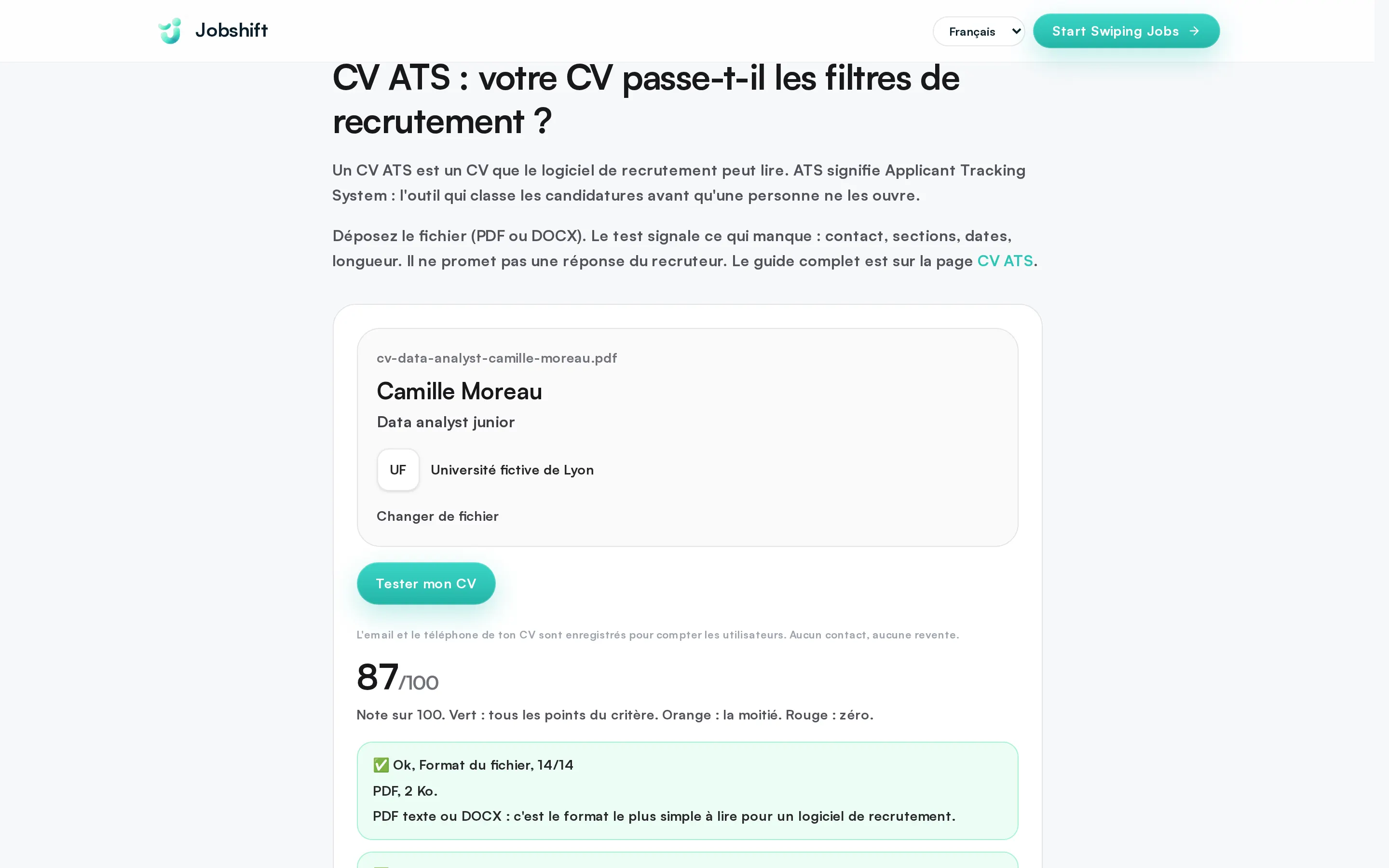
For a layout that stays readable by this software (one column, no skills in images), see our ATS friendly resume template; for how filters work in full, the guide to passing ATS filters (in French). And for the method to adapt your resume ad by ad, read how to adapt your resume to a job ad (in French).
Resume headline: show your hard skills in it
The resume headline is the first line read, by a human and by the software. It should repeat the title of the target role, ideally as written in the job ad, then one or two key hard skills. France Travail suggests adding your soft skills under the target job title; the same spot works for your key technical skills, often the most telling for a technical role.
Structure: job title + specialty or key tool + level or contract type sought, if relevant.
| Target role | Generic headline | Headline with hard skills |
|---|---|---|
| Data analyst | "Data analyst" | "Data analyst: SQL, Power BI, Python" |
| Accountant | "Experienced accountant" | "General accountant: Sage, closings, VAT" |
| Developer | "Web developer" | "Front-end developer React / TypeScript" |
| Forklift driver | "Forklift driver" | "Forklift driver: CACES R489 cat. 3 and 5" |
| Payroll officer | "HR assistant" | "Payroll officer: Silae, DSN" |
| Marketing work-study | "Marketing student" | "Digital marketing work-study: SEO, Google Ads, GA4" |
Three rules: one role per headline (if you target two jobs, make two resumes), no more than three skills, and only skills that appear in the job ad. If you are looking for a work-study contract in France, the Jobshift work-study job listings (in French) group offers by job: read several to spot the skills that come up again and again, then put them in your headline.
Talking about your hard skills in an interview
In the interview, the recruiter checks what the resume claims. For each of your three or four main hard skills, prepare:
- A precise example: the context, what you did with the tool or method, the result.
- Your real level: what you do alone, and where you still need help. "I master pivot tables and I am learning Power Query" is more reassuring than "I master Excel" that falls apart at the first exercise.
- The possible technical test: if the job ad mentions one (Excel, code, case study), practice the exact skill requested.
- What you are learning right now: a technical skill ages, showing that you keep it up to date is an argument.
- An answer for the skill you lack: if the ad asks for software you do not know, name the one you already use in the same family and explain how you plan to learn it.
To practice answering out loud, the free Jobshift interview simulator (in French) generates questions tailored to the target role.
Common mistakes with hard skills
- Listing 30 skills. The recruiter no longer knows what matters, and the key skills of the ad are buried. Keep the ones for the role.
- Staying vague. "IT", "management software", "social media": these words match no precise search criterion. Name the tool.
- Mixing hard and soft skills in one list. "Python, autonomous, SQL, curious" blurs the reading. Separate technical skills from qualities, and prove the qualities in your experience.
- Using gauges or logos. Screening software does not read them and they do not say what you can do.
- Keeping outdated skills. Software nobody uses anymore, an expired certificate without renewal: remove them or date them.
- Making things up to match the ad. This is the shortcut that costs the most: it shows in the technical test or at the first precise question.
- Forgetting hard skills gained outside work. School projects, volunteering, clubs, self-study: a WordPress site built for a club or books kept for an association are valid proof, especially if you have no experience yet. To structure this kind of profile, see how to write a resume with no work experience (in French).
Hard skills checklist before sending your resume
- [ ] I highlighted the tools, software, standards, certifications and languages requested in the job ad.
- [ ] My "Technical skills" section uses their exact names, for those I master.
- [ ] Each skill listed is proven in an experience, a course or a project.
- [ ] My languages have a CEFR level or a certification, not "fluent".
- [ ] The resume headline contains the job title and one to three key hard skills.
- [ ] No gauges, stars or skills in images.
- [ ] I ran my resume through the ATS test, compared its skills with those of the job ad, and redid the layout with the free resume builder if needed.
Your hard skills adapted to each job, in 1 swipe with Jobshift
Adapting the skills section and the resume headline to each ad works, but takes time when you apply a lot. That is what Jobshift automates: the app lets you apply to jobs by swiping.
- Swipe right on a job you like: Jobshift prepares the application for you.
- Resume and message adapted to each job, with the keywords of the role, which you can still review.
- One place to track all your applications, so you know who to follow up with and when.
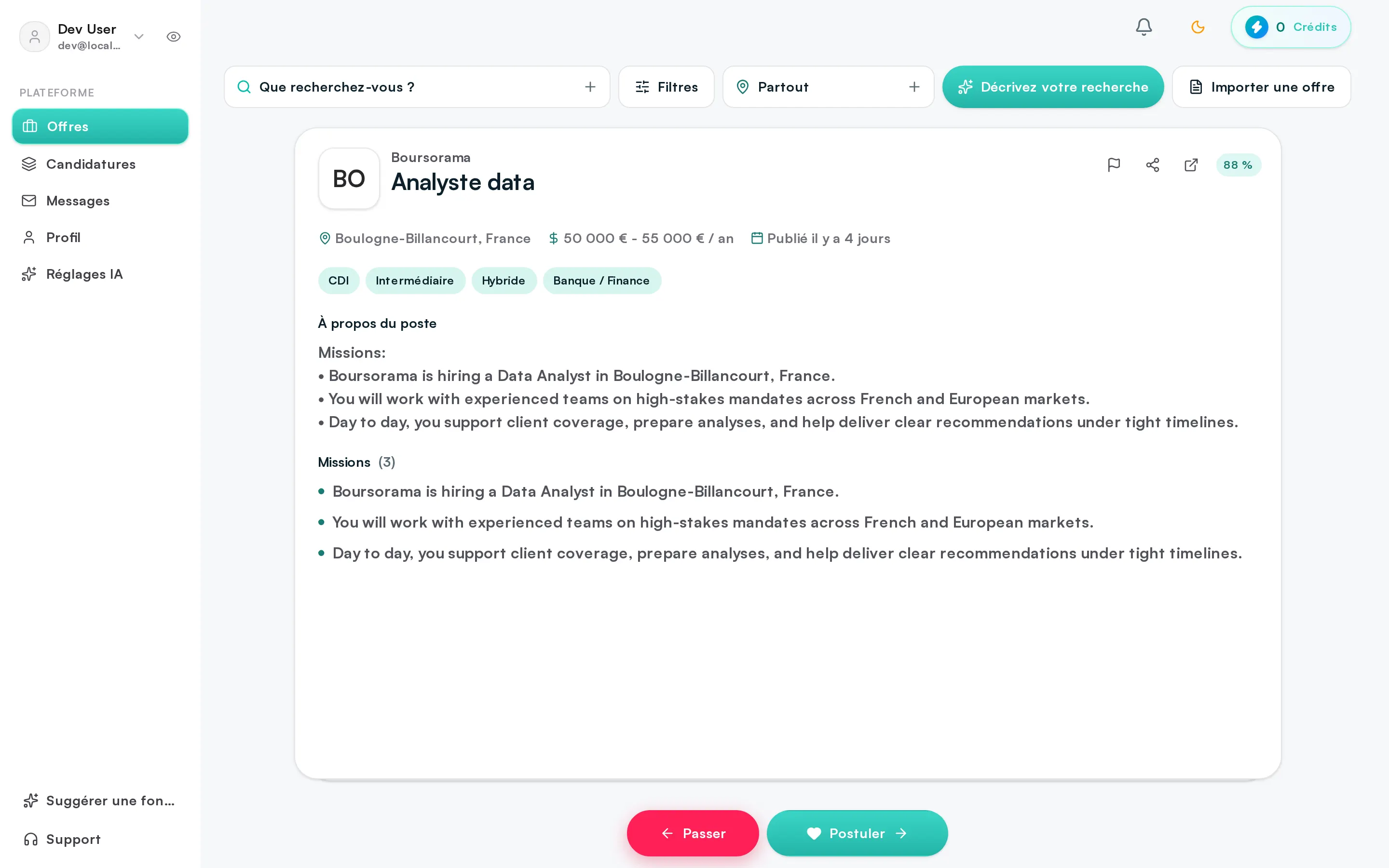
Check that your skills match the job, then apply in 1 swipe. Create your profile in a few minutes and start applying to jobs that fit you. Try Jobshift for free
Related articles
- Idées compétences CV : 9 exemples à valoriser en 2026 (in French)
- CV ATS : le guide pour passer les filtres de recrutement en 2026 (in French)
- ATS friendly resume template
- Adapter son CV à une offre d'emploi : guide pratique (in French)
FAQ
What is a hard skill?
A hard skill is a technical skill linked to a job: software, a programming language, a method, a standard, a technique or a foreign language. It can be learned, checked (degree, certification, test, piece of work) and named precisely, for example "SQL", "payroll on Silae" or "forklift certificate".
What is the difference between hard skills and soft skills?
Hard skills are the technical knowledge and know-how of a job. Soft skills are behavioral skills, how you work: organization, communication, adaptability. The first are proven with a certification, a level or a piece of work; the second with concrete examples told in an interview.
How many hard skills should you put on a resume?
Aim for 6 to 10 technical skills, grouped by family, chosen according to the job ad. Fewer skills, all proven in your experience, are better than a long generic list where the keywords of the role get lost.
Where should you put hard skills on a resume?
In a "Skills" or "Technical skills" section with a standard heading, in the experience that proves them (action verb + tool + result), and for one or two of them in the resume headline, right after the job title.
How do you state your language level on a resume?
Use the levels of the Common European Framework of Reference for Languages (A1 to C2) or the result of a recognized certification, rather than "fluent" or "good level". If possible, add a context of use: "English B2, daily written exchanges with clients".
Are languages and Excel hard skills?
Yes. A foreign language and mastery of software like Excel are technical skills. Be specific: CEFR level for the language, functions you master for Excel (pivot tables, XLOOKUP, Power Query) rather than "proficient in Microsoft Office".
Sources
- Soft skills : mettez en valeur votre savoir-être auprès des recruteurs (France Travail, in French)
- Le recrutement par les compétences, est-ce fait pour mon entreprise ? (France Travail, in French)
- Comment rédiger son CV ? Les 10 questions à se poser (Onisep, in French)
- CEFR global scale, French version (Council of Europe, in French)
- Vérifiez si votre futur diplôme est reconnu par l'État (France compétences, in French)
- MétierScope: information and skills by job (France Travail, in French)
- Pix: assess, develop and certify your digital skills (in French)