Job application in English: email, resume, and templates ready to copy
 Chris Massie
Jobshift
October 27, 2026 · 12 min read

Partager l'article
In English, "candidature" is application (or job application), and "postuler à un poste" is to apply for a position. A job application in English rests on three documents: a CV (called a resume in the United States), an application email, and, often, a cover letter. This guide gives you the exact vocabulary, the differences between a French CV and an Anglo-Saxon resume, three application emails to copy, an English speculative application template, and the opening and closing formulas to use.
In short
- Candidature = application; candidature spontanée = speculative application (United Kingdom) or unsolicited application; lettre de motivation = cover letter.
- An Anglo-Saxon resume is not translated word for word: you remove the photo and personal information, and you put results first.
- A good application email in English runs 120 to 180 words, with a precise subject line and a sign-off suited to the recipient.
- False friends (postulate, formation, actually) quickly give away a French speaker: proofread with the list below.
Job application vocabulary in English
| French | English | Good to know |
|---|---|---|
| Job application (candidature) | Application, job application | Candidature exists in English, but it mainly refers to a political candidacy. |
| Apply for a position (postuler à un poste) | To apply for a position / a job | Never to postulate, which means "to postulate" in the sense of setting out a hypothesis. |
| Speculative application (candidature spontanée) | Speculative application (UK), unsolicited application | In the United States, people also say cold application. |
| Application for the position of… (candidature pour le poste de…) | Application for the position of… | An ideal formula for an email subject line. |
| Application file (dossier de candidature) | Application pack, application materials | Application form = the form to fill in online. |
| Call for applications (appel à candidatures) | Call for applications | Common for scholarships, programs, and competitive calls. |
| Cover letter (lettre de motivation) | Cover letter (US/UK), covering letter (UK) | |
| CV (CV) | CV (UK, Europe), resume or résumé (US, Canada) | |
| Job posting (offre d'emploi) | Job posting, job advertisement, vacancy (UK) | Careful: job offer = the employment offer you receive. |
| Internship (stage) | Internship, placement (UK) | Stage in English means a theater stage. |
| Work-study program (alternance) | Work-study programme, apprenticeship | Specify the schedule: 3 days at work, 2 days at school. |
| Interview (entretien) | Interview | |
| Follow-up (relance) | Follow-up (email) | |
| Your application was successful (votre candidature a été retenue) | Your application has been successful / You have been shortlisted | Shortlisted = selected for an interview. |
| Your application was not successful (votre candidature n'a pas été retenue) | We will not be moving forward with your application | The most common rejection formula. |

Differences between a French CV and an Anglo-Saxon resume
Translating your resume line by line is not enough. British and American recruiters expect different conventions.
| Element | French CV | British CV / American resume |
|---|---|---|
| Photo | Common, optional | Generally absent |
| Age, family situation, nationality | Sometimes included | Remove them |
| Length | 1 to 2 pages | US resume: 1 page for a junior, 2 at most. UK CV: 2 pages is common |
| Hook | "Profile" or a title | Professional summary or Profile of 2 to 3 lines |
| Experience | Duties described | Quantified achievements, introduced by an action verb (led, built, increased) |
| Dates | 03/2022 | Mar 2022 – Present (avoid all-numeric formats: 03/04 is read as March 4 in the United States) |
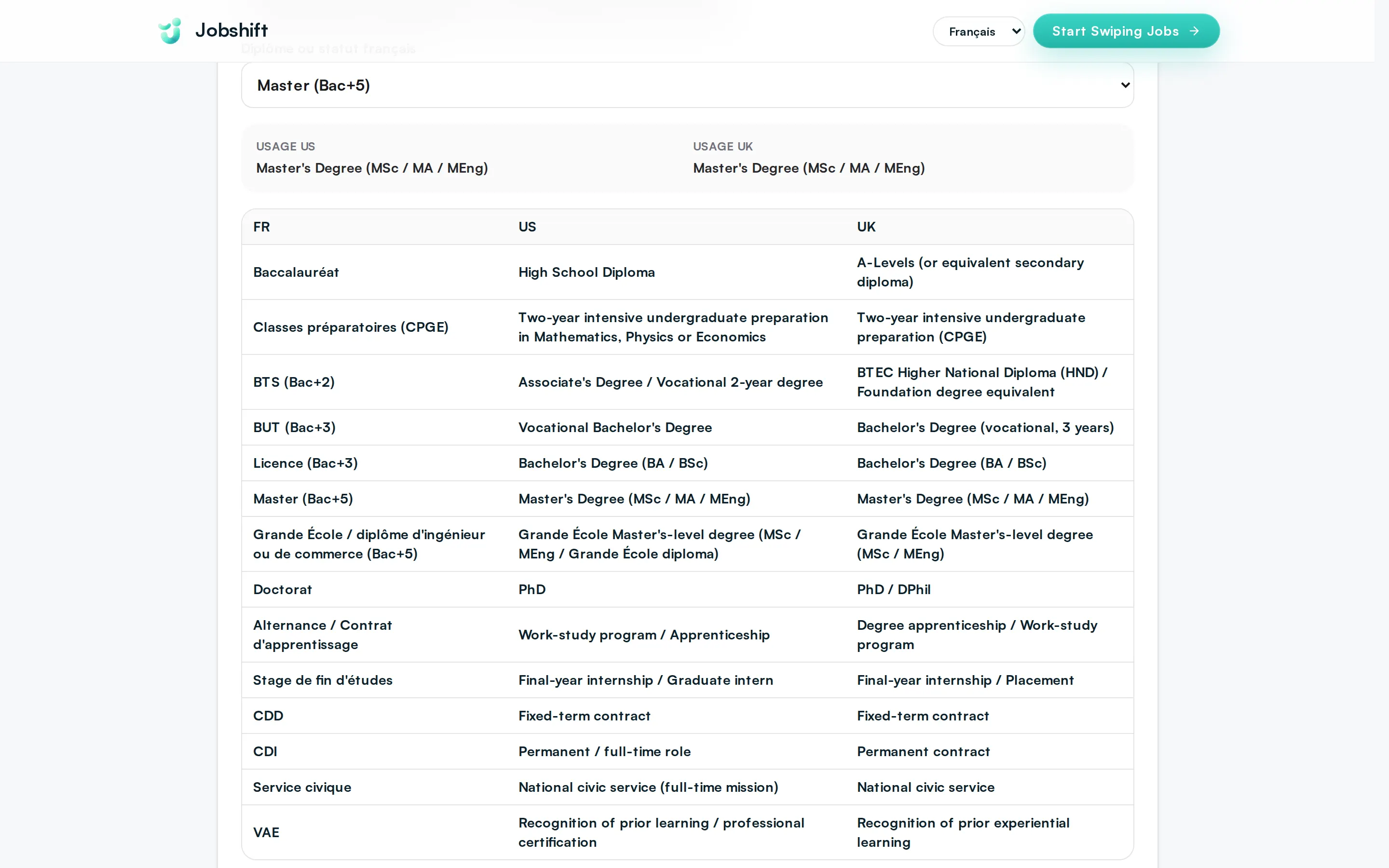
| Degrees | French abbreviations (BTS, Bac+5) | Equivalent explained in parentheses |
| Languages | "Anglais courant" | CEFR level: English: C1 (advanced) |
Translating your degrees and job titles
French abbreviations mean nothing to a recruiter in London or New York. Keep the original name and add a short explanation:
- Master's degree in Finance, ESSEC Business School (Grande École, top-ranked French business school)
- BTS Management Commercial Opérationnel (2-year vocational degree in sales management)
- Baccalauréat (French high school diploma)
Do the same for job titles: "chargé d'affaires" has no single translation. Choose the English title used in job postings in your field (account manager, business developer) rather than a literal translation.
Section headings in English
Professional summary, Work experience (or Professional experience), Education, Skills, Languages, Certifications. These standard headings are also the ones recruitment software recognizes. Large companies, in France and abroad, often sort applications with an ATS: the rules in our ATS resume guide also apply in English (one column, selectable text, keywords from the posting).
For the base of the document, our free resume generator produces a resume in plain, well-structured text. Then replace the section headings with their English equivalents above.
On the photo, the rule is simple for Anglo-Saxon markets: do not include one. Our guide on which photo to use on a resume details the practice country by country.
Application email in English: structure and 3 examples
The 6-block structure
- Subject line: the role, the job reference if there is one, your name. Example: Application for Marketing Analyst (Ref. MA-2026) – Julie Moreau.
- Greeting: Dear Ms Taylor, if you know the name; otherwise Dear Hiring Manager,.
- Hook: the role you are targeting and where you saw it, in one sentence.
- Proof: one or two quantified achievements linked to the posting.
- Call to action: suggest a conversation, and mention the attachments.
- Closing formula and signature: Kind regards, then name, phone in international format (+33 6 …), and LinkedIn link.
Example 1: replying to a job posting
Subject: Application for Customer Success Manager – Thomas Petit

Dear Ms Reynolds,

I am writing to apply for the Customer Success Manager position advertised on your careers page.

Over the past four years at a French SaaS company, I have managed a portfolio of 60 B2B accounts
and reduced churn from 9% to 5% by setting up quarterly business reviews. Your focus on
expanding into the French market is exactly where I can help from day one.

Please find my CV attached. I would welcome the opportunity to discuss how I could contribute
to your team.

Kind regards,
Thomas Petit
+33 6 00 00 00 00 | linkedin.com/in/thomaspetit
Example 2: applying for an internship
Subject: Internship application – Data Analyst (6 months, from January 2027) – Inès Garnier

Dear Hiring Manager,

I am a final-year Master's student in Data Science at Université Paris-Saclay, and I am applying
for your six-month Data Analyst internship starting in January 2027.

During a recent university project, I built a Python dashboard that cut the reporting time
of a local retailer from two days to two hours. I am keen to apply these skills to your
product analytics team.

My CV is attached. I am available for an interview at your convenience.

Best regards,
Inès Garnier
+33 6 00 00 00 00 | linkedin.com/in/inesgarnier
Remember to state the length, the start date, and, if your school requires it, the internship agreement (internship agreement).
Example 3: an application referred by a contact
Subject: Referred by Mark Evans – Application for Frontend Developer

Dear Ms Chen,

Mark Evans, who works in your platform team, suggested I contact you about the Frontend
Developer opening.

I have three years of experience with React and TypeScript, and I recently led the migration
of a checkout flow that increased mobile conversions by 12%. I would be glad to bring the
same focus on performance to your product.

I have attached my CV and would be happy to talk whenever suits you.

Best regards,
Hugo Lambert
+33 6 00 00 00 00 | github.com/hugolambert
Putting the name of the person who referred you in the subject line gives the recipient an immediate reason to open the email.
Speculative application in English: the template
A speculative application in English follows the same logic as in French: you write to a company that has not published a job for your profile. The full method (targeting, finding the right contact, following up) is in our speculative application guide. Here is the template to adapt in English:
Subject: Speculative application – Supply Chain Analyst – Camille Roux

Dear Mr Patel,

I have followed [Company]'s expansion in Europe with great interest, particularly the opening
of your new distribution centre in Lyon. I am writing to ask whether you have, or expect to have,
an opening for a Supply Chain Analyst.

In my current role at [Current company], I redesigned our inventory planning process, which
reduced stock-outs by 18% in one year. I am fluent in French and English (C1) and comfortable
working with SAP and Power BI.

I have attached my CV and would appreciate the chance to discuss how I could support your
operations team. I will follow up next week in case this email gets lost in a busy inbox.

Yours sincerely,
Camille Roux
+33 6 00 00 00 00 | linkedin.com/in/camilleroux
Three things make the difference: a precise reason for writing to this company (first sentence), a quantified achievement, and the announcement of a follow-up. Aim for a real recipient's name: Dear Hiring Manager works for a posted job, and works less well for a speculative application.
If you attach a cover letter in English, our free cover letter generator gives you a first draft personalized from the role, the company, and one concrete fact, to adapt into English afterward.
Opening and closing formulas in English
How to open
| Situation | Formula |
|---|---|
| Name known | Dear Ms Taylor, / Dear Mr Jones, (Ms suits any woman, whatever her marital status) |
| Name unknown | Dear Hiring Manager, or Dear [Team name] Team, |
| Very formal, unknown recipient | Dear Sir or Madam, (correct but dated) |
| To avoid | To whom it may concern, (impersonal), Hi or Hello (too familiar for a first contact) |
Useful opening lines:
- I am writing to apply for the [position] role advertised on [site].
- I was excited to see your opening for a [position], as…
- [Name] suggested I get in touch regarding…
How to close
| Situation | Closing formula |
|---|---|
| General case, email | Kind regards, or Best regards, |
| United Kingdom, recipient's name known | Yours sincerely, |
| United Kingdom, opened with Dear Sir or Madam | Yours faithfully, |
| United States, formal tone | Sincerely, |
Useful closing lines:
- I would welcome the opportunity to discuss my application.
- Thank you for considering my application.
- Please find my CV attached.
False friends and phrases to avoid
- I postulate for… → I am applying for…
- My formation → My education or my training
- Actually (= in fact) does not mean "currently" (actuellement) → currently
- I have realised a project → I have completed / delivered a project
- I am motivated and dynamic → replace it with a quantified achievement
- I permit myself to… (a calque of "je me permets") → delete it and get to the point
Applying internationally with Jobshift
Writing one email per job, adapting the resume to the keywords of each ad, filling in forms in English: at the scale of an international search, that adds up to hours. Jobshift includes remote jobs from European and American companies that hire through Greenhouse or Lever, two recruitment tools common at startups and scale-ups.
How it works is simple: you import your resume once, you swipe the matching jobs, and for each swipe right Jobshift generates a tailored resume and a personalized cover letter, then submits the application directly into the recruiter's ATS. You can review, edit, or cancel each application before it is sent. The details are on the how Jobshift works page, and tech profiles will find the specifics on Jobshift for developers.
Apply to jobs in French and in English in one swipe. Import your resume, swipe the jobs that match you, and let Jobshift prepare and send each application. Try Jobshift for free
FAQ
How do you say "candidature" in English?
You say application or job application. "Postuler" translates as to apply for, and "candidature spontanée" as speculative application (United Kingdom) or unsolicited application.
Should you translate your resume or write a new one?
It is better to adapt it than to translate it: remove the photo and personal information, add a professional summary, quantify your achievements, and explain your French degrees in parentheses.
Do you need a cover letter for a job application in English?
Often, yes: many postings ask for a cover letter. When they do not, the body of the email plays that role: three short paragraphs are enough.
Should you put a photo on a resume in English?
No, for the United Kingdom, the United States, and Canada. Recruiters there expect a resume with no photo and no personal information such as age or family situation.
How do you show your English level on a resume?
Use the Common European Framework of Reference (A1 to C2), for example English: C1 (advanced), and add a test score if you have one (TOEIC, IELTS, Cambridge).
When should you follow up on a job application in English?
About one week after sending, with a short email: I am following up on my application for the [position] role, sent on [date]. I remain very interested and would be glad to provide any further information.