Speculative application email: 7 templates that get replies
 Chris Massie
Jobshift
October 29, 2026 · 16 min read

Partager l'article
A speculative application email is a short email (150 to 200 words) sent to a company that has not published a job, to offer your profile for a specific role or a specific type of work, with your resume as a PDF attachment. It often replaces the classic cover letter: the recruiter reads the body of the email first, and opens the attachments only if those few lines have convinced them.
The goal is to maximize your chances of getting a reply with a clear, targeted message, without dubious shortcuts and without damaging your credibility. Below you will find the subject line to use, the 4-paragraph structure, 7 templates ready to copy for your situation, the "candidature pour or à" rule, the attachments to include, and a follow-up email. For the full method (choosing companies, finding the right contact, the right time to send), see our speculative application guide.
In short
- Subject line:
Speculative application – [Role or occupation targeted] – [First name Last name], with availability or contract type if it is an internship or an apprenticeship. - Length: 150 to 200 words, 4 short paragraphs, readable on a phone screen without scrolling.
- Structure: a hook tied to the company, what you bring (with a concrete result), why this company, a proposal to talk.
- Attachments: resume as a PDF named
CV-Firstname-Lastname-Role.pdf, plus a cover letter only if the company or the sector expects one. - Follow-up: only one, 7 business days after sending, in the same email thread.
Email or cover letter: what should you send?
When you write directly to a recruiter or a manager, the body of the email serves as the cover letter. It is the first text read, and often the only one. Attaching a full cover letter as well remains useful in three cases:
- The company explicitly asks for it on its careers page ("send resume and cover letter to…").
- The sector stays formal: public sector, banking, law firms, large industrial groups.
- Your career needs an explanation that the email cannot hold in 4 paragraphs, for example a career change or a long break.
In the other cases, a well-written email and a clear resume are enough. If you attach a letter, do not copy the email into it: the email summarizes, the letter develops. You can prepare it in a few minutes with our free cover letter generator.

The subject line of a speculative application email
The subject line decides whether your email is opened, then found later when the recruiter searches for your name in their inbox. It should contain three pieces of information: the nature of the message, the role or occupation targeted, and your name.
| Situation | Recommended subject line |
|---|---|
| Permanent or fixed-term contract, role identified | Speculative application – Recruitment officer – Léa Martin |
| No specific role | Speculative application – Digital marketing profile (3 years of experience) – Léa Martin |
| Internship | Speculative application – 6-month web development internship from January 2027 – Léa Martin |
| Apprenticeship | Speculative application – Management control apprenticeship (3 days / 2 days) – Léa Martin |
| Referral | Speculative application – Management controller – recommended by [First name Last name] |
Avoid: an empty subject line, "Resume", "Application" alone, capitals everywhere, or a subject line so long it will be cut off on mobile.
The 4-paragraph structure (150 to 200 words)
A recruiter who receives an unsolicited application asks one question: "Can this profile solve a problem I have, now or soon?" Each paragraph should help them answer yes.
1. The hook: show that you are writing to this company
One sentence that cites a real, verifiable element: a product launched, a site opening, a job published in another department, an article or a talk by the chief executive. Avoid "I am writing to submit my application" as the first line: it is the sentence the recruiter has already read in every other email of the day.
2. What you bring: a skill and a concrete result
Your occupation, your level of experience, and a measurable achievement drawn from your career: a shorter deadline, a portfolio managed, a project delivered, a tool you know. Use your real figures, never figures rounded up: they will be checked in the interview.
3. Why them: the link between your profile and their challenges
Two sentences that connect your skill to what you have understood about the company. This is the paragraph that separates a targeted speculative application from a mass send.
4. The proposal: a short conversation, not "a job"
Suggest a 15-minute call or a conversation at their convenience, remind them that your resume is attached, then sign with your phone number and the link to your LinkedIn profile. A simple, limited request gets a yes more easily than a request to be hired.
7 speculative application email templates to copy
Replace everything in brackets. If a bracket cannot be filled with real information, delete the sentence rather than inventing it.
Template 1: speculative application with no specific role
This is the most common situation, and the one that requires the most precision: with no published job, it is up to you to say where you would be useful.
Subject: Speculative application – [occupation or field] profile ([X] years of experience) – [First name Last name]

Hello [Ms. / Mr. Last name, or first name],

I came across [real element: the launch of your new offer / the opening of your Lyon office / your article on…] and I would like to offer my application, even though no matching role is published today.

[Occupation] for [X] years at [Company], I have in particular [concrete, quantified achievement with your real figures]. I am proficient in [2 or 3 key skills or tools].

Your [project / growth / team] seems directly tied to what I know how to do: [1 sentence of concrete connection]. I could contribute to [type of work] in [department or team].

Would you be available for a 15-minute conversation in the coming weeks? You will find my resume attached.

Kind regards,
[First name Last name]
[Phone] | [LinkedIn link]
Template 2: speculative application for a permanent or fixed-term contract (role identified)
Subject: Speculative application – [Job title] – [First name Last name]

Hello [first name],

Following [Company]'s growth in [market / product / region], I thought your [team name] team might need a [job title] in the coming months.

Currently [current role] at [current company], I [main duty] and I have [concrete result]. I work every day with [tools: Salesforce, SAP, Figma, SQL…].

The way you [observed element: organize your product teams / support your SME clients] matches the way I like to work, and I would be glad to contribute to it.

I am available for a conversation at your convenience. My resume is attached to this message.

Kind regards,
[First name Last name]
[Phone] | [LinkedIn link]
Template 3: speculative application for an internship
Subject: Speculative application – [field] internship of [length] starting [month year] – [First name Last name]

Hello [Ms. / Mr. Last name],

I am a student in [year and program] at [School / University], I am looking for a [length] internship in [field] starting [month year], and [Company] is one of the places where I would most like to learn, in particular because of [specific reason].

During my studies, I [concrete project: completed / took part in…], which let me practice [skills or tools]. I also have [a student association, a student job, or a related personal project].

I would be motivated to contribute to [type of work] within your [team name] team, and the internship agreement can be signed quickly with my school.

Could we talk about it in a short conversation? My resume is attached.

Kind regards,
[First name Last name]
[Phone] | [LinkedIn link]
Template 4: speculative application for an apprenticeship
Always state the schedule and the start date: those are the first details an HR team checks for an apprenticeship contract.
Subject: Speculative application – [occupation] apprenticeship – [degree] – start [month year] – [First name Last name]

Hello [Ms. / Mr. Last name],

Admitted to [degree and title] at [School / CFA] for the [month year] start, I am looking for a host company for an apprenticeship (schedule [3 days at the company / 2 days at school, or another schedule]) and I would like to join [Company].

During [previous training or experience], I [concrete achievement], and I am comfortable with [tools or skills].

Your work in [field] matches exactly the occupation I want to learn, in particular [specific duty or project].

Would you be open to a conversation to discuss it? You will find my resume and my apprenticeship calendar attached.

Kind regards,
[First name Last name]
[Phone] | [LinkedIn link]
If you are also looking for published jobs alongside your speculative applications, browse our apprenticeship jobs page, sorted by occupation.
Template 5: speculative application for a career change
The recruiter needs to understand in two lines why you are changing occupation and what transfers. Do not apologize for your career: present it as an asset.
Subject: Speculative application – [New occupation targeted] (career change, [training completed]) – [First name Last name]

Hello [first name],

After [X] years as a [former occupation], I am changing careers into [new occupation] and I have just [finished / started] [training or certification].

My previous experience gave me [transferable skill: client relations, project management, regulatory rigor…], which I have already put into practice in [a concrete project tied to the new occupation].

[Company] interests me in particular because [specific reason], and I think a profile like mine can bring [concrete value] to your team.

Would you accept a 15-minute conversation so I can present my background? My resume is attached.

Kind regards,
[First name Last name]
[Phone] | [LinkedIn link]
To go further on this case, see our page on career change with Jobshift.
Template 6: speculative application with a referral
The referral goes in the subject line and in the first sentence. Always ask the person's permission before using their name.
Subject: Speculative application – [Role or occupation] – recommended by [First name Last name]

Hello [first name],

[First name Last name], [their role] at [Company], advised me to contact you about [the team's need or project].

I am a [occupation] with [X] years of experience, in particular in [field], where I [concrete achievement].

From what [first name] explained to me about [project or challenge], I think I can be useful to you on [specific duty].

Would you have a slot in the coming days to discuss it? My resume is attached.

Kind regards,
[First name Last name]
[Phone] | [LinkedIn link]
Template 7: short version (under 80 words) for a manager or an SME
When you write directly to an operational manager or to the owner of a small company, the shorter it is, the more likely it is to be read to the end.
Subject: [Occupation] available to strengthen your team – [First name Last name]

Hello [first name],

[Occupation] with [X] years of experience in [field], I have [concrete achievement]. I think I can help you with [specific need you have observed].

My resume is attached. Would you have 10 minutes this week or next to talk about it?

Have a good day,
[First name Last name]
[Phone]
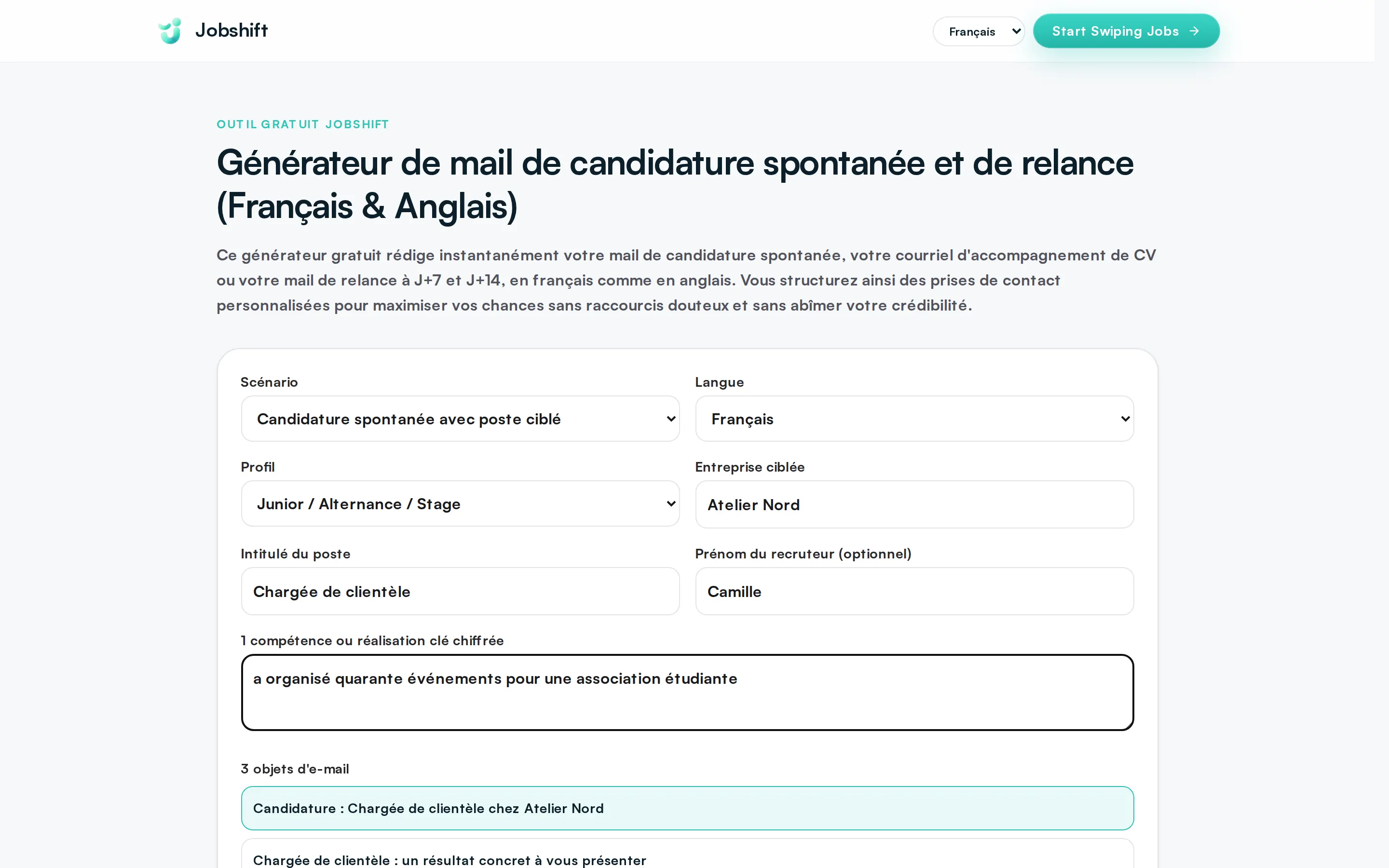
If you would rather start from a draft generated from your occupation and the company you are targeting, our application email generator produces a speculative application or follow-up email in French or in English, ready to personalize. For an international company, also adapt your resume with the resume translator into English.
"Candidature pour" or "candidature à": the right formula
Both prepositions are correct, but they are not used with the same words:
| Formula | Example | Usage |
|---|---|---|
| Candidature au poste de | "Ma candidature au poste de chargé(e) de clientèle" | The most common and safest formula. |
| Candidature pour le poste de | "Ma candidature pour le poste de comptable" | Also correct and very widespread; pick one or the other and do not mix them in the same email. |
| Candidature à une offre | "Ma candidature à votre offre de stage" | "À" is used before the word "offre" or before the name of a program. |
| Candidature pour un stage / pour une alternance | "Ma candidature pour un stage de 6 mois" | Common before a contract type, especially in a speculative application. |
| Candidature chez [Entreprise] | "Ma candidature chez Decathlon" | Accepted in speech; in writing, prefer "au sein de" or "auprès de". |
For a speculative application, the most natural formula remains: "Je vous adresse ma candidature spontanée pour un poste de [métier] au sein de [Entreprise]."
Attachments: what to send and how to name them
- The resume as a PDF, always. A Word file can display differently on the recruiter's side. Name it
CV-Firstname-Lastname-Role.pdf, neverCV final v3.pdf. - A resume that recruitment software can read. Your email may be forwarded to HR, which will record your file in its ATS (the software that sorts and analyzes applications). Check that the content of your resume is read correctly with our free ATS test, or start again from a simple template with the resume generator.
- The cover letter, only in the cases listed above, also as a PDF.
- A portfolio or work samples for creative or technical occupations: a link in the signature rather than a heavy attachment.
- Light files: a few megabytes at most in total, so a mail filter does not block them.
Following up on a speculative application email
With no reply after 7 business days, one polite follow-up is enough. Reply in the same email thread so the recruiter finds your first message and your resume.
Subject: RE: Speculative application – [Role or occupation] – [First name Last name]

Hello [first name],

I am writing to follow up on my speculative application sent on [date]. I remain very interested in [Company], in particular in [project or challenge cited in the first email].

If the timing is not right, I would be glad if you kept my profile in mind for your next needs.

Kind regards,
[First name Last name]
[Phone]
To note your send dates and not miss any follow-up, use our free application tracking tool. The column template to copy is in the job application tracker.
The mistakes that get a speculative application email ignored
- Sending the same email to several companies in visible copy. One address per send, always. A visible recipient list signals a mass send.
- Writing to a generic address when a contact exists. Look for the recruiter's or manager's name on the company site or on LinkedIn before writing to
contact@. - Copying the cover letter into the body of the email. Too long, unreadable on mobile. The email summarizes; the letter, if it is attached, develops.
- Forgetting to say what you are looking for. "I am open to any opportunity" forces the recruiter to guess where to place you. Name an occupation or a type of work.
- Using an unprofessional email address. Prefer
firstname.lastname@…to a nickname. - Sending without proofreading. A mistake in the company name or the recipient's name is often enough to disqualify the application.
Save time on all your applications with Jobshift
A speculative application works because it is targeted: it takes time, and that is normal. You can free that time on jobs that are already published, the other side of your search.
That is what Jobshift does:
- You import your resume once to create your candidate profile.
- You swipe the jobs that match your occupation, your experience level, and your location preferences.
- On each swipe right, Jobshift prepares a resume and a cover letter tailored to the job, then submits the application into the recruiter's ATS (notably Greenhouse and Lever). You can review, edit, or cancel each application before it is sent.
- Your applications are recorded in your candidate space, with the company, the role, and the date.
The process is explained on the how Jobshift works page.
Save time: generate your cover letter in 1 click and apply by swiping. Keep your energy for your targeted speculative applications, and let Jobshift tailor your file and apply to published jobs for you. Try Jobshift for free
FAQ
How do you write a speculative application email?
Write 4 short paragraphs (150 to 200 words in total): a hook tied to the company, what you bring with a concrete result, why this company in particular, then a proposal for a 15-minute conversation. Put the occupation targeted and your name in the subject line, and attach your resume as a PDF.
What subject line should you use for a speculative application by email?
Use the format Speculative application – [Role or occupation targeted] – [First name Last name]. For an internship or an apprenticeship, add the length, the schedule, or the start date. Avoid empty subject lines or ones reduced to "Resume".
Should you attach a cover letter to a speculative application email?
Not systematically: the body of the email already plays the role of a cover letter. Attach one if the company asks for it, if the sector is formal (public sector, banking, legal), or if your career deserves a longer explanation, such as a career change.
How do you make a speculative application with no specific role?
Still name an occupation or a type of work ("digital marketing profile", "sales assistant"), then explain which company need you could work on. Template 1 on this page is designed for this case.
Do you say "candidature pour" or "candidature à" a role?
Both are correct: "candidature au poste de" and "candidature pour le poste de" are accepted. You write "candidature à une offre" and, most often, "candidature pour un stage" or "pour une alternance".
When should you follow up on a speculative application sent by email?
Only once, 7 business days after sending, by replying in the same email thread. With no reply after that follow-up, move on to other companies.