Career change resume: how to present your path + 3 examples
 Chris Massie
Jobshift
November 15, 2026 · 23 min read

Partager l'article
A career-change resume has to make three things clear to the recruiter in a few seconds: the job you are aiming at now, what you already know how to do that is useful to them, and what you have done to learn the rest. The format that usually fits is a skills-based resume or a combination resume, with a title that names the new job, a short summary and past roles rewritten from the angle of the target role.
The aim of this guide is to raise your chances without dubious shortcuts and without hurting your credibility: a path presented honestly and linked to the role is more convincing than a resume that hides years or inflates a course.
You will find here a diagnosis of why a career-change resume gets set aside, the method section by section, three complete examples (retail towards customer relations, teaching towards adult training, restaurants towards web development), a way to measure whether your resume works and a checklist. If you are still choosing the trade or the funding, start with our page JobShift for career change.
In brief
- The right format: France Travail (the French public employment service) advises, for a career change, a skills-based resume so that skills which transfer from one trade to another stand out. The combination resume, which joins skills and chronology, suits varied paths.
- The title names the target job, not the old one. Job titles should match today's names, because they are keywords read by recruitment software (France Travail).
- Past roles stay on the resume, but rewritten: keep the duties and results useful to the new role, and summarise the rest.
- The career-change training (a titre professionnel, which is a French state vocational title, a diploma, a VAE, or a course in progress) moves up the resume, with the expected award date.
- Reading time is short: France Travail says a recruiter takes only 30 seconds to shortlist or reject a resume. The link with the role must be visible from the top of the page.
Diagnosis: why a career-change resume is set aside
A recruiter who receives a career-change resume does not ask whether your old trade was interesting. They ask whether you can do the job they are offering, and whether they are taking a bigger risk than with a candidate from the trade. Your resume has to answer that question before they even form it.
In practice, a career-change resume is set aside for fairly predictable reasons. Most of them are not about the path itself, but about how it is presented.
The resume tells the old trade
The title says "Sales adviser" or "Primary school teacher", the first role describes the previous job in its own vocabulary, and the new project appears only at the bottom, in education. The recruiter reads a sales resume applying for a customer adviser role, and files it as off target.
The link between the old and the new is not written
You know that managing a class of 25 children means leading a group, preparing sequences and assessing progress. The recruiter will not do that translation for you. What is not written does not exist for them, nor for the software that sorts applications.
The keywords of the new trade are missing
Recruitment software (ATS) and recruiters look for the terms of the posting: tools, duties, job titles. A resume that uses only the vocabulary of the old sector does not surface in a search, even when the skills are there.
The training is not given weight
The training that makes the career change credible is often hidden at the bottom of the page, with no date, no content, no project. Yet it is what proves you have learned the basics of the new trade.
The path looks vague
Dates that do not follow, a period with no explanation, a course "in progress" with no end date: the recruiter fills the gaps, rarely in your favour. A clear line is often enough to remove the doubt.

The deeper causes: what the recruiter must be able to check
Behind these presentation mistakes there are three questions of substance. A good career-change resume answers them explicitly.
- Why this trade? The recruiter wants to see a thought-through project, not an escape. A summary of one or two sentences is enough. The detail goes in the letter or the interview.
- What do you already know how to do that is useful to me? Those are your transferable skills. France Travail distinguishes transversal skills, shared by many trades and sectors (a foreign language, sales techniques, office software, written communication, a sense of welcome), and transferable skills, which can be used in different trades of the same sector.
- What have you done to learn what you still lack? Training, a certification, a VAE (validation des acquis de l'expérience, the French scheme that certifies professional or non-professional experience), an internship, a personal project, volunteering: you need concrete, dated proof.
If one of the three answers is missing, the resume looks incomplete, even when the layout is good. Before you write, note your three answers in one sentence each. They will be the thread of the whole document.
Solutions: build the career-change resume section by section
Choose the right format: skills-based, combination or chronological
France Travail describes three main resume formats. The choice depends on the distance between your old trade and your new one.
| Format | Principle | When to choose it for a career change |
|---|---|---|
| Chronological resume | Roles from the most recent to the oldest | A close change (same sector, neighbouring trade), where recent experience speaks for itself |
| Skills-based resume (thematic) | Headings by skill, illustrated with achievements | A distant change: transferable skills count more than job titles |
| Combination resume | Skills first, then dated and rewritten roles | Varied paths, or recruiters attached to chronology: often the best compromise |
France Travail says the thematic resume can suit people starting a career change, and that the combination resume is ideal for people with complementary experience in different fields. In both cases, keep a dated experience section, even a short one: a resume with no dates worries more than it reassures, and some recruitment software reads resumes without a chronology poorly.
The title: name the new job
The title is the first line read. It should reuse the title of the target role, ideally the one in the posting, and it can state your situation in a few words.
- "Customer adviser | 8 years of in-store customer relations"
- "Adult trainer | former primary school teacher, titre professionnel in progress"
- "Junior web developer | titre professionnel awarded in 2026"
Avoid titles that say nothing about the role ("In career change", "Versatile profile") and titles that name only the old trade. Check that the title matches a current name: France Travail reminds readers that job titles and diploma titles are among the keywords that feed software and search engines.
The summary: two or three lines, no more
The summary links the old and the new. It answers "why this trade" and "what I bring", without justifying or apologising.
A simple structure:
- The target job and your situation (training awarded, in progress, availability date).
- The one or two skills from your old trade that are most useful to the new one.
- What you are looking for: contract type, sector, start date.
Example: "After eight years of in-store sales, I am specialising in remote customer relations. Used to handling complaints and keeping a demanding clientele, I am looking for a permanent customer adviser role from January."
Transferable skills: translate, do not list
The skills section is the heart of a career-change resume. It should not be a list of qualities ("dynamic, rigorous, motivated"), but three to five skills useful to the new role, each illustrated by an achievement taken from your path.
France Travail gives the example of a florist applying for a customer adviser role: she can highlight a sense of service and customer relations, e-commerce (click and collect, delivery), in-store promotion and the merchandising learned in local retail.
A four-step method:
- From three postings in the target trade, pick out the skills that come up most.
- For each one, find a real situation in your path where you used it, even under another name.
- Rewrite it in the vocabulary of the new trade: an action verb, the context, the result.
- Keep only what you can explain in an interview. A skill you cannot illustrate weakens the others.
If you do not know what to highlight, France Travail offers the online tool "Mes compétences" ("My skills"), which helps you identify your skills, explore the trades that need them and prepare applications. For the distinction between technical and behavioural skills, see also our guide to hard skills.
Past roles: sort and rewrite
Your old jobs stay on the resume, but they are no longer described as before. France Travail reminds readers that a resume is not meant to be exhaustive and advises, for a career change, to describe the path in a "transparent" way by highlighting "universal" skills that transfer from one trade to another.
For each role:
- Keep the real job title and the employer: changing the title would be misleading and is easy to check.
- Choose two to four duties that link to the target role, and describe them in its words.
- Quantify when you can (number of customers, budget, team size, deadlines), as France Travail advises, with figures you can justify.
- Summarise in one line old roles or roles with no link, rather than deleting them and creating a gap in the path.
Career-change training: move it up
In a career change, recent training is often your best proof. Place it just after the skills, or even before if it is the main argument.
- State the exact title of the certification, the organisation, the award date or the expected date.
- Add a line on the concrete content: key modules, end-of-course project, internship.
- If the course is in progress, write that clearly ("in progress, award expected in June 2027"): it is information, not a weakness.
The validation des acquis de l'expérience (VAE) is another strong proof. According to Service-Public (the French government information site, page checked on 13 August 2026), it lets you have professional or extra-professional experience recognised (volunteering, being a family carer, an elected mandate, for example) by a certification listed in the RNCP (the French national register of professional certifications), or by one or more skill blocks, and you no longer have to show at least one year of experience related to the target certification. A VAE in progress, or skill blocks already validated, goes in the education section, with the date.
Complementary sections
- Projects: essential if your new trade is proved by work you can show (development, graphic design, writing, data). One or two projects, with the problem, what you did and the result.
- Volunteering and commitments: keep them if they illustrate a skill of the role (leading a group, managing a budget, supervising people).
- Languages and tools: with an honest level and, if you have them, the certifications (France Travail cites the TOEFL or the TOEIC, for example).
- Interests: only if they serve the project. They are not required.
What you do not have to include
Article L1221-6 of the Code du travail (the French Labour Code) provides that information requested from a candidate may only be used to assess their ability to hold the job or their professional aptitudes, and that it must have a direct and necessary link with the role. Service-Public also recalls that it is forbidden to reject a candidate on discriminatory grounds, among them age, family situation, physical appearance or place of residence.
You are therefore not required to state your age or your family situation, or to include a photo. The same article, however, requires the candidate to answer in good faith requests for information linked to the role: you can choose what you highlight, not invent.
In practice: 3 examples of a career-change resume
The three examples below are fictional: names, employers, cities, dates and figures are invented for illustration (exemple.fr addresses, numbers in 00). They are kept in the original French wording. Adapt them to your real path and to the posting.
Example 1: from in-store sales to customer relations (combination resume)
A close change: customer-relations skills transfer directly. The combination resume keeps the chronology while putting skills first.
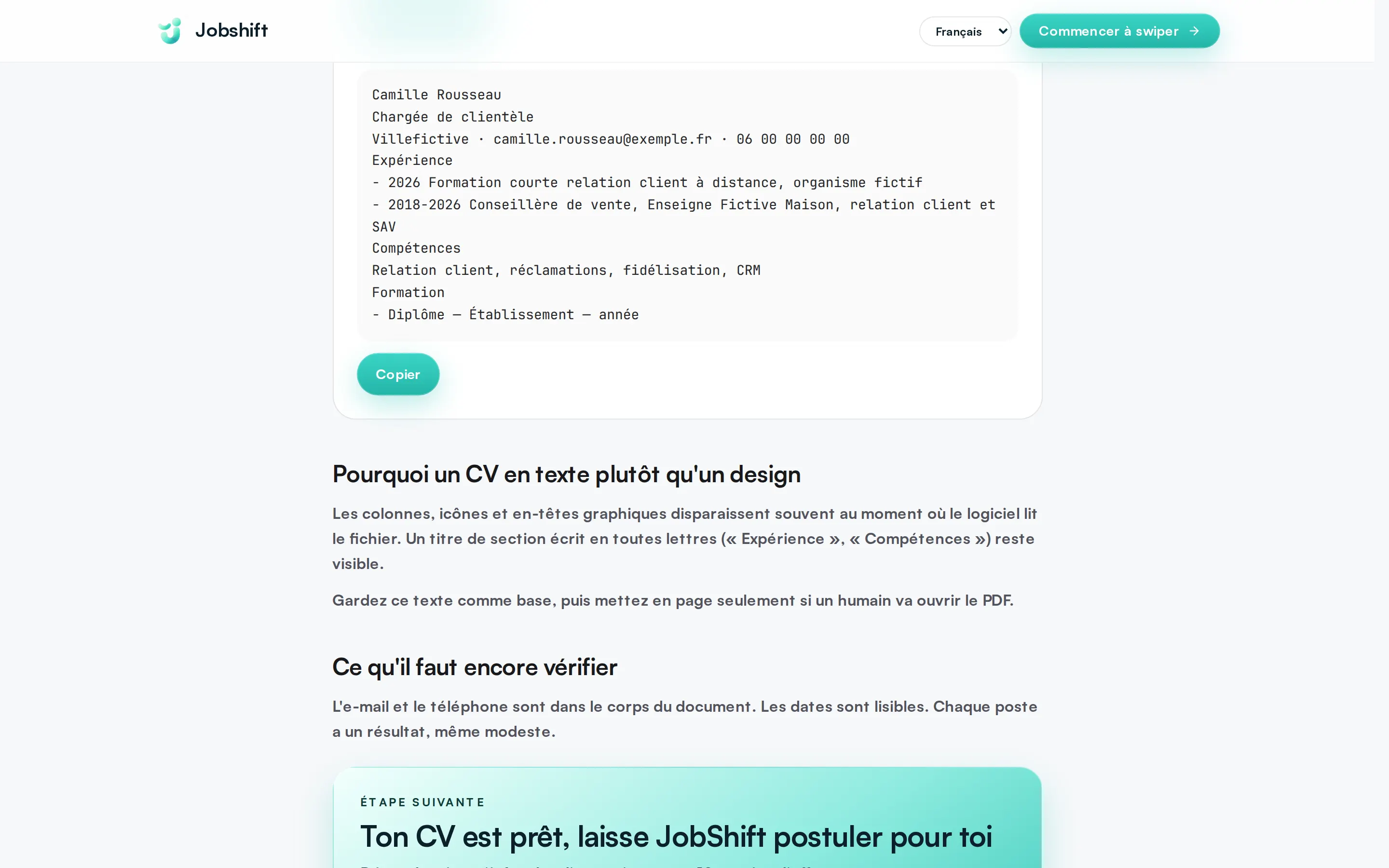
CAMILLE ROUSSEAU
Chargée de clientèle | 8 ans de relation client en magasin
Villefictive | camille.rousseau@exemple.fr | 06 00 00 00 00
Disponible en janvier, CDI, sur site ou en hybride

PROFIL
Après huit ans de vente en magasin, je me spécialise dans la relation client
à distance. Habituée à traiter des réclamations et à fidéliser une clientèle
exigeante, je recherche un poste de chargée de clientèle.

COMPÉTENCES
Relation client et réclamations
  Traitement des retours et litiges en caisse et au comptoir SAV,
  environ 20 dossiers par semaine, avec solution proposée sur place.
Fidélisation
  Gestion du programme de fidélité du magasin, relances par e-mail
  et par téléphone des clients inactifs.
Outils
  Logiciel de caisse, CRM du réseau, suivi de commandes en ligne
  (click and collect), Pack Office.
Communication écrite
  Réponses aux avis clients et aux e-mails du magasin.

EXPÉRIENCES
2018 - 2026  Conseillère de vente, Enseigne Fictive Maison, Villefictive
  - Accueil, conseil et vente, préparation des commandes click and collect
  - Référente SAV : retours, échanges, réclamations
  - Formation de 4 nouveaux vendeurs aux procédures de caisse
2016 - 2018  Hôtesse de caisse, Supermarché Fictif, Villefictive

FORMATION
2026  Formation courte relation client à distance (organisme fictif)
2016  Baccalauréat professionnel Commerce

LANGUES
Anglais : niveau intermédiaire (échanges écrits avec la clientèle)
What works: the title names the new job, the skills reuse the vocabulary of customer adviser postings (complaints, loyalty, CRM), and the old role stays visible with its real title.
Example 2: from teaching to adult training (skills-based resume)
A medium-distance change: the recruiter at a training organisation, or in a company training department, must see that the pedagogy transfers, but to a different audience.
THOMAS LEMAIRE
Formateur pour adultes | ancien professeur des écoles
Villefictive | thomas.lemaire@exemple.fr | 06 00 00 00 00
Titre professionnel en cours, disponible pour un stage ou un CDD dès mars

PROFIL
Professeur des écoles pendant douze ans, je me reconvertis dans la formation
d'adultes. Je conçois des séquences, j'anime des groupes hétérogènes et
j'évalue les acquis. Je recherche un poste de formateur en organisme
ou en entreprise.

COMPÉTENCES ET RÉALISATIONS
Conception pédagogique
  Construction de progressions annuelles et de séquences avec objectifs,
  supports et évaluations, pour des classes de 22 à 28 élèves.
Animation de groupe
  Animation quotidienne, gestion de niveaux différents dans un même groupe,
  ateliers en petits groupes.
Évaluation et suivi
  Évaluations diagnostiques et finales, comptes rendus individuels
  aux familles trois fois par an.
Outils numériques
  Création de supports sur outil de présentation, utilisation
  d'un environnement numérique de travail, quiz en ligne.

FORMATION
2026 - 2027  Titre professionnel Formateur professionnel d'adultes,
             organisme fictif (en cours, obtention prévue en juin 2027)
             Stage de 6 semaines prévu en organisme de formation
2013  Master Métiers de l'enseignement (MEEF)

PARCOURS
2014 - 2026  Professeur des écoles, Éducation nationale, Villefictive
2012 - 2013  Animateur en accueil de loisirs (été), Ville Fictive

ENGAGEMENTS
Bénévole en alphabétisation pour adultes, association fictive, depuis 2024
What works: the skills are those of a trainer, each proved by an achievement from the old trade, and volunteering with adults answers the objection "you have only worked with children".
Example 3: from restaurants to web development (skills-based resume with projects)
A distant change: the old trade is not technical. The training and the projects carry the resume. Qualities from the previous trade come in support.
NADIA BENALI
Développeuse web junior | titre professionnel obtenu en 2026
Villefictive | nadia.benali@exemple.fr | 06 00 00 00 00
github.com/exemple-nadia | Disponible immédiatement, CDI ou alternance

PROFIL
Ancienne cheffe de partie, je me suis reconvertie dans le développement web.
J'ai réalisé trois applications pendant ma formation et je cherche un premier
poste de développeuse front-end ou full-stack junior.

COMPÉTENCES TECHNIQUES
HTML, CSS, JavaScript, React, Node.js, SQL, Git

PROJETS
Application de gestion de stocks pour un restaurant (projet de fin de formation)
  React + Node.js + base SQL : saisie des livraisons, alertes de rupture,
  export des commandes. Code public sur GitHub.
Site vitrine responsive pour une association fictive
  Maquette, intégration, mise en ligne, formulaire de contact.

FORMATION
2025 - 2026  Titre professionnel Développeur web et web mobile,
             organisme fictif, Villefictive (obtenu)
             Stage de 2 mois dans une agence web fictive

EXPÉRIENCES
2017 - 2025  Cheffe de partie, Restaurant Fictif, Villefictive
  - Organisation d'un poste en service sous forte contrainte de temps
  - Gestion des commandes fournisseurs et des stocks de la partie
  - Encadrement de 2 commis
2015 - 2017  Commis de cuisine, Brasserie Fictive, Villefictive

LANGUES
Anglais : lecture de documentation technique
What works: the projects come before experience, the end-of-course project links to the old trade (stock management in a restaurant), and the years in the kitchen stay visible, summarised through organisation and pressure.
Variants depending on your situation
A career change with no experience in the new trade
If you do not yet have a finished course or an internship, the resume must show the start of proof: a course in progress, a personal project, a professional immersion, volunteering. Advice for a first resume with no experience applies in part, but your old path remains an asset: it proves your reliability and your ability to hold a job.
A career change after 40 or 50
France Travail advises, when you have a long career, to stay concise (one page, or a page and a half), to focus on the last ten years or on the years that serve the project, and to choose a skills-based structure, then list the successive jobs briefly. You do not have to state your age (see above). Highlight recent continuing training, which shows that you are still learning.
A career change through an apprenticeship (alternance)
If you are aiming at an alternance contract (the French work-study contract), state at the top of the resume the course, the schedule and the start date. To estimate pay according to your age and the type of contract, use our apprenticeship pay calculator, and look at apprenticeship openings by trade and by city.
A career change towards an international role
If the posting is in English, the resume should be in English too, with the job titles of the target country. Our resume translator into English gives you a first version to reread.
Measure: know whether your career-change resume works
A career-change resume is tuned by iteration. Rather than rewriting it at random after every silence, measure.
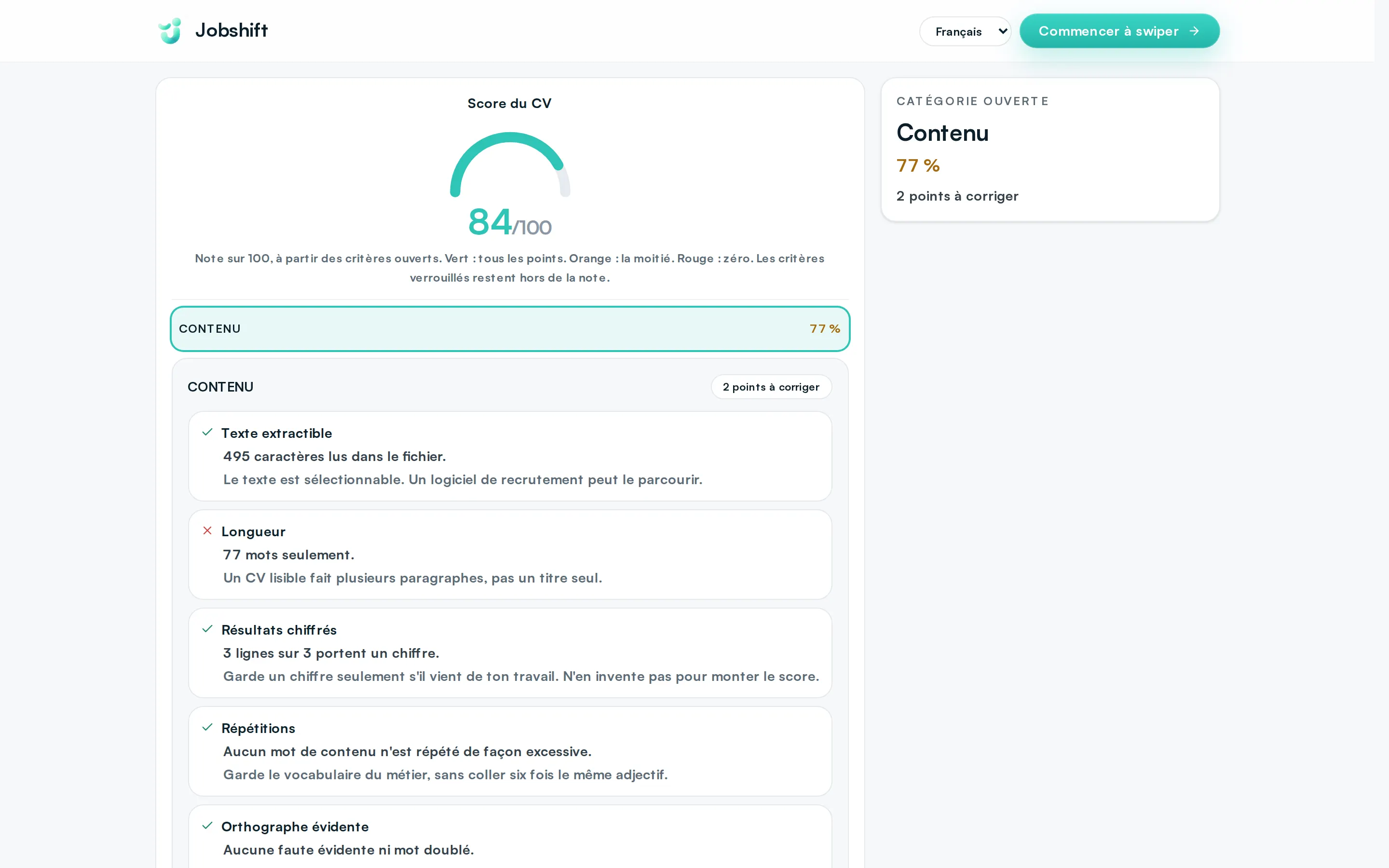
- Test how readable it is for recruitment software with our free ATS test: it checks that sections, job titles and keywords are read properly.
- Note each application (date, employer, role, resume version, reply) in our application tracker.
- After about fifteen targeted applications, look at where you lose chances. No reply: the top of the resume does not link to the role, so rework the title, the summary and the keywords. Interviews but no offer: the resume works, and it is interview preparation that needs strengthening.
- Change only one element at a time (title, summary or section order) so you know what makes the difference.
This threshold of about fifteen applications is a method marker, not a statistic: what matters is comparing versions on comparable postings.
Frequent mistakes and their effects
- Hiding the career change: the recruiter discovers the change in the interview, or spots a path that does not fit, and trust drops. Better to announce it in the title and the summary.
- Deleting every past role: a gap of several years, more worrying than a different trade.
- Changing job titles to bring them closer to the new trade: an inconsistency that a simple reference check can verify, and a problem of good faith.
- Listing qualities with no proof: the skills section does not stand out from those of hundreds of other resumes.
- Sending the same resume to every posting: the keywords of each posting are missing, and the resume surfaces poorly in ATS. Our guide to tailoring a resume to a job posting sets out the method.
- Justifying the change at length: the resume takes a defensive tone. One sentence is enough on the resume. The explanation comes in the letter and the interview.
- Aiming at a confirmed role with no experience of the trade: a series of refusals. Target junior roles, alternance or bridge roles.
Checklist before you send your resume
- The title reuses the title of the target role.
- The summary says in two or three lines the target job, what you bring and what you are looking for.
- The skills section contains three to five skills from the posting, each illustrated by a real achievement.
- The career-change training is high up, with the award date or the expected date.
- Past roles keep their real title and are rewritten from the angle of the new role.
- There is no unexplained period of more than a few months.
- The resume fits on one page, a page and a half at most for a long career.
- The resume passes the ATS test without losing information.
- The letter or the message explains your project in a few lines.
- Each send is noted with a follow-up date.
The letter and the message that go with the resume
The resume shows what you know how to do. The letter explains why you are changing and why this employer. In a career change, it is often the letter that removes the last doubts. Our guide to the cover letter for a career change gives the structure and an annotated example.
To go faster, our cover letter generator prepares a first version from the posting, and our application email generator the sending message. Before the interview, practise telling your path in two minutes with our interview simulator: the question "why this career change?" almost always comes up.
Apply during a career change with JobShift
Adapting a career-change resume to each posting takes time, especially when you are training at the same time or still in your old job. JobShift is a job and apprenticeship search app by swipe, designed in particular for juniors, apprentices, technical profiles and people changing career. For the detail, see how JobShift works.
- You import your resume once to create your candidate profile, or you create it with our free resume generator.
- You swipe the openings that match the target trade, your level and your search area, from the Jobs page.
- On each swipe right, JobShift prepares a resume and a cover letter adapted to the posting, then submits the application in the recruiter's ATS (notably Greenhouse and Lever). You can reread, edit or cancel each application before it is sent.
- Your applications are saved in your candidate space, with the employer, the role and the date.
Depending on your profile, see also JobShift for career change or JobShift for juniors if you are aiming at a first role in your new trade.
JobShift: apply during a career change with a resume and a letter adapted to each posting, reread before sending. Try JobShift for free
Related articles
FAQ
Which resume should you choose for a career change?
The skills-based resume or the combination resume. France Travail advises, for a career change, a skills-based resume to highlight transferable skills. The combination resume, which adds a chronology of roles, suits varied paths and reassures recruiters attached to dates. The chronological resume remains suitable if your new trade is close to the old one.
Should you mention your career change on your resume?
Yes. Announce the target job in the title and explain the change in one or two sentences in the summary. A recruiter who discovers the career change by themselves, through a path that does not fit, asks more questions than if they read it clearly presented.
How do you present old roles that have no link with the job?
Keep their real title and rewrite them from the angle of the new trade: two to four duties that link to the role, with quantified results when you can. Summarise in one line old roles or roles with no link, instead of deleting them, so you avoid a gap in the path.
Should you state your age on a career-change resume?
It is not required. Under the Code du travail (the French Labour Code), information requested from a candidate must have a direct and necessary link with the role, and age is among the discriminatory criteria forbidden in hiring that Service-Public recalls. You can therefore leave it out, and leave out a photo.
How long should a career-change resume be?
One page in most cases. For a long career, France Travail accepts one page, or a page and a half, focusing on the last ten years or on the experience useful to the project, and listing older jobs briefly.
How do you highlight a course in progress or a VAE on your resume?
Place it high on the resume, just after the skills, with the exact title of the certification, the organisation and the expected award date ("in progress, award expected in June 2027"). For a VAE, state the target certification and, where relevant, the skill blocks already validated, with their date.
Sources
- How to write an effective and striking resume, France Travail
- Resume: examples for presenting your professional experience, France Travail
- Transversal and transferable skills: how to make the most of them, France Travail
- How to write your resume when you have a long career behind you, France Travail
- The Mes compétences tool, France Travail
- Applicant to a job offer: permitted recruitment methods, Service-Public (page checked on 20 February 2026)
- Article L1221-6 of the Code du travail, Code du travail numérique
- Validation des acquis de l'expérience (VAE), Service-Public (page checked on 13 August 2026)