How to Tailor Your CV to a Job Offer: Practical Guide 2026
October 10, 2026

89% of UK recruiters first focus on professional experience, with over 70% prioritizing relevant industry experience. Tailoring your CV means reorganizing your achievements to match the job offer, not just adding keywords.
You might face this situation: the job interests you, your skills are close, but your last job title doesn’t exactly match the one requested. You change the title, copy phrases from the job ad, and send a CV that remains hard to read. The issue often isn’t your background but how clearly you present your evidence.
A tailored CV must succeed in two readings. It should be understandable by applicant tracking systems (ATS) and convincing for recruiters who quickly look for relevant experience, proven skills, and concrete results. The right approach is to align your vocabulary with the job ad without turning your CV into an artificial copy.
Contents
- Analyze the Job Ad Before Editing Your CV
- 5-Step Method to Tailor Your CV in the UK
- CV Before and After Example to Demonstrate Impact
- Tailoring Your CV for ATS and Human Recruiters
- Using Jobshift to Test and Refine Your CV
- Frequently Asked Questions About CV Tailoring
Analyze the Job Ad Before Editing Your CV
Many candidates open their CV before thoroughly reading the job ad. It should be the other way around. A chronological CV tells your story but may not address the employer’s priorities. To tailor your CV to a job offer, start by studying the language used in responsibilities, skills, and selection criteria.
The UK’s National Careers Service recommends identifying the three most repeated or prioritized skills and highlighting them rather than presenting your experience only chronologically. This approach aligns with UK recruitment trends: research shows 89% of employers request a CV, with over 70% focusing on relevant professional experience, and soft skills are prioritized by 57% of employers (National Careers Service on recruiter expectations).
Extract Key Signals
Copy the job ad into a working document and categorize information into four groups:
- Main responsibilities, such as managing schedules, handling client accounts, or organising meetings.
- Technical skills, for example Excel, project management, sales prospecting, or data analysis.
- Soft skills, like autonomy, teamwork, or customer service orientation.
- Requirements and conditions, including certifications, availability, willingness to travel, or language proficiency.
Not all terms carry equal weight. A skill repeated in the job title, responsibilities, and candidate profile deserves more emphasis than a quality mentioned only once at the end.
Practical rule: every skill you keep on your CV should link to an experience, task, or result you can discuss in an interview.
Turn Keywords into Proof
If the job ad asks for project management, don’t just list it. Find an example from your experience where you coordinated people, tracked schedules, prepared progress reports, or managed deliverables. Your goal is to demonstrate equivalent tasks, not claim you held the exact same job.
To understand how to structure your application around the targeted job, explore how Jobshift works, then ask yourself: which achievement truly proves this requirement?
5-Step Method to Tailor Your CV in the UK
Effective tailoring follows a reproducible process. It’s not about rewriting every line randomly but selecting elements that align your experience with the employer’s needs.
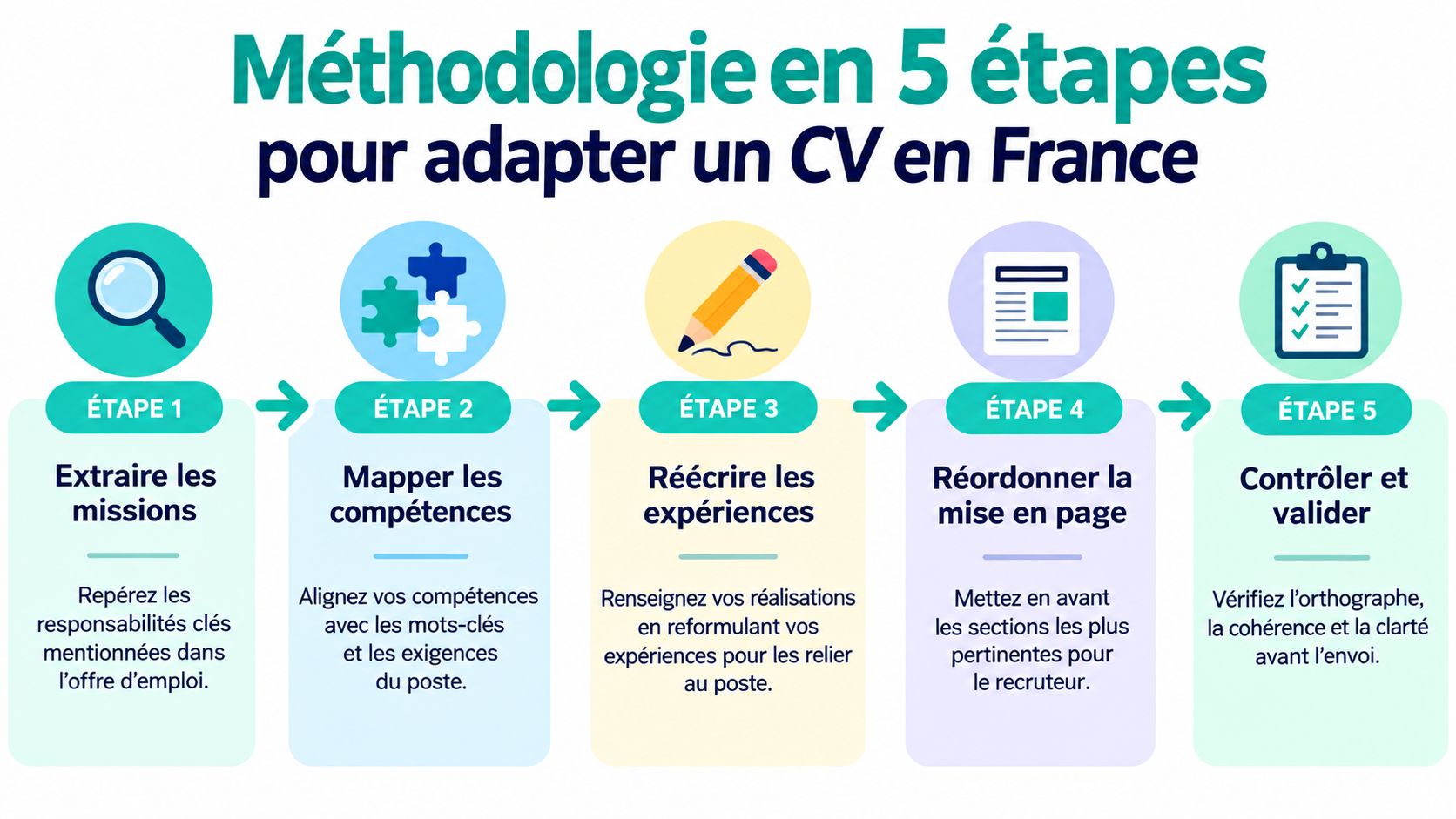
1. Extract Responsibilities and Requirements
Note down duties, tools, methods, certifications, and exact job titles. Separate must-haves from nice-to-haves. Employer preferences shouldn’t automatically become claimed skills.
2. Prioritize Key Points
Rank elements by repetition and placement in the ad. Skills in the title, first responsibilities, or mandatory criteria should guide your tailoring. Soft skills shouldn’t remain vague. For example, autonomy can be shown by a task done without supervision, teamwork by a collective achievement.
3. Rewrite Your Personal Statement
Your personal statement should target the job, not just summarise your last role. Use the job title if it honestly reflects your goal, then include the top three skills and a proof point.
For instance, a student who coordinated a charity project might say they organised meetings, delegated tasks, and tracked team progress. They shouldn’t call themselves a project manager if they never held that responsibility.
4. Reorder Experiences
Put first the experiences, projects, internships, or voluntary activities that directly match the job responsibilities. You can keep chronological order within each block, but the overall hierarchy should serve the job offer.
Career changers often need this translation work. An administrative assistant role may contain transferable skills like coordination, client relations, or operational follow-up if you highlight the relevant tasks.
5. Check Final Coherence
Compare the job title, personal statement, experiences, cover letter, and application form. The same skills should be named consistently without adding something in one document that you don’t support in another.
The National Careers Service recommends this extraction and verification approach, while Prospects advises integrating job-specific keywords naturally, including qualifications, software, and sector terms (Prospects advice on CV organisation).
CV Before and After Example to Demonstrate Impact
Recruiters don’t always judge your level from a task list. Your wording should link three elements: what you did, in what context, and with what result. Without this clarity, relevant experience can seem ordinary.
Here’s a fictional example. The job is for a project assistant requiring schedule tracking, meeting preparation, and information coordination. The candidate worked on a training project but their title doesn’t match.
Before
Student project participant
Helped organise the project.
Attended meetings.
Updated documents.
Worked in a team.
This version isn’t wrong but too general. The recruiter can’t tell if the candidate had real responsibility, what tools were used, or what was coordinated.
After
Training project, volunteer coordinator
Organised weekly meetings and prepared project tracking materials.
Updated team schedule on Trello and reminded participants before deadlines.
Centralised key information to facilitate action tracking and progress updates.
The second version uses vocabulary closer to the job ad without inventing a job. It keeps the training context, names the actual tool, and describes observable actions.
What Changes in Perception
The first text lists participation. The second shows identifiable contribution. This difference is crucial for students, recent graduates, and career changers whose job titles may not reflect transferable skills.
Numbers should only appear if accurate and verifiable. You can mention caseloads, deadlines, budgets, rates, or participant numbers if you actually tracked them. Otherwise, precise qualitative wording is better than invented results.
| Weak Wording | Defensible Wording |
|---|---|
| Client relationship management | Responded to client emails and directed queries to the right contact |
| Project tracking | Updated schedule and prepared progress reports |
| Excel proficiency | Created tracking spreadsheets using actual functions applied |
| Good team spirit | Coordinated information among team members |
The goal isn’t to make your CV seem more impressive but more verifiable.
Keep your real job titles, dates, and responsibility levels. You can clarify a task, select a relevant project, or reorder experiences, but don’t replace Trello with Jira or turn participation into full project management.
Tailoring Your CV for ATS and Human Recruiters
An ATS (applicant tracking system) extracts text from your CV and matches information to the job ad. In the UK, this matters: 50% of large companies use recruitment software for hiring professionals in 2024, according to Prospects (Prospects on ATS use).
This doesn’t mean software decides your worth. Your CV must be readable, match the job ad, and be clear for the recruiter who reviews it later.

Creating an ATS-Friendly File
Prefer:
- Standard sections, like Work Experience, Education, Skills, and Languages.
- Clear headings, using exact terms from the job ad when they fit your experience.
- Selectable text, avoiding essential info embedded in images.
- Consistent dates, with the same format for each role.
- Simple layout, without complex tables, hard-to-extract columns, or decorative text replacements.
If the ad mentions project management and you truly have that skill, keep the exact phrase. “Project coordination” might read well to humans but exact wording helps ATS match. Then add an example proving your experience.
Avoiding Keyword Stuffing
Repeating the same term in the title, personal statement, each experience, and skills list doesn’t make your CV stronger. Recruiters may see it as mechanical optimisation, especially if no achievement confirms the keyword.
Prospects notes that profiles listing 6 to 10 skills instead of 3 to 5 get about 40% more views, but this doesn’t guarantee interviews (Prospects on visible skills). The key is to select relevant skills and demonstrate them.
Practices are evolving with AI. Prospects reports 13% of mid-sized and large UK companies used AI tools in graduate recruitment in 2025, up from 6% the year before (Prospects on AI in recruitment). Assisted rewriting should always be reviewed carefully. If you can’t explain a skill in an interview, remove it.
For more on ATS-friendly structure and readability, see this guide on ATS filters in recruitment.
Using Jobshift to Test and Refine Your CV
Rewriting your CV for each job takes time, especially when comparing roles or with transferable experience. Tools can spot vocabulary gaps, missing tasks, or skills listed in the ad but absent in your CV.
Jobshift is a UK web app combining job discovery, AI-assisted CV, cover letter, and quick response personalisation, then streamlining applications. Use it as a testing partner, not a judge of your professional value.
Review Suggestions, Don’t Accept Automatically
Start by comparing your CV with a specific job ad. Review flagged gaps, then ask:
- Is this skill reflected in a real experience?
- Does the suggested wording accurately describe your responsibility level?
- Can you provide a concrete example in an interview?
Suggestions can help replace vague expressions with job ad vocabulary but should never push you to add unused software, unmeasured results, or misleading job titles.
For a targeted compatibility check, use the Jobshift ATS test. Then compare results with a human review: your CV must stay fluent, credible, and suitable for the UK context.
Frequently Asked Questions About CV Tailoring
Should I Use All Keywords from the Job Ad?
No. Use job titles, tools, methods, and certifications that truly match your experience. Prospects recommends specific keywords integrated naturally and consistently. An exhaustive list without proof weakens your application.
What If I Don’t Have the Exact Keyword?
Describe the equivalent task in its real context. Explain what you did, with which tools, and the outcome. You can clarify that your experience is transferable but don’t swap software names to create artificial matches.
Should I Change My Old Job Titles?
Keep official titles in your Work Experience section. You may add clarifications in parentheses or use your personal statement to present your goal, but don’t imply you held a different position.
How to Prove Soft Skills?
Link them to situations. “Autonomous” alone isn’t enough. Show a task done without supervision, a decision made within limits, or a problem solved. The National Careers Service highlights teamwork, autonomy, and rule compliance as essential for nearly all employers (National Careers Service data on sought skills).
What Personal Information Should I Remove?
Remove data unrelated to recruitment. The UK’s Information Commissioner’s Office (ICO) advises employers to collect only relevant and necessary information, and not to request National Insurance numbers before hiring (ICO guidance on recruitment data). Also check your contact details, mobility, availability, and public links before each application.
How Long Can Recruiters Keep My CV?
After an unsuccessful application, CVs and cover letters can typically be kept for up to two years from last contact to build talent pools, if candidates are informed and can object (ICO rules on recruitment data retention). Share only up-to-date professional information needed for the role.
Jobshift helps you find jobs, tailor your CV and cover letter to each role, and reduce repetitive application steps. Test your next version with a real job and discover Jobshift to make your search more targeted without giving up human review of every phrasing.
À propos de l'auteur
Chris Massie, cofondateur de l'appli Jobshift. Il travaille sur l'outil depuis sa première version : analyse du CV face à l'offre, réécriture automatique des blocs faibles, candidatures envoyées en mode swipe. Profil LinkedIn