Career change in France without a diploma: 20 accessible trades and funding
 Chris Massie
Jobshift
November 9, 2026 · 20 min read
Partager l'article
A career change in France without a prior diploma is possible: many trades are learned through a titre professionnel, a validation des acquis de l'expérience (VAE), or a state diploma that does not require a diploma at entry, and several French public schemes help pay for the training.
The aim of this guide is to raise your chances without dubious shortcuts and without hurting your credibility: a realistic trade, a recognised certification route and checked funding are worth more than ten applications sent at random.
You will find a way to compare the five access routes, a list of 20 trades whose entry does not depend on a prior diploma, the aid to know (CPF, AIF, POEI, projet de transition professionnelle), a six-step plan, three sample paths and a checklist before you start. The rules cited come from official sources, listed at the end. They change, so always check the update date on the source page. This guide describes French rules only. It does not restate the law of any other country.
In short
- "Without a diploma" does not mean "without a certification": most of the trades below are reached through a titre professionnel at level 3 (CAP equivalent), a state diploma or a professional card, prepared without a prior diploma.
- Five routes exist: certifying training, VAE, apprenticeship (apprentissage), pre-hire training (POEI) and state diplomas by selection. The right choice depends on your experience, your budget and your calendar.
- The VAE no longer requires one year of experience: experience directly related to the target certification is enough, even if it is short, according to Service-Public.
- The CPF is credited with 500 € a year (ceiling of 5 000 €) for work of at least half-time, and the AIF from France Travail can top up a CPF that is too low.
- The conseil en évolution professionnelle (CEP) is free and open to every working person: it is the best first meeting before you pay anything.
- Each trade has its own prerequisites (CNAPS authorisation for security, a driving licence for driving, selection for health): check them before you commit.
What "without a diploma" really means
No diploma at entry, a certification at the exit
When people look for a career change without a diploma, they often picture a job with no training at all. In practice, most accessible trades rest on a professional certification recorded in the répertoire national des certifications professionnelles (RNCP), run by France compétences. The entry condition is flexible. The certification is required by the employer or by the law.
The titre professionnel is the clearest example. Titres professionnels cover every sector (building, home services, transport, restaurants, retail, industry) and run from level 3 to level 6, according to the DREETS. Level 3 matches the CAP. Level 4 matches the baccalauréat. Level 5 matches the BTS or DUT. Level 6 matches a licence or a bachelor.
Three myths to drop
- "Without the bac, I am stuck": false for titres professionnels at level 3, and false for the state diplomas of aide-soignant or auxiliaire de puériculture, which are open with no diploma condition.
- "You need one year of experience for a VAE": that minimum length has been removed. The experience must still relate directly to the target certification.
- "My CPF is always enough": no. You sometimes need a top-up (employer, France Travail, region), and a course that costs more than your balance can still go ahead with extra funding.
What this changes in your job search
A recruiter rarely reads a career-change CV like a standard CV. They look for three things: a recent, recognised certification, transferable skills proved by concrete situations, and a coherent plan. Without a diploma, what reassures them is the line between your old trade, your training and the role you want.

Five ways to change career without a diploma: which one to choose?
Comparing the access routes
| Route | Who it is for | Strength | Point to watch |
|---|---|---|---|
| Certifying training (titre professionnel, CQP) | You are starting from zero in a new trade | Certification recorded in the RNCP, training split into blocks | You have to fund the course and follow a calendar |
| VAE | You already do all or part of the trade, even outside a job | Certification earned from your experience, without a full new course | The certifier judges the direct link with the certification |
| Apprentissage | You are at most 29 completed years old (35 in some cases) | You learn the trade in a company while preparing a diploma or a titre | You must find an employer and respect the age limit |
| POEI / AFPR (training before hire) | You are registered with France Travail and an employer is ready to hire you after training | Training aimed at one precise role, tied to a vacancy | It assumes a precise job offer, not a "general" career change |
| State diploma by selection (health, social care) | You are aiming at aide-soignant, auxiliaire de puériculture or accompagnant éducatif et social | No diploma required at entry | Selection on file and interview. Places are limited by the institute |
When to choose what
- You have no experience of the target trade: certifying training or, if you are under 30, apprentissage.
- You already do the trade without the titre (home help, warehouse work, kitchen commis): the VAE is often the most direct route, because it validates what you already know how to do.
- You are a jobseeker and a local employer is hiring: ask your France Travail adviser whether a POEI or an AFPR is possible on that vacancy.
- You are aiming at care or social support: prepare the file and the selection interview at the institute, because admission does not rest on a diploma.
- You are hesitating between two routes: book a CEP adviser, which is free, before you sign a quote.
Apprentissage after 30: a point to know
The maximum age to be an apprentice is 29 completed years. It can go up to 35 completed years in some cases (a new contract to reach a higher diploma level, a break that was not your choice, a temporary physical unfitness), and there is no limit for an apprentice recognised as a disabled worker (RQTH), according to Service-Public. Beyond that, people usually turn to certifying training, the VAE or the POEI. If you are in the age band, browse Jobshift alternance openings and estimate your pay with the alternance pay calculator.
20 trades you can enter without a prior diploma
The trades below share one point: you can prepare the certification without an entry diploma. The RNCP codes point to France compétences records, from the MonTitrePro comparison of titres professionnels (October 2026 referentials). Each referential states its prerequisites: read the sheet before you enrol.
Logistics and transport
- Agent magasinier (warehouse agent): titre professionnel at level 3 (RNCP 40216). Stock, receiving and parts picking.
- Préparateur de commandes en entrepôt (warehouse order picker): level 3 (RNCP 40498). Logistics picking and loading.
- Cariste d'entrepôt (warehouse forklift driver): level 3 (RNCP 40499). Driving handling machines in a warehouse.
- Conducteur livreur sur véhicule utilitaire léger (delivery driver on a light commercial vehicle): level 3 (RNCP 41633). Delivery in parcels, express or for a company.
- Conducteur du transport routier de marchandises sur porteur (road freight driver on a rigid truck): level 3 (RNCP 39796). Regional distribution in a heavy goods vehicle.
- Conducteur du transport routier de marchandises sur tous véhicules (road freight driver on all vehicles): level 3 (RNCP 39795). Articulated vehicles and long distance.
- Conducteur de transport en commun sur route (road public-transport driver): level 3 (RNCP 37878). Regular urban or interurban lines.
For driving trades, check the licence conditions in the referential. The CPF can fund preparation for the tests of heavy-vehicle categories (road freight or collective transport), according to Service-Public. Since 21 February 2026, the permis B is no longer fundable by the CPF except for employees who have a co-funded CPF.
Retail and restaurants
- Employé commercial (retail employee): level 3 (RNCP 37099). Shelf filling, replenishment, self-service.
- Commis de cuisine (kitchen commis): level 3 (RNCP 38722). Preparing dishes in a restaurant or a canteen.
- Employé polyvalent de restauration (multi-skilled restaurant employee): level 3 (RNCP 38663). Fast food or collective catering.
- Serveur en restauration (restaurant server): level 3 (RNCP 39534). Dining-room service, restaurant commis.
Cleaning, building and maintenance
- Agent de propreté et d'hygiène (cleaning and hygiene agent): level 3 (RNCP 37872). Cleaning companies, health establishments.
- Agent de maintenance des bâtiments (building maintenance agent): level 3 (RNCP 42031). Multi-trade upkeep of premises and multi-technical maintenance.
- Électricien d'équipement du bâtiment (building electrician): level 3 (RNCP 37442). Electrical installation in buildings.
Health, social care and early childhood
- Assistant de vie aux familles (ADVF): level 3 (RNCP 37715). Home help, support with everyday tasks. The France compétences sheet does not set an entry diploma. Afpa and other bodies indicate access without a school diploma, with reading, writing and arithmetic desired. Always check the conditions with the body you choose.
- Agent de service médico-social (medico-social service agent): level 3 (RNCP 41365). Hotel-style service and accommodation in an establishment.
- Aide-soignant: state diploma at level 4, open with no diploma condition from the age of 17, with selection on file and interview directly with the institute. Training lasts 1 540 hours (770 h of theory and 770 h of practice), according to the DREETS.
- Auxiliaire de puériculture: state diploma (DEAP) under the same admission order as the aide-soignant, open with no diploma condition (DREETS Nouvelle-Aquitaine), with a file and an interview, from the age of 17.
- Accompagnant éducatif et social: state diploma (DEAES) accessible with no diploma required at entry (order of 30 August 2021; Ministry of Solidarities: no prerequisite is required, a year-9 level is wished for the written part), with a file then a motivation interview, and several routes (initial training, apprentissage, continuing training).
Security
- Agent de sécurité privée (private security agent): no school diploma is required, but a prior authorisation from the CNAPS before entering training (including an administrative check), then a certifying course and a professional card, valid for 5 years. A French level at least equal to B1 is required for non-European foreign candidates who have no supporting document.
How to choose among these 20 trades
Do not choose only because no diploma is required. Cross four points: your physical and schedule constraints, employers within 45 minutes of home, the cost and length of the certification, and the room to progress. For openings near you, the Jobs page on Jobshift explains how offers matched to a profile are shown, and how to filter by trade and by area.
Funding a career change without a diploma
This section sums up the essential French schemes. For detailed amounts, read the 2026 guide to career-change aid in France. These schemes exist in France. This section does not describe funding rules outside France.
The CPF
The compte personnel de formation is credited with 500 € a year if you work at least half-time, with a ceiling of 5 000 €, according to Service-Public. It follows you even when you are unemployed. It funds certifying courses, support for the VAE, the bilan de compétences, or preparation for some driving licences. If the course costs more than your balance, you can look for a top-up from your employer, from Agefiph or from the regional council.
Another useful point: you do not need your employer's agreement for training followed outside working time. If it takes place during working time, the employer can refuse the request. The finance bill for 2027 also plans a rise in the compulsory flat participation: check the amount left to pay when you apply.
The aide individuelle à la formation (AIF) from France Travail
The AIF is for jobseekers registered with France Travail, whether they receive benefits or not. It can fund all or part of a course validated in your projet personnalisé d'accès à l'emploi (PPAE), alone or on top of other funding. It is not an automatic right: France Travail grants it after looking at your plan. The steps: ask the training body for a quote, validate it in your personal space, then wait for the decision.
The POEI and the AFPR
The préparation opérationnelle à l'emploi individuelle (POEI) funds, with the employer, training before hire. It assumes a precise job offer, with a contract of a minimum length (4 or 6 months depending on the case, according to France Travail). It is the fastest route for a local role, but it does not replace a broad career-change plan.
The projet de transition professionnelle (PTP)
The PTP lets an employee take leave to follow a certifying course in order to change trade, with pay maintained in some cases. For a CDI, you need 24 months of salaried work, consecutive or not, including 12 months in the current company, counted at the date you leave for training. The file is filed with Transitions Pro. Civil servants come under other types of leave.
The conseil en évolution professionnelle (CEP)
The CEP is a free, confidential and personal public service, open to every working person: employees, jobseekers, self-employed people, public-sector staff. It helps you clarify the plan, choose the route and look for funding. It is the first step we recommend before any paid enrolment.
A 6-step plan for a career change without a diploma
- Take stock of your situation: list your jobs, volunteer missions, family or association responsibilities, and what you already know how to do. This list will serve the VAE, the CV and the interview.
- Book a CEP adviser: set out two or three trades you are considering and ask which certifications and which funding apply in your region.
- Test the ground: call two or three employers, visit a training site, talk to someone who does the trade. One day of immersion avoids many costly mistakes.
- Choose the certification route (training, VAE, apprentissage, POEI or state diploma) and get comparable quotes.
- Build the funding: CPF balance, AIF or employer top-up, possible PTP. Get each agreement in writing before you start.
- Prepare the job search during the training: career-change CV, adapted letter, applications aimed at the employers of the placement. Do not start applying on the day of the diploma.
Three sample paths
These profiles are illustrative: they are not testimonials, and the results always depend on the local market and on your consistency.
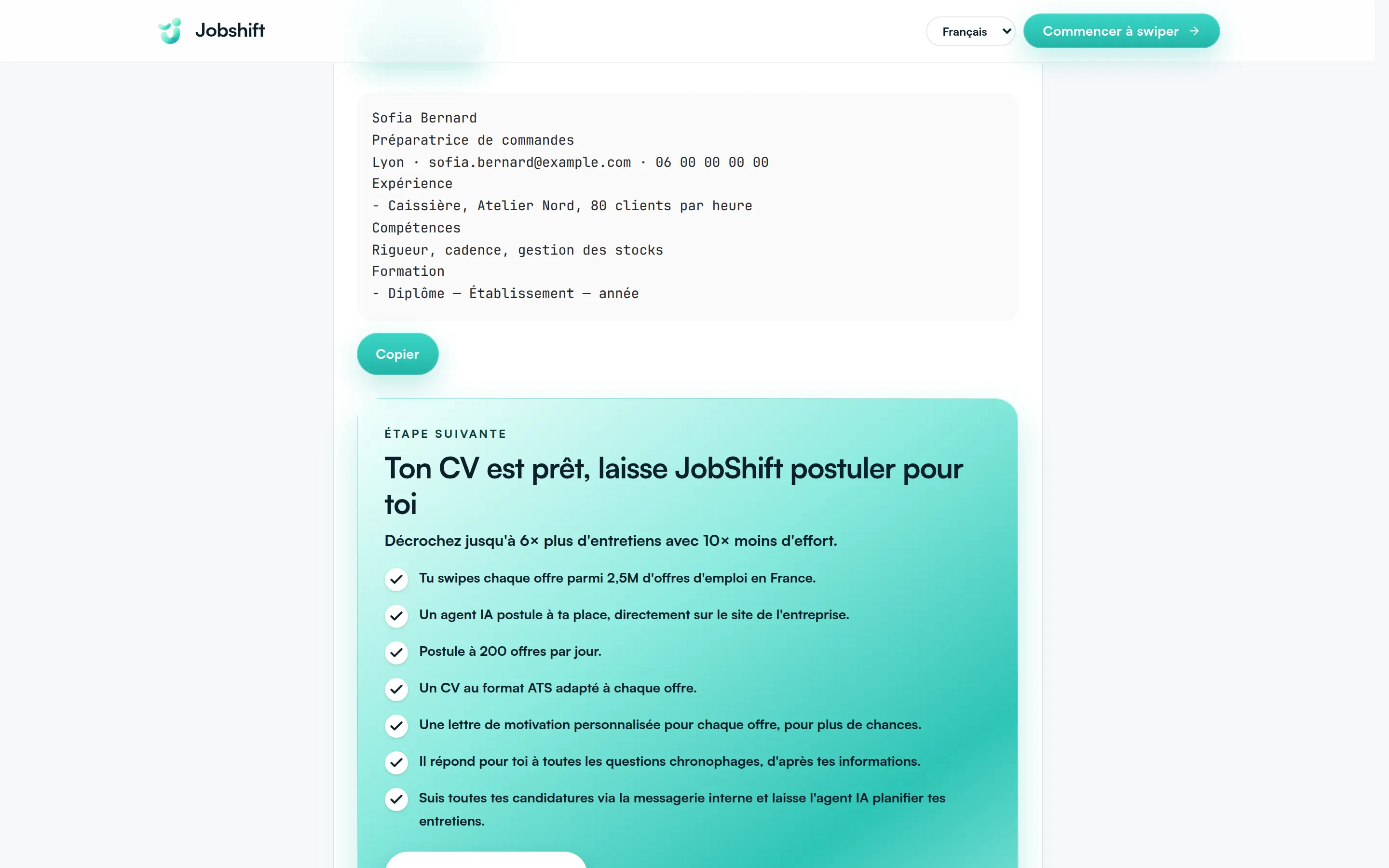
Sofia, 38, cashier, aiming at an order-picker role
Sofia works full time and has a credited CPF. She books a CEP adviser, finds a titre professionnel of préparateur de commandes en entrepôt (level 3) and asks for a quote. She funds the course with her CPF, topped up if needed, then applies to warehouses within 30 minutes of home. Her strength: the rigour and the pace learned on the till, which she puts as numbers in her CV.
Karim, 45, home helper without a titre, aiming at the VAE for assistant de vie aux familles
Karim has already done the trade for several years, without a certification. The VAE is therefore more direct than a full course: he describes his tasks in direct link with the referential, has the support funded by his CPF and presents his file to the jury. The result: a level 3 titre recorded in the RNCP, which he can put at the top of his CV.
Léa, 24, fast-food assistant, aiming at an apprentissage contract as commis de cuisine
Léa is under 29: apprentissage lets her train in a company while preparing a titre or a diploma. She looks at alternance openings, adapts her CV to the kitchen and prepares an interview centred on punctuality, hygiene and teamwork.
Showing a path without a diploma in your CV and your application
What a recruiter wants to see
Put at the top of the CV the titre you are aiming at and your certification (or "in preparation", with the expected date). Then detail your transferable skills as checkable situations: volume handled, teams supervised, standards applied, hours kept. Avoid vague promises. For the form, a one-page CV that recruitment software can read is more effective than a long document. This section stays short on purpose: a full CV guide would overlap a later article.
The free Jobshift tools to use
- CV generator to structure a career-change CV.
- ATS test to check that recruitment software can read your CV.
- Cover letter generator to adapt the letter to each role.
- Application email generator for speculative applications.
- Application tracker to follow up at the right time.
- Interview simulator to rehearse your answers, especially "why this change of trade?".
- Alternance pay calculator if you are aiming at apprentissage.
- CV translator into English if you are aiming at an international employer or a bilingual role.
To go further on the writing, read the cover letter for a career change (in French) and the guide how to write a resume without professional experience.
The mistakes that cost money in a career change
- Paying for a course before checking that it is recognised: check that the certification is recorded in the RNCP and eligible for the funding you want.
- Mixing up a trade "without a diploma" and a trade without prerequisites: the CNAPS authorisation, the driving licence or an institute's selection arrive early in the path.
- Aiming at a trade without knowing the real hours: one day of observation often settles the question.
- Resigning before the funding is secured: unemployment rights and the PTP depend on precise conditions, to check before you resign.
- Waiting for the diploma before you search: the employers of the placement are the first possible recruiters.
- Sending the CV of your old trade: without a rewrite, your transferable skills stay invisible.
Checklist before you start
- I know which trade I am aiming at and I have spoken to at least one person who does it.
- I have booked (or had a conversation with) a CEP adviser.
- I have checked the prerequisites of the trade: driving licence, CNAPS authorisation, institute selection.
- I have compared two quotes and checked that the certification is in the RNCP.
- I have costed my funding: CPF balance, AIF, employer, possible PTP.
- My CV puts the target certification and my transferable skills first.
- I have listed ten local employers to contact during the training.
Apply faster during the training with Jobshift
Jobshift is also for people changing career who want to apply to openings that match their new profile, without rewriting a full file for every role. See the page Jobshift for a career change.
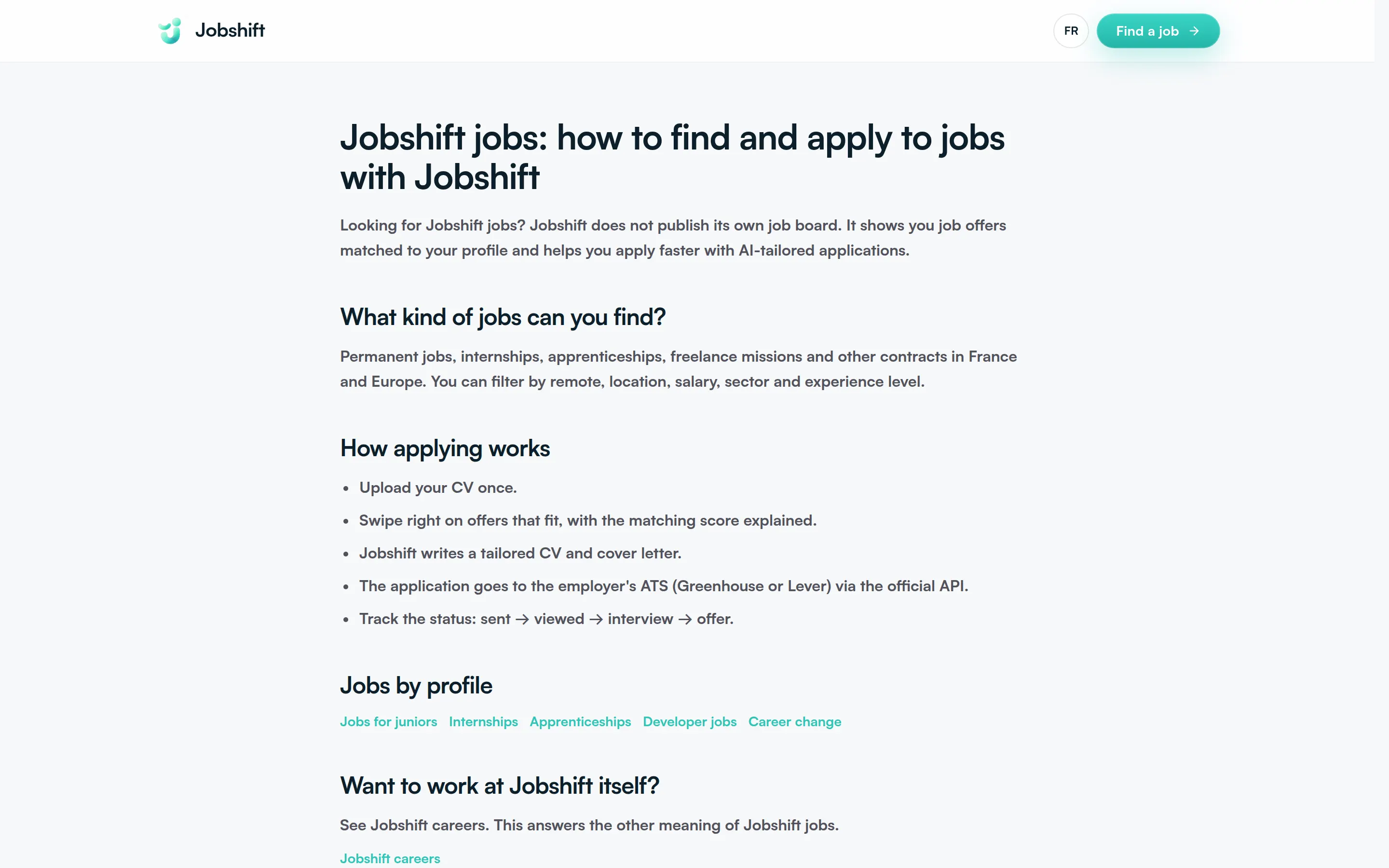
- You import your CV once to create your candidate profile.
- You swipe the openings that match your new trade and your search area.
- On each swipe right, Jobshift prepares a CV and a cover letter adapted to the opening, then submits the application in the recruiter's ATS (notably Greenhouse and Lever). You can reread, edit or cancel each application before it is sent.
- Your applications are saved in your candidate space, with the company, the role and the date.
To understand the full flow, see how Jobshift works.
Jobshift: apply to openings in your new trade in one swipe. Reread each application before it is sent. Try Jobshift for free
Related articles
- What career-change support is available in France in 2026?
- Cover letter for a career change (in French)
- How to Write a Resume Without Professional Experience
- "I can't find a job": 12 concrete reasons and a 30-day action plan
- How to find a job quickly without sending 200 CVs
FAQ
Can you change career without a diploma?
Yes. Many trades are reached through a titre professionnel at level 3 (CAP equivalent), a VAE or a state diploma open with no diploma condition, such as aide-soignant or auxiliaire de puériculture. What matters is the certification you obtain at the exit and the prerequisites of the trade.
Which trades can you do in a career change without a diploma?
Notably agent magasinier, préparateur de commandes, cariste, conducteur livreur, employé commercial, commis de cuisine, agent de propreté et d'hygiène, assistant de vie aux familles, agent de service médico-social, aide-soignant, auxiliaire de puériculture, accompagnant éducatif et social or agent de sécurité privée. Each trade has prerequisites (driving licence, CNAPS authorisation, selection) to check before you enrol.
How do you fund a career change without a diploma?
Combine the CPF (500 € a year for work of at least half-time, ceiling 5 000 €), the aide individuelle à la formation from France Travail for jobseekers, the POEI if an employer hires you after training and, for an employee, the projet de transition professionnelle through Transitions Pro. A CEP adviser helps you choose, for free. These are French schemes.
Is the VAE possible without a diploma and without one year of experience?
The VAE does not ask for a diploma. Since the reform, you no longer need to prove one year of experience: experience, even short, directly related to the target certification can be taken into account. It can be professional, voluntary, from a union or from a placement. Some certifications, such as the medical degree, are not open through the VAE.
Can you change career after 40 without a diploma?
Yes, but the routes differ. Apprentissage is reserved for people of at most 29 completed years (35 in some cases), so people usually turn to certifying training, the VAE or the POEI, funded by the CPF, the AIF or the projet de transition professionnelle. There is no age limit for an apprentice recognised as a disabled worker (RQTH).
Where do you start a career change without a diploma?
With a free meeting with a conseil en évolution professionnelle (CEP) adviser, after listing your experience and two or three trades you are considering. Test the ground (calls to employers, a visit to a training centre), then choose the certification route and the funding before you sign a quote.
Sources
- Validation des acquis de l'expérience (VAE), Service-Public
- Compte personnel de formation (CPF) of a private-sector employee, Service-Public
- Projet de transition professionnelle (PTP), Service-Public
- Conseil en évolution professionnelle (CEP), Service-Public
- Contrat d'apprentissage, Service-Public
- Aide individuelle à la formation (AIF), France Travail
- Préparation opérationnelle à l'emploi individuelle (POEI), France Travail
- Titres professionnels, DREETS Nouvelle-Aquitaine
- Diplôme d'État d'aide-soignant (DEAS), DREETS Nouvelle-Aquitaine
- Diplôme d'auxiliaire de puériculture (DEAP), DREETS Nouvelle-Aquitaine
- Training for private security trades, CNAPS
- Comparison of 47 titres professionnels (levels and RNCP codes), MonTitrePro
- VAE rules, France VAE
- Accompagnant éducatif et social (AES), solidarites.gouv.fr
- Order of 30 August 2021 on the DEAES (Official Journal, Praxis Alsace PDF)
- RNCP37715 Assistant de vie aux familles, France compétences
- ADVF training, Afpa