"I can't find a job": 12 concrete reasons and a 30-day action plan
 Chris Massie
Jobshift
October 30, 2026 · 12 min read

Partager l'article
If you cannot find a job despite your applications, the cause almost always sits at one of these three stages: your applications do not pass the first screen (no reply), your interviews do not convert (no offer), or you are not sending enough well-targeted applications for the odds to work in your favor. Identifying the stage that is blocked keeps you from changing everything at random.
This guide helps you make that diagnosis, lists the 12 most common reasons with the fix to apply for each one, then proposes a 30-day action plan. The goal is to maximize your chances of landing a role, without dubious shortcuts and without damaging your credibility with recruiters.
In short
- No reply at all: the problem comes from the resume, from how readable it is to recruitment software (ATS), or from how you target jobs.
- Interviews but no offer: the problem comes from preparation, from what you say, or from the fit with the role.
- Few applications sent: the problem comes from volume and organization, not from your profile.
- The method: each week, measure your applications, replies, and interviews, fix only one thing at a time, and keep the pace for 30 days.
- If it is urgent: widen the contract type (temporary agency work, fixed-term contracts, assignments), activate your network, and register with public support services.
Why can't I find a job? Start with the diagnosis
Before rewriting your resume for the fifth time, go back over your applications from the last two months and sort them. If you have written nothing down, start today with our free application tracking tool: without numbers, it is impossible to know what is blocked.
| What you observe | Stage that is blocked | What to fix first |
|---|---|---|
| No reply, or only automatic rejections | Application screening | Resume, ATS compatibility, fit with the jobs you chose |
| A few replies, but rarely an interview | The first conversation (HR call, shortlist) | Introduction pitch, salary expectations, availability |
| Interviews, but no offer | The interview | Preparation, concrete examples, questions asked of the recruiter |
| Very few applications sent each week | Volume | Organization, tools, time spent on the search |
Once you have identified your stage, focus on the matching reasons below.

The 12 reasons you cannot find a job
When your applications get no reply
1. Your resume is not read correctly by the ATS
Many companies receive applications in an ATS, software that records, sorts, and analyzes resumes. A resume in complex columns, with text inside images or original section headings, can be read badly: your experience or your skills then do not appear where the recruiter looks for them. Check your resume with our free ATS test and, if needed, start again from a simple structure with the resume generator.
2. Your resume does not reuse the words of the posting
The recruiter, like the software, looks for the skills and the titles in the ad. If the posting talks about "client relationship management" and your resume talks about "account follow-up", the link is not obvious. Adapt the job title, the hook, and the skills to each posting, while staying faithful to what you can actually do.
3. You are aiming at roles too far from your profile
Applying to jobs that ask for clearly more experience, a degree you do not have, or a tool you do not know produces few replies by default. Keep a share of "ambitious" applications, but make sure the majority match at least the essential required criteria of the ad.
4. You apply too late
On many jobs, recruiters start reviewing applications in the first days. An ad that has been up for several weeks often already has a list of candidates in interviews. Create alerts on your job sites and handle new postings first.
5. Your application looks like all the others
A generic cover letter ("I am writing to submit my application…") or an email with no link to the company goes unnoticed. Three or four specific sentences are worth more than a standard page. Our cover letter generator gives you a base adapted to the posting, to personalize afterward.
When you get replies but no interview
6. Your phone introduction is not ready
The first HR call is often short: they check your motivation, your availability, and the salary level you expect. Prepare a 60-second introduction (who you are, what you can do, what you are looking for) and a realistic salary range for the role and the region.
7. Your online profile contradicts your resume
Recruiters often look at your LinkedIn profile before calling you back. Job titles or dates that differ from your resume create doubt. Align the two, and add a photo and a clear profile headline.
When you get interviews without receiving an offer
8. Your answers lack concrete examples
"I am rigorous and motivated" convinces no one. For each key skill of the role, prepare a real situation: the context, what you did, the result you got. Practice out loud with our free interview simulator, which asks you questions adapted to the role you are targeting.
9. You do not know the company well enough
Not knowing what the company sells, who its clients are, or what the team you would join does is often disqualifying. Before each interview, read the site, the careers page, recent news, and the profiles of the people you will meet.
10. You do not ask questions and you do not follow up
An interview that ends with "No, I don't have any questions" leaves an impression of low interest. Prepare two or three questions about the role and the team, then send a short thank-you email within 24 hours. The application email generator can also write your follow-ups.
When the problem comes from the pace of your search
11. You send too few applications
When each application takes you an hour, it is hard to send more than a few a week, and each rejection weighs more. It is not your profile that is the issue, it is the time available. The solution is to reduce the time spent per application without lowering quality: a solid base resume, email templates, tools that adapt your file to the job.
12. You use only one channel
Replying only to the ads on a single site puts you in the same competition as everyone else. Combine ads, speculative applications, your network (former colleagues, former classmates, professional events), and job apps. Our comparison of the best apps for finding a job in 2026 helps you choose.
How long does it take to find a job?
There is no "normal" length that applies to everyone. The delay depends above all on your occupation and demand in that sector, on your geographic area and your mobility, on your level of experience, on the type of contract you are looking for, and on the time of year. A hiring process also includes several stages (application screening, interviews, decision, possible notice period), which lengthens the delay between the first application and the start date.
Rather than comparing yourself to an average, set markers you control: a number of targeted applications per week, a reply rate that you measure, and a checkpoint every two weeks to decide what you change. If you want official data on job-search duration in your region or your occupation, your France Travail adviser or the statistical publications of the Ministry of Labor (DARES) are the sources to consult.
I can't find a job: the 30-day action plan
This plan assumes you give your search regular time, ideally every business day. Adapt the volume to your situation, but keep the order of the steps.
Week 1: diagnose and rebuild the basics
- Go back over your past applications and fill in the diagnosis table above.
- Choose one or two target job titles, no more. A resume that aims at everything convinces no one.
- Rebuild a clear base resume, then run it through the ATS test.
- Align your LinkedIn profile with that resume.
- Prepare three templates: an application email, a short cover letter, and a follow-up email.
Week 2: increase the volume of targeted applications
- Create alerts on your job sites for your target titles.
- Set yourself a realistic weekly target of tailored applications, and keep it.
- Add a few speculative applications to companies you really want.
- Note every send in your application tracking tool: company, role, date, channel, planned follow-up date. The column template is in the job application tracker.
Week 3: activate your network and prepare interviews
- Contact a handful of people in your network directly and tell them precisely which role you are looking for.
- Follow up on applications sent more than a week ago.
- Prepare your concrete examples for each key skill and practice with the interview simulator.
Week 4: measure and correct
- Calculate your own ratios: replies relative to applications sent, interviews relative to replies.
- If replies stay rare, rework the resume and the targeting. If interviews do not lead anywhere, focus on preparation.
- Change only one thing at a time so you know what works, then start a new 30-day cycle.
For a shorter plan focused on speed, also see our method to find a job quickly.
Urgent job search: the options to activate right away
If you need income quickly, temporarily widen your search without giving up your main goal:
- Temporary agency work and short fixed-term contracts: temp agencies often hire for assignments that start quickly. It is also a way to gain recent experience to put on your resume.
- Occupations that are hiring in your local job market: logistics, sales, restaurants, personal services, depending on the region and the season.
- Your close network: say clearly around you that you are available immediately and for what type of role.
- Support services: France Travail for all job seekers, Apec for managers and recent graduates at bac+3 level and above, and missions locales for people under 26.
- An apprenticeship if you are a student or changing careers: it lets you be paid while you train. Browse our apprenticeship jobs by occupation.
Special cases: recent graduate, career change, no experience
- Recent graduate or no experience: put forward your internships, apprenticeships, projects, student jobs, and volunteer commitments as real experience. Our guide to writing a resume with no professional experience explains the method, and our Jobshift for juniors page presents the matching jobs.
- Career change: the recruiter needs to understand in one line why you are changing occupation and what transfers. Put an explicit hook at the top of the resume and the training you completed in a visible place. More advice on our career change page.
- After a long period without a job: explain the period briefly (training, personal project, family reason) without a long justification, and highlight what you did during that time.
Apply to more jobs, without spending your evenings on it, with Jobshift
Reason 11 is one of the easiest to fix: when each application takes less time, you can send more of them without sacrificing quality. That is what Jobshift does:
- You import your resume once to create your candidate profile.
- You swipe the jobs that match your occupation, your experience level, and your location preferences.
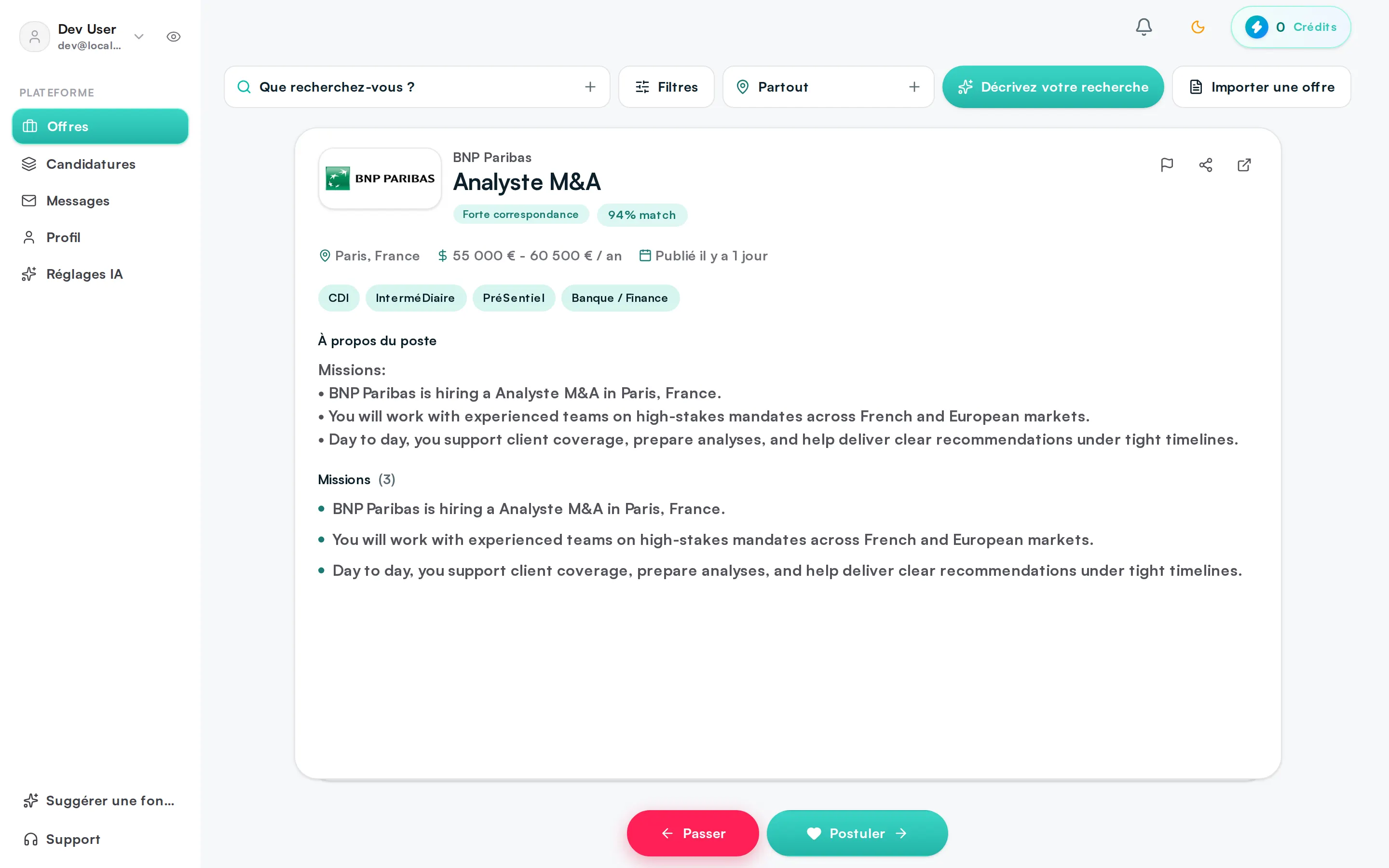
- On each swipe right, Jobshift prepares a resume and a cover letter tailored to the job, then submits the application into the recruiter's ATS (notably Greenhouse and Lever). You can review, edit, or cancel each application before it is sent.
- Your applications are recorded in your candidate space, with the company, the role, and the date.
The detail is explained on the how Jobshift works page.
Apply to 50 relevant jobs a week by swiping. Keep your energy for networking and interview preparation, and let Jobshift tailor your file to each job. Try Jobshift for free
FAQ
Why can't I find a job even though I send a lot of applications?
If you get no reply at all, the problem most often comes from the resume (badly read by recruitment software, or not adapted enough to the jobs) or from the choice of jobs, too far from your profile. Check how readable your resume is with an ATS test and reuse the keywords of the ads you are targeting.
How long does it take to find a job?
There is no standard length: it depends on the occupation, the region, experience, the type of contract, and the time of year. Set yourself weekly goals you control instead (number of targeted applications, follow-ups, interviews prepared) and take stock every two weeks.
What should you do when you have not found a job for months?
Diagnose the stage that is blocked (replies, interviews, or offers), fix only one thing at a time, increase the number of targeted applications, and combine several channels: ads, speculative applications, network, and job apps. Also get support from France Travail, Apec, or a mission locale depending on your profile.
How do you find a job in a hurry?
Temporarily widen your search to temporary agency work, short fixed-term contracts, and occupations that are hiring near you, tell your network that you are available immediately, and register with public support services.
Is my resume the problem if I get no reply?
That is the first lead to check. A resume with a complex layout can be misread by the ATS, and a generic resume does not reuse the skills the posting expects. Test it for free with the Jobshift ATS test, then adapt the hook and the skills to each ad.
Should you accept any job in the meantime?
It is not required, but a temporary role (temporary agency work, fixed-term contract, assignment) can secure an income, add recent experience to your resume, and widen your network. In parallel, keep applying to the roles that match your main goal.