Original resumes: 7 modern examples that still pass ATS filters
 Chris Massie
Jobshift
November 10, 2026 · 19 min read
Partager l'article
Original resumes can pass ATS filters, on one condition: originality belongs in the hierarchy, the colour, the typography and the content, never in elements the recruiting software cannot read (text in an image, columns, tables, skill gauges).
The aim is not to "trick" a piece of software. It is to raise your chances without dubious shortcuts and without hurting your credibility: a resume that stands out to the eye and stays fully readable by a machine is worth more than a spectacular visual whose text half disappears on import.
This guide answers a precise question: how do you keep a modern, personal resume when the application goes through an applicant tracking system (ATS, for Applicant Tracking System)? You will find the received ideas to drop, the two-layer method, 7 examples of original ATS-friendly resumes with a structure you can copy, the right level of boldness for your sector, a 6-step test plan and a checklist. The rules cited come from ATS vendor documentation and public bodies, listed at the end.
In short
- An original resume is not rejected because it is attractive: it becomes a problem when its text is unreadable for the parser (image, columns, tables, header or text box), according to Greenhouse documentation.
- Not everyone goes through an ATS: according to Apec (2025), cited by France Travail, 27% of all French companies use one, and 68 to 75% of large organisations.
- The sound method has two layers: a simple text layer (one column, standard headings, text PDF or Word) and a light design layer (colour, typography, rules, hierarchy) that carries no information.
- The highlight test is enough for a first check: if you cannot select the text of your PDF, the Lever parser probably cannot read it either.
- The level of originality depends on the role: high for design and communication, measured for marketing and tech, discreet for finance or legal.
- For a creative role, two versions: a sober version for the online form and a design version for the interview or a direct send, as France Travail advises.
Myths and reality: what an ATS actually reads in an original resume
Myth 1: "A designed resume is rejected automatically"
The reality is more technical. An ATS starts by extracting the text of the file to fill a candidate record: name, contact details, experience, education, skills, dates. France Travail sums it up this way: a badly formatted resume can cause reading errors, not because the tool is hostile, but because it cannot extract text from an image or a complex table.
Greenhouse, one of the most widely used ATS tools, publishes the formatting that makes a resume import fail or come back incomplete:
- spaced letters ("C O M M U N I C A T I O N") that the parser does not recognise as a word;
- graphics, photos or stylised text saved as an image;
- a resume sent as an image rather than as a document;
- complex tables, headers and footers;
- the name and contact details placed in the header, the footer or a text box;
- a column layout;
- no clear sections, and formatting that changes from one section to the next;
- abbreviated job titles ("Resp. comm." instead of "Responsable communication").
Greenhouse also states that it does not parse resumes over 2.5 MB, which happens quickly with high-definition images. In other words: originality is not the problem. Some layout choices are.
Myth 2: "Every company filters resumes with software"
According to Apec (2025), cited by France Travail, only 27% of all French companies use an ATS, a rate that rises to 68 to 75% in organisations with more than 200 employees. A 2024 HelloWork study says, for its part, that 80% of recruiters use or plan to use an ATS, against 64% in 2018. That figure includes intentions, not only current use.
Practical consequence: in a very small company, an agency or a start-up, your resume has a good chance of being opened directly by a person. In a large group that publishes openings through an online form, it will almost always pass through software before anyone reads it.
Myth 3: "A completely neutral resume is the only safe option"
Apec warns against the opposite trap: a resume that is too standardised, with no personal touch, does not then let you stand out with recruiters, especially in creative industries. Its formula: a sober resume, but not a soulless one.
The human reader always arrives after the software. The Ladders eye-tracking study (2018) measured a first screen of 7.4 seconds on average per resume. The resumes that were read best had a simple layout, clearly visible section and job titles, a hook at the top of the page and clear fonts. The ones read least well were crowded, with long sentences, several columns and little white space. Useful originality is the kind that guides the eye, not the kind that occupies it.

The two-layer method: where to put the originality
An original, ATS-friendly resume is built as two layers, one on top of the other.
Layer 1, the readable text: everything that must be understood (name, target role, contact details, experience, dates, skills, education) is selectable text, in a single column, with standard section headings.
Layer 2, the design: everything that makes the resume memorable (colour, title size and weight, rules, spacing, a strong hook, a link to a portfolio) contains no indispensable information. If the design disappears on import, nothing is missing.
What is risky, and the compatible version
| Original element | Risk on import | ATS-friendly version |
|---|---|---|
| Side column with contact and skills | Text mixed or ignored (column layout) | A single column; contact under the name, skills in their own section |
| Gauges, stars or skill percentages | Not readable, and ambiguous for a human | Levels in text: "English: fluent (C1)", "Figma: advanced" |
| Title or name as an image or stylised text | Graphic ignored by the parser | Text in a title font, larger and heavier |
| Icons instead of words (phone, email) | Information lost if the icon stands alone | Optional icon, always followed by the full text |
| Contact details in the header or a text box | Contact not imported into the record | Contact details in the body, first line under the name |
| Creative headings ("My journey") | Section not recognised | "Work experience", "Education", "Skills" |
| A table to align dates and roles | Partial reading | A line of text: "Role - Company - City - Month year to month year" |
| Spaced letters for a graphic effect | Word not recognised | Normal spacing, effect from size or colour |
| A very heavy photo, an illustrated background | File over 2.5 MB, not parsed by Greenhouse | Compressed image or none, plain background |
A word on two-column resumes
The advice diverges. France Travail recommends a single column and advises against tables and text boxes. Greenhouse lists a column layout among the causes of a failed import. HelloWork, on the contrary, relays its product manager's advice: a two-column resume, with a very short left column for contact. Our position: if the application goes through an online form, choose one column. Keep the two-column version for a direct send to a person.
7 examples of original ATS-friendly resumes
The examples below use fictional data. Each block shows the order of the text as a parser should read it. The design is described beside it. To start from a clean base, the free Jobshift resume generator produces exactly this text layer, which you then dress.
1. The one-column resume with a colour accent
Who it is for: most profiles, from sales to project manager. What is original: one colour, reused on the name, the section headings and a thin rule under each heading. The rest of the text is black or dark grey. What stays readable: all the content is text, in reading order.
CAMILLE ROUSSEAU
Digital communications officer
Lyon, France | camille.rousseau@exemple.fr | 06 00 00 00 00 | portfolio.exemple.fr

PROFILE
Digital communications officer with 4 years of experience in social networks and B2C content.

WORK EXPERIENCE
Digital communications officer - Maison Exemple - Lyon - March 2023 to today
- Ran the Instagram and LinkedIn editorial calendar
- Produced 3 seasonal campaigns with the product teamTip: one accent colour, contrasted enough to stay readable when printed in black and white.
2. The resume with expressive typography
Who it is for: creative or editorial profiles who want a visual signature without heavy graphics. What is original: a marked title font for the name and the job title, paired with a classic text font (Arial, Calibri, Garamond or Georgia, recommended by France Travail) for the body. What stays readable: the name and the title are real text, not a logo exported as an image.
Tip: do not space the letters to get a "poster" effect. Greenhouse says spaced letters stop the parser from recognising the word. Play with size, weight and colour instead.
3. The resume with a "Key achievements" band
Who it is for: salespeople, project managers, results-oriented profiles. What is original: under the hook, a block of three achievements in bold, separated from the rest by a very light background or a rule. The recruiter's eye lands there first. What stays readable: the block is a simple bullet list, not a table or a text box.
KEY ACHIEVEMENTS
- Opened 12 key accounts in 2025 (demonstration data)
- Redesigned the follow-up process, adopted by the team of 6 salespeople
- Trained 2 apprentices on the CRM toolsTip: put in this band only facts you can explain in an interview.
4. The portfolio resume with clickable links
Who it is for: graphic designers, UX/UI designers, developers, writers, photographers. What is original: the resume points to your work instead of showing it. Each project cited has a short, descriptive link. What stays readable: the links are written in plain text in the body of the document. HelloWork notes that an ATS can read links, such as a portfolio link, and that a well placed link is simpler to open than a QR code.
PROJECTS
Booking app redesign - Studio Exemple - 2025
User research, Figma mockups, tests with 8 users (fictional)
portfolio.exemple.fr/reservationTip: check each link just before you send, and prefer a readable address to a shortened link.
5. The "thread" resume as a text timeline
Who it is for: rich or atypical paths, people changing career. What is original: a chronological timeline, but built in text: one line per step, dates on the left in bold, the title and one line of result. A decorative vertical rule can sit beside the timeline, without holding any information. What stays readable: the dates follow a standard format. France Travail advises "Janvier 2020 - Décembre 2023" rather than "01/20 - 12/23".
Tip: choose one thread (a skill or a sector) and keep only the steps that serve it. Apec advises atypical profiles to avoid drowning an ATS in untargeted information and to show a clear job title.
6. The resume organised by projects
Who it is for: recent graduates, apprentices, developers, people changing career who have more projects than years of experience. What is original: a "Projects" section placed just after the profile, before experience, with the context, your role and the result for each project. What stays readable: "Projects" is a recognised section heading. Skills are also listed as text in a "Skills" section.
PROJECTS
Budget tracking application - personal project - 2025
React, Node.js, PostgreSQL; 40 test users (fictional)

SKILLS
JavaScript (advanced), React (advanced), SQL (intermediate), English: fluent (C1)Tip: if you are aiming at an alternance (a French apprenticeship contract), link each project to the missions in the opening and look at Jobshift alternance openings to pick up the recruiters' vocabulary.
7. The ATS resume plus creative resume pair
Who it is for: designers, art directors, communication, advertising and events roles. What is original: you keep a real graphic piece, without compromise, but you do not send it through an online form. What stays readable: the version filed in the ATS is a sober version, from the same content. This is the strategy France Travail recommends: a sober version for online applications, a creative version to present in an interview if your sector allows it.
Tip: the content (roles, dates, figures) must be strictly identical in both versions. A recruiter who compares two different resumes starts asking questions.
How much originality for your sector
Recruiters interviewed by L'Etudiant place the graphic resume first in communication, advertising, events, web design and marketing. Adecco, for its part, recalls that originality has value only when it fits the role: a classic resume for an accountant, a more assertive resume for a developer.
| Sector or role | Recommended level of originality | Examples that fit |
|---|---|---|
| Graphic design, UX/UI, art direction | High, with a pair of versions | 2, 4, 7 |
| Communication, advertising, events | High to medium | 1, 2, 4, 7 |
| Marketing, product, sales | Medium | 1, 3, 4 |
| Tech and development | Medium, centred on projects | 4, 6 |
| Finance, legal, audit, administration | Discreet | 1, 5 |
| Industry, logistics, health | Discreet, centred on clarity | 1, 3, 5 |
| Alternance, first job, career change | Medium | 3, 5, 6 |
For tech, the page Jobshift for developers explains how the app sorts openings. For a first role, see Jobshift for juniors. For a change of trade, Jobshift for a career change.
Method: build and test an original resume in 6 steps
- Write the text first, without layout: name, target role, contact details, profile, experience, education, skills, languages. Use the standard headings cited by France Travail: "Work experience", "Education", "Skills", "Languages", "Certifications".
- Reuse the vocabulary of the opening: job title, software, skills, written in full at least once ("SEO (search engine optimisation)"). Apec and HelloWork both advise weaving the words of the posting in naturally, without stuffing.
- Add the design layer in a word processor or a layout tool, in one column: one accent colour, one title font, rules, spacing.
- Export as a text PDF or as Word: Greenhouse accepts .doc, .docx, .pdf, .rtf and .txt files. Lever parses PDF and Word in particular, but not JPG or PNG images. Keep the file under 2.5 MB.
- Do the highlight test, then copy and paste: select all the text of the PDF and paste it into an empty document. If the order is broken or blocks are missing, the parser is likely to do the same.
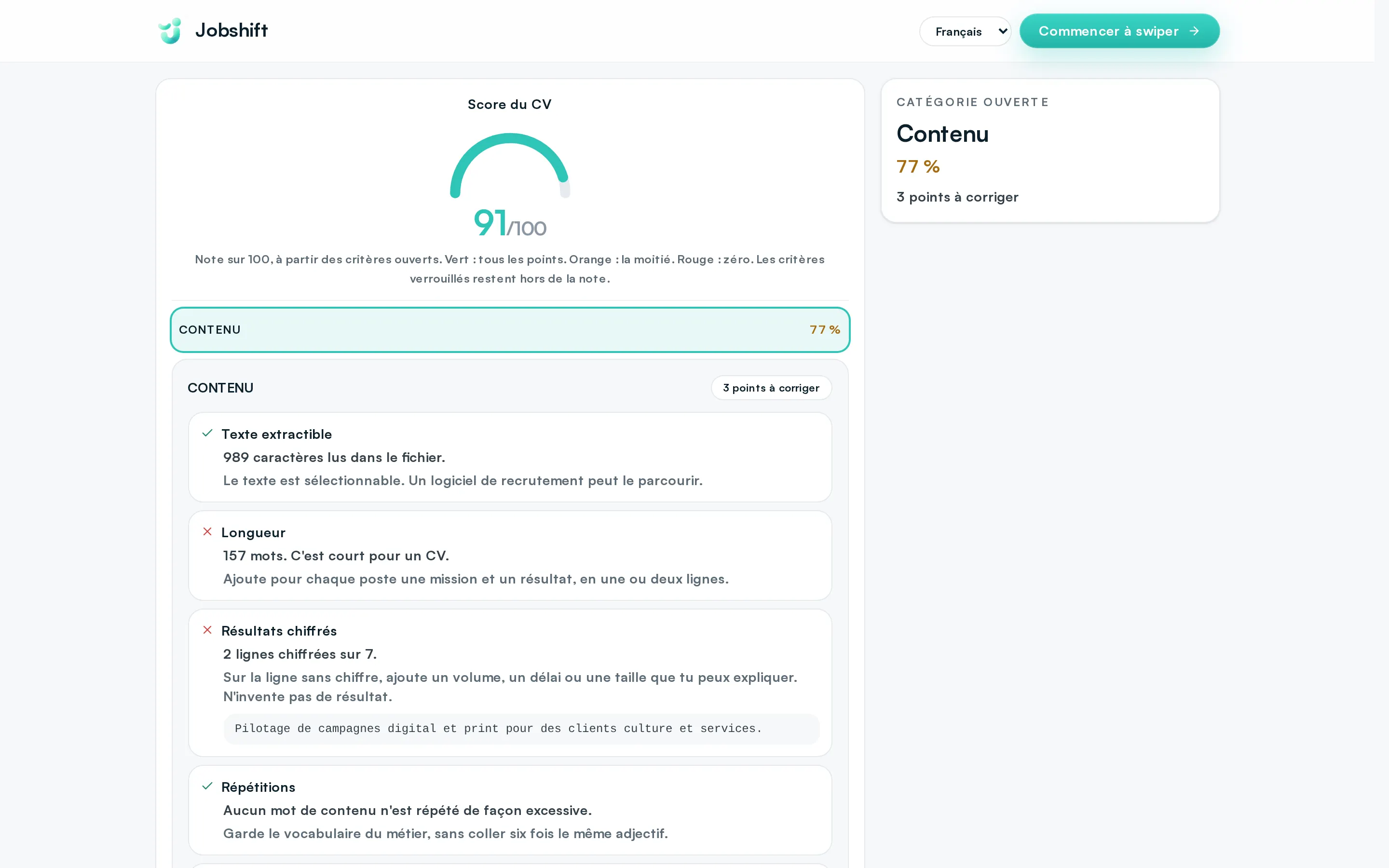
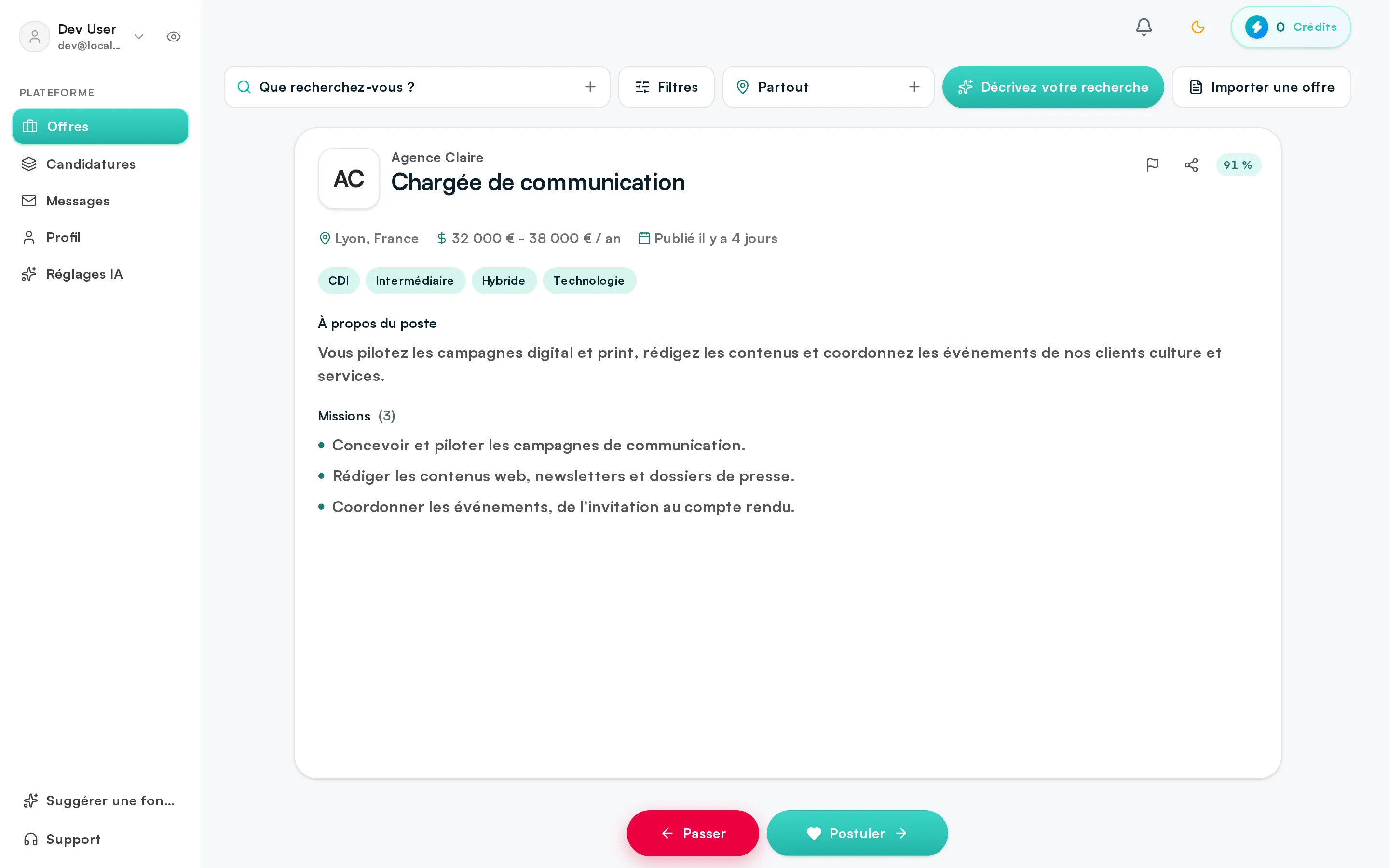
- Run the file through the test: the free Jobshift ATS test checks that the text is selectable and that the contact, the sections and the dates are present. It does not grade your career and it does not promise a reply: it checks whether the file can be read.
Once the resume is validated, complete the application with the other free Jobshift tools:
- Cover letter generator for a letter as readable as the resume.
- Application email generator for a direct send to an agency or a start-up.
- Resume translator into English if you are aiming at an international role: the English version must keep the same readable structure.
- Application tracker to note which version (sober or creative) was sent to whom.
- Interview simulator to prepare how you present your portfolio.
- Alternance pay calculator if your project resume is aimed at an apprenticeship contract.
The mistakes that make an original resume disappear
- Exporting the resume as an image or as a "flattened" PDF: impact, the parser reads nothing. Lever says it cannot extract information from image files.
- Putting the name and the phone number in the header: impact, the candidate record can be created without contact details, according to Greenhouse.
- Replacing words with icons: impact, skills and contact lost on import. For a human, a gauge at 80% does not say whether you are bilingual or merely comfortable.
- Abbreviating job titles: impact, a search by title fails. Greenhouse cites the example of "Sr. Account Exec" instead of "Senior Account Executive".
- Crowding the page: impact, the Ladders study associates crowded resumes, with several columns and little white space, with the weaker performances.
- Sending two versions that do not say the same thing: impact, doubt about your reliability at the interview.
Checklist before you send your original resume
- All the text of the PDF is selectable, and copy-paste comes out in the right order.
- The resume stays on a single column for applications filed online.
- Name, target role, email and phone are in the body of the document, at the top of the page.
- Section headings are standard: Work experience, Education, Skills, Languages.
- Skill and language levels are written as text, not as gauges.
- Dates follow one readable format (month and year).
- Job titles are written in full, with the vocabulary of the opening.
- The file is a text PDF or a Word file and weighs less than 2.5 MB.
- The links to the portfolio or the professional profile work.
- If you have a creative version, its content is identical to the sober version.
Apply with Jobshift without rewriting your resume for every opening
Jobshift is a job-search application for candidates who want to apply to targeted openings without rewriting a full file for every role: recent graduates, apprentices, developers, people changing career. To understand the full flow, see how Jobshift works.
- You import your resume once to create your candidate profile.
- You swipe the openings that match your trade and your search area, from the Jobs page.
- On each swipe right, Jobshift prepares a resume and a cover letter adapted to the opening, then submits the application in the recruiter's ATS (notably Greenhouse and Lever). You can reread, edit or cancel each application before it is sent.
- Your applications are saved in your candidate space, with the company, the role and the date.
Keep your creative version for direct sends and interviews. Jobshift handles the versions adapted to online forms.
Jobshift: apply in one swipe with a resume adapted to each opening, reread before it is sent. Try Jobshift for free
Related articles
- ATS-friendly resume: the template to copy and 3 filled-in examples
- Free ATS Resume: 10 Tools and Templates to Compare in 2026
- Best Online Resume Builders for 2026: Top 10 Tools to Create Your Professional CV
- Create an AI-Powered Resume: Step-by-Step Method to Stand Out
- How to Customize Your Resume for a Specific Job Offer
FAQ
Does an original resume pass ATS filters?
Yes, if its content stays readable text: one column, standard section headings, contact details in the body of the document and a text PDF or a Word file. Images, columns, tables, text boxes and spaced letters are what make the import fail, according to Greenhouse documentation, not the colour or the typography.
What is the best modern ATS-friendly resume format?
A one-column resume, with one accent colour, a marked title font and a body in a classic font, exported as a text PDF or as Word and weighing less than 2.5 MB. Greenhouse accepts .doc, .docx, .pdf, .rtf and .txt. Lever parses PDF and Word in particular, but not images.
Can ATS tools read resumes made in Canva?
It depends on the template you choose and on the export. Many graphic templates rely on columns, icons and text boxes, which Greenhouse cites among the causes of a failed import. Choose a one-column template, export as PDF, then check that you can highlight and copy-paste all the text in the right order.
Can you use colour and a photo on an ATS resume?
Colour is not a problem as long as the text stays text and the contrast is sufficient. For the photo, Greenhouse cites photos and graphics among the elements that can disturb the import, and it does not parse files over 2.5 MB: if you include one, compress it and put no information inside it.
Do you need two versions of your resume, one sober and one creative?
For creative trades, yes. France Travail advises a sober version for online applications, where the ATS comes in, and a creative version to present in an interview if your sector allows it. The content must stay identical in both versions.
How do you check whether an original resume is readable by an ATS?
Highlight the text of the PDF: if it cannot be selected, it is probably unreadable, as Lever indicates. Then copy-paste all the text into an empty document to check the reading order, and run the file through a free ATS test that checks the contact, the sections and the dates.
Sources
- Recruitment software (ATS): adapt your resume so you are easier to find, France Travail
- Unsuccessful resume parse, Greenhouse Support
- Supported formats for resumes, cover letters and other candidate uploads, Greenhouse Support
- Understanding resume parsing, Lever Help Center
- How to write an effective resume for ATS tools, Apec
- Atypical path: how to stay readable to recruiters, Apec
- How to optimise your resume for recruiters' ATS tools in 2025, HelloWork
- Eye-Tracking Study 2018, Ladders (PDF)
- The graphic resume: a paying trend?, L'Etudiant
- Recruiters, what to do with an original application?, Adecco