How to Find an Internship Quickly in 2026: A Practical Guide
October 13, 2026

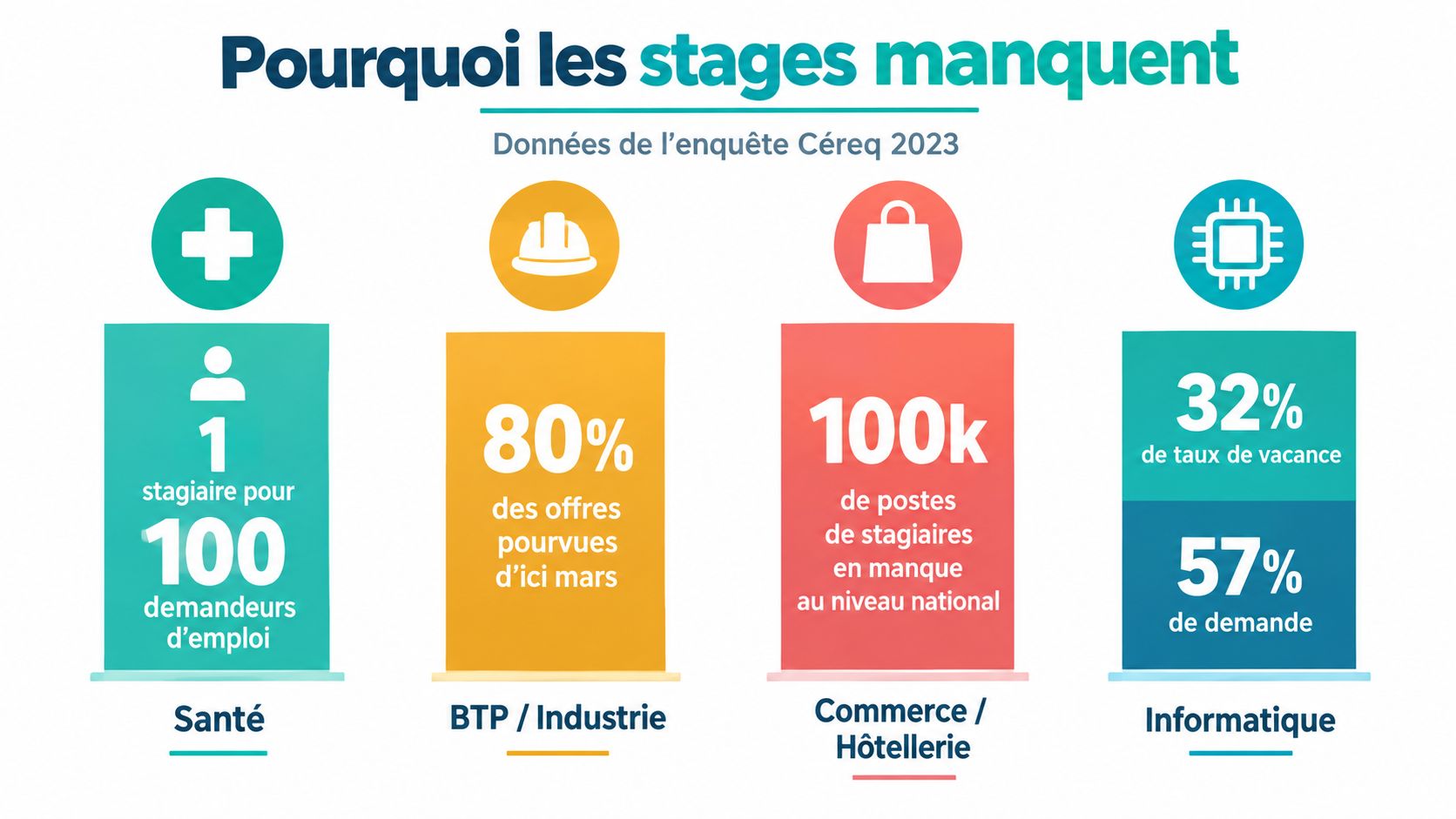
In the UK, around four in ten students secured their last internship through speculative applications, and 79% of 2010 graduates surveyed by the Higher Education Statistics Agency (HESA) had completed at least one internship during their studies (HESA Graduate Outcomes Survey). If you want to find an internship quickly, the real challenge isn’t the lack of opportunities but knowing how to spot the right ones before others do.
Contents
- Why You Can’t Find an Internship When There Are Plenty
- Three Channels to Activate from Day One
- Building Your Target List and Sorting Effectively
- Tailored CV vs Mass Applications: What the Numbers Say
- Administrative Pitfalls That Block Your Internship
- 30-Day Action Plan to Secure Your Internship
Why You Can’t Find an Internship When There Are Plenty
The issue in most internship searches isn’t the number of available positions. It’s slow filtering, followed by generic applications and passive waiting. Since speculative applications remain a major channel, it’s clear that those who move fastest are the ones who can identify a target quickly, not those who send the most CVs.
The Real Bottleneck
You waste time treating all offers as equal. An interesting listing that doesn’t fit your availability, university requirements, or schedule isn’t an opportunity—it’s a disguised dead end. Speed comes from effective filtering, not frantic activity.
Successful students don’t “apply more.” They open fewer offers but with better focus, quickly knowing what to discard. That’s the difference between active and scattered searching.
Practical rule: If an offer requires too much administrative consideration, it’s probably not a priority.
The Trap of Blind Applications
Sending the same email to twenty companies feels productive but creates no relevance signal. Recruiters see a standard message, a generic CV, and no proof you understand the role. This doesn’t speed things up; it just increases the chance of being ignored.
The right approach is to treat your search like a pipeline. Spot, filter, tailor, follow up, and track responses. It’s less glamorous than hoping for a “lucky break,” but much more effective.
Three Channels to Activate from Day One
Your first instinct shouldn’t be to pick between platforms, networks, or direct applications. Activate all three channels simultaneously because they serve different needs and rhythms. UK university data shows that the university careers service remains a key facilitator for internships, ahead of speculative applications (Universities UK).
The University Channel
Start with your careers service, placement office, alumni networks, and internal contacts familiar with internship agreements and timelines. This often saves time because administrative rules are already understood. A clear, simple email stating your course, duration, and dates is usually enough.
A useful message looks like this—straightforward, with a concrete need and a precise request. For example, you can say you’re looking for an internship in a specific area and are ready to send your CV and exact dates upon first contact.
Speculative Application
This is the most underestimated channel but often decisive. Target UK companies that fit your field, contact them with a short email explaining why their business aligns with your studies. The goal isn’t to “sell yourself,” but to show you understand where you can add value.
Clear subject line, brief opening sentence, available period, request for feedback. That’s the structure. Then follow up at 5 and 10 working days with polite, brief messages.
The Professional Network
Your network doesn’t replace applications; it shortens them. An alumnus, professor, lecturer, or someone you met at an event can save you multiple unnecessary back-and-forths. On LinkedIn, keep messages as simple as emails, not lengthy essays.
When a contact replies, ask for the right person’s name, realistic timing, and expected application format. This way, you avoid starting from scratch.
For more on quick job board and internship application strategies, see this guide on job boards and placements.
Building Your Target List and Sorting Effectively
A fast search works like a funnel, not a volume hunt. Contacting everyone wastes time on impossible leads, incompatible dates, or files that will stall due to agreement issues. A clean shortlist avoids waste and lets you track real progress.
Filter Before Reading
Before opening an offer, check five points: tasks, required skills, location, availability period, and agreement compatibility. If any block you, move on.
I recommend a quick, almost ruthless first pass—no more than 90 seconds per listing. Keep it if it fits; discard immediately if not.
Simple rule: an offer that doesn’t match your internship length or university requirements isn’t a “maybe later” lead. Remove it now.
Turn Reading into Sorting
Tools like Jobshift, with fast scanning logic, help classify offers without drowning in endless lists. The benefit isn’t a gimmick but focus—you decide faster what to pursue or drop. You also reduce decision fatigue, which slows down most poorly organized searches.
On optimizing a CV for a specific offer, the principle is the same. The document follows the target, not the other way around. Your CV then acts as both a filter and an application support, echoing the job’s vocabulary instead of piling generic elements.
Try this exercise: list companies and organisations aligned with your study level, geographic area, and internship duration. Then keep only those passing your five technical filters. This turns a fog of possibilities into an actionable workflow.
Tailored CV vs Mass Applications: What the Numbers Say
Numbers reveal a clear gap between quantity and outcome. In a UK survey of 463 students, 52% had sent at least 20 applications, but only 23% secured an internship in fewer than 10 applications, and 11% found one within a month (Prospects UK). In other words, speed doesn’t come from volume alone.
Why Copy-Paste Weighs Down Your Search
Mass applications rarely impress recruiters. They look like documents made for everyone but designed for no one. Conversely, targeted applications create an immediate sense of coherence.
The right balance isn’t rewriting everything each time. Keep reusable blocks for education, experience, and common skills. Then add a specific paragraph showing you understand the company’s mission and environment.
The Useful Version of a Tailored CV
Adapt your CV to the explicit keywords in the offer without inventing experience. If the listing mentions data analysis, prospecting, content creation, customer support, or development, your examples should reflect that. The recruiter must quickly see the link between the role and your profile.
The cover letter follows the same principle: a personalised hook, proof of understanding the need, then a clear request. It’s cleaner, more readable, and avoids the “applying everywhere” effect.
The smart move isn’t producing more documents but producing clearer documents for each target.
If you want to save time adapting without losing precision, you can also use a structured speculative application tool to keep your pace without starting from scratch each time.
Administrative Pitfalls That Block Your Internship
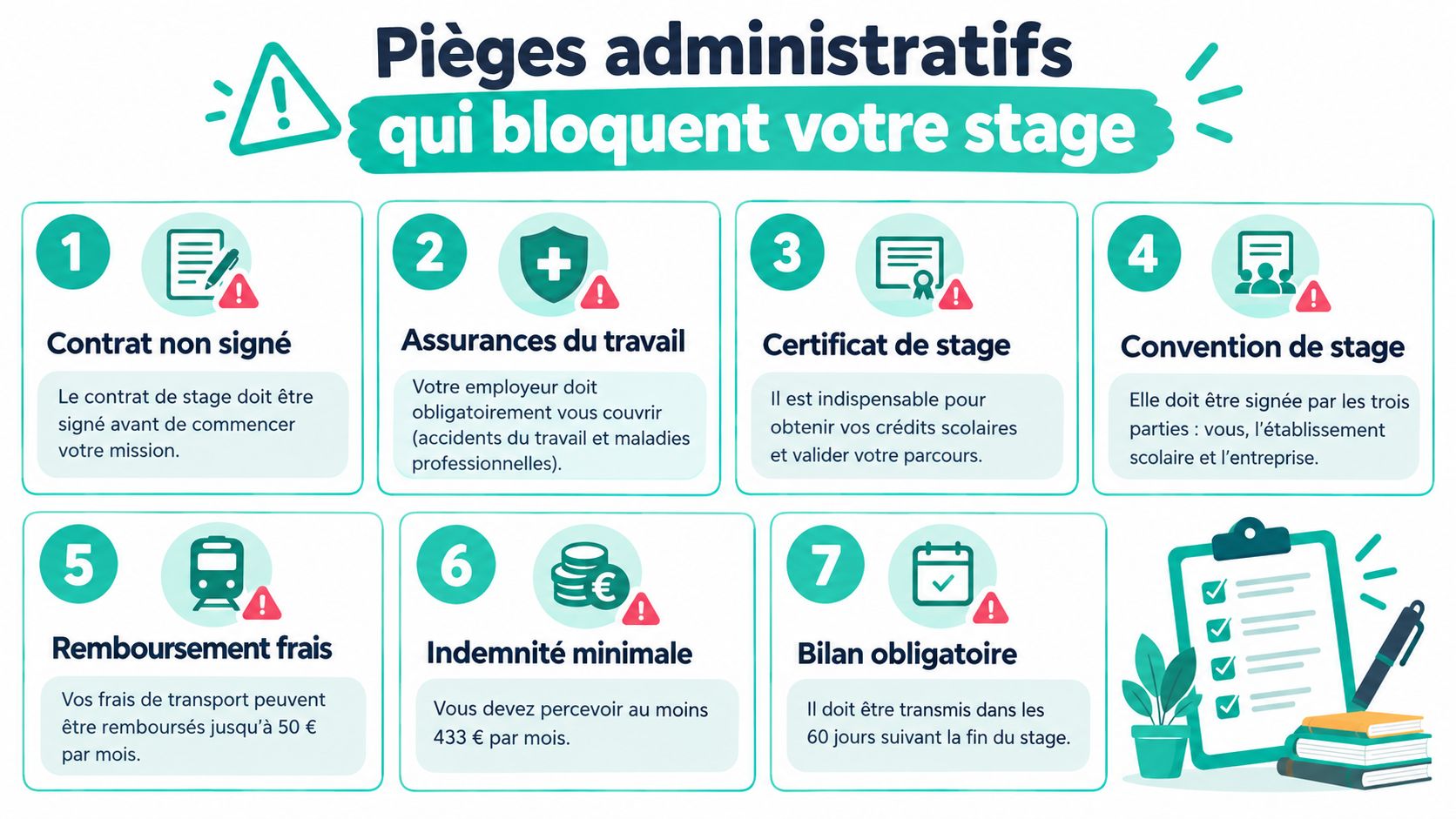
Many applications progress to a verbal yes, then stall on formalities. That’s where files get stuck, not in the search itself. UK internships require a signed agreement between the university, host organisation, and intern before starting, as outlined by UK government guidelines.
What to Check Right Away
The maximum duration is typically six months per host organisation per academic year, with a standard 35-hour week. Payment rules vary, but many UK internships are unpaid unless specified otherwise. Check the details early to avoid surprises.
These rules change everything. An offer may seem perfect in content but unusable once you consider agreements, duration, or payment. Waiting until the end to ask these questions wastes time and looks unprofessional.
Your Quick Check Before Applying
- Agreement readiness: ask who signs, timelines, and required documents upfront.
- Compatible duration: ensure the proposed period fits your academic calendar.
- Payment terms: never assume a long internship is handled like a short one.
- Weekly schedule clarity: avoid misunderstandings about working days.
- Exact dates: get them in writing before finalising any exchange.
A serious candidate doesn’t discover these points last minute. They treat them as sorting criteria, just like the role or sector. To maintain momentum without starting over at each follow-up, you can also use a structured speculative application tool.
30-Day Action Plan to Secure Your Internship
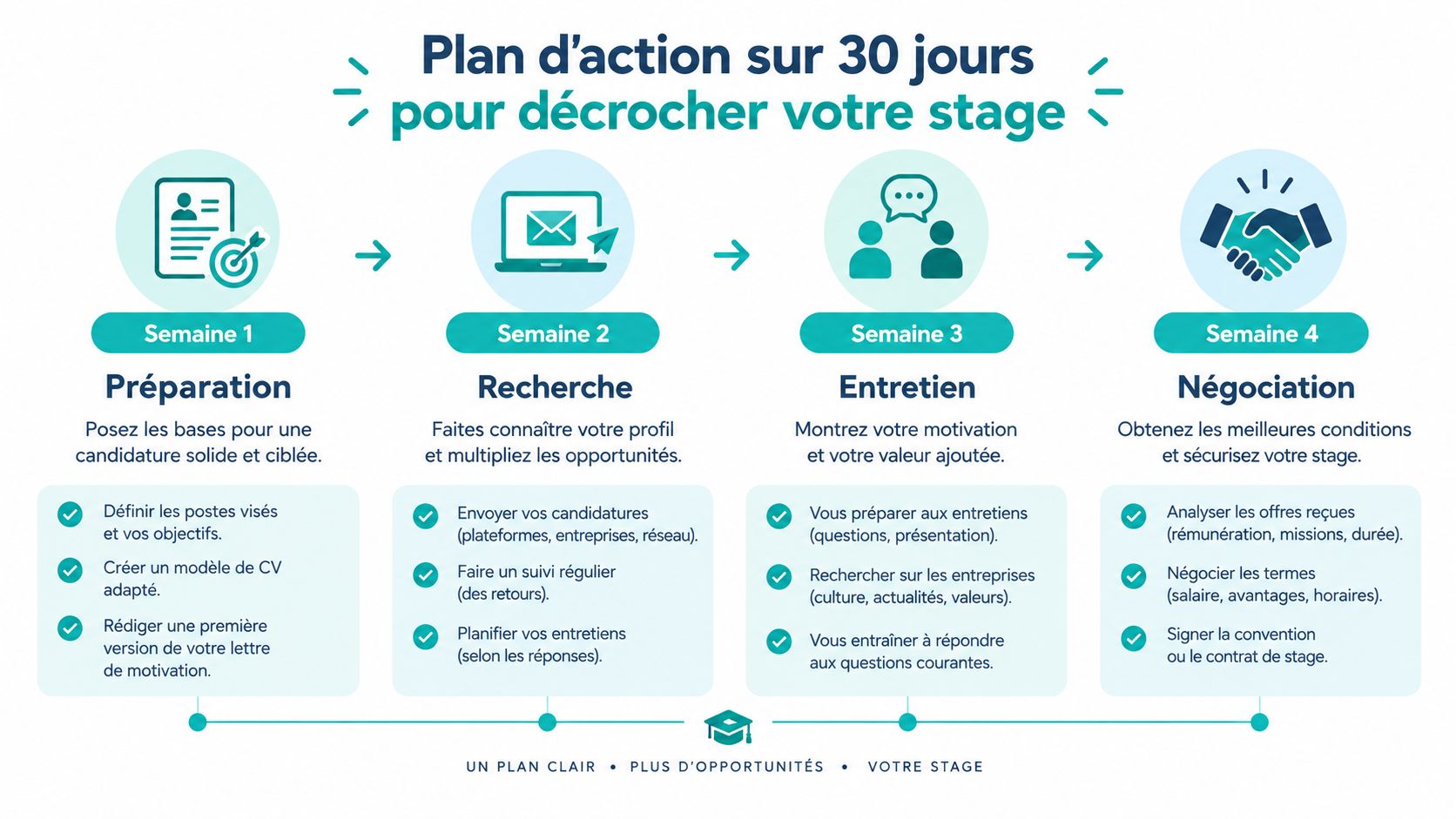
An internship is easier to secure when treated as a short project with checkpoints. The classic trap is two days of energy followed by five days of waiting. Instead, maintain a simple, measurable, and sustainable pace.
Week 1: Prepare the Machine
Define your two or three target roles, then prepare a one-page CV focused on relevant skills. Draft your email template, follow-up script, and sorting criteria list. This is also the week to open your search space, classify targets, and verify basic administrative elements.
Week 2: Apply Methodically
Move to targeted applications, aiming for a reasonable number of well-tailored dossiers rather than a barrage of identical messages. Track your submissions in a simple spreadsheet with key columns: date, channel, response, follow-up, interview. This lets you see what works and what stalls.
Week 3: Follow Up and Activate Your Network
Follow up on silent applications. Also contact alumni, professors, and people who might open doors. A well-crafted call or message often beats a tenth blind email.
Week 4: Secure the Next Steps
Prepare interviews, ask for mission details, and verify the offer still fits your constraints. If you receive a proposal, read it like a fixed-term contract, not a favour. You must know exactly what you’re accepting.
If you want to save time on the slowest part, Jobshift centralises offer discovery, document tailoring, and smoother application sending on its platform. You keep control of your targets but greatly reduce time spent rephrasing the same content repeatedly.
If you want to stop wasting evenings on poorly filtered listings, try Jobshift to organise your targets, tailor your applications, and move faster on internship offers. Start with Jobshift and treat your search like a project to manage, not a matter of luck.
À propos de l'auteur
Chris Massie, cofondateur de l'appli Jobshift. Il travaille sur l'outil depuis sa première version : analyse du CV face à l'offre, réécriture automatique des blocs faibles, candidatures envoyées en mode swipe. Profil LinkedIn