International Jobs in France 2026: Your Practical Guide
October 15, 2026
You’re finishing your Master’s degree in Lyon, your visa is about to expire, and your CV is already circulating between Paris, Brussels, and Casablanca. The real challenge isn’t just "finding a job in France," but understanding if your status, profession, and target region make your application feasible or just theoretically appealing.
In the international job market in France, many candidates waste time treating administrative requirements, the job market, and application channels as separate issues. In reality, you need to consider them together right away. Otherwise, you’ll apply to positions that will never open doors for you, even with a strong CV.
The right approach is simple. First, check if you’re allowed to work, then target professions truly in demand, and finally choose the channels that fit your profile. To help organize this efficiently, Jobshift can be your starting point to quickly filter job offers and tailor your applications.
Looking for International Jobs To or From France
You might fit the classic profile of an international graduate unsure about your next step. Should you stay in France, return home, or move to another European market? The question isn’t emotional but pragmatic. If your residence permit, the demand level of your profession, and your chosen region don’t align, your application will stall.
This is especially true for those who studied in France. France hosted 284,865 international students in 2024-2025, a 3% increase year-on-year and 13% over five years official ministry source. The talent pool exists, but access to the job market isn’t just about "having a French degree."
Simple rule: if you’re unsure whether a job offer is administratively accessible, don’t treat it as a priority option.
The best practice is to start from your actual situation. If you’re outside the EU, think work rights before your application message. If you’re in France, consider your residence permit timeline, not just the job posting. If you’re abroad, filter even more strictly to avoid unnecessary rejections.
Successful candidates don’t look for "international jobs" broadly. They target a country, region, contract type, and acceptable level of administrative friction. This clarity saves months of sending CVs that won’t lead anywhere.
Understanding the International Job Market in France Today
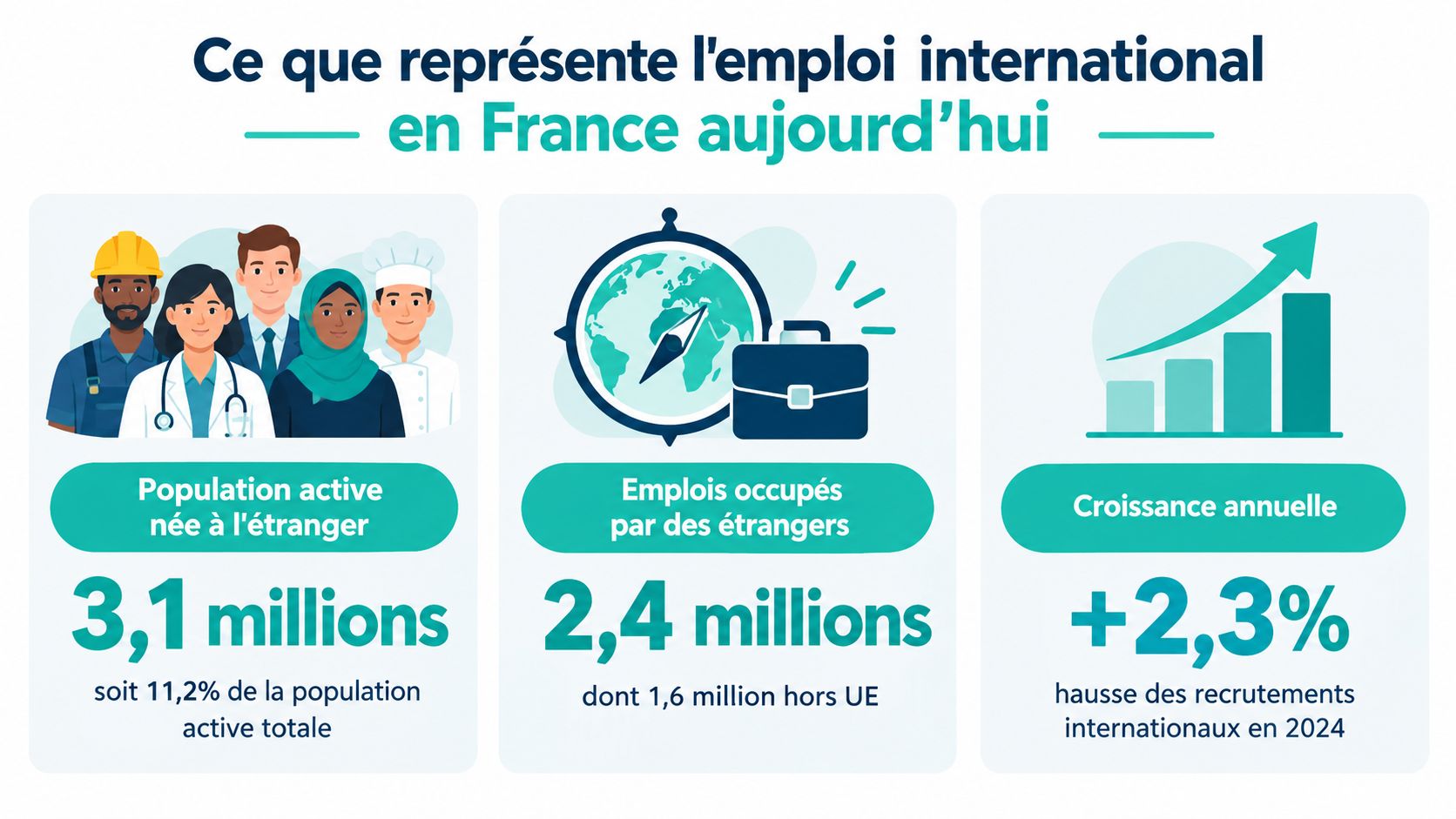
The French job market isn’t homogeneous. It combines a foreign-born population integrating long-term, temporary mobility like secondments, and qualified recruitments through very different channels. Knowing which sub-market you’re in is essential when seeking a job in France.
In 2024, foreign-born individuals made up 14.3% of the 15-64 age group in France, up from 13.5% in 2019, with an employment rate of 62.9%, a +2.6 point increase since 2019 INSEE. This isn’t just a statistic; it shows a growing share of active workers in France were born abroad, often with well-established local careers.
Seconded work tells a different story. In 2023, excluding transport, 237,100 employees from foreign companies were seconded at least once in France, averaging 97 days DARES. Construction accounted for 42% and industry 31%. This remained a minority nationally, with a usage rate of 0.4% of private non-seconded salaried employment DARES.
Three Distinct Realities Not to Confuse
- Long-term settlement for graduates, employees, and candidates already integrated locally.
- Short or cross-border assignments, often sector-specific and administrative.
- Targeted qualified recruitment, depending on both profession and status.
An excellent international CV can remain invisible if submitted under the wrong administrative category.
That’s why good targeting starts with a simple question: Are you seeking long-term entry into the French job market, a short assignment, or a position requiring a specific employer procedure? Once answered, the rest becomes much more rational.
Work Visas and Permits Explained
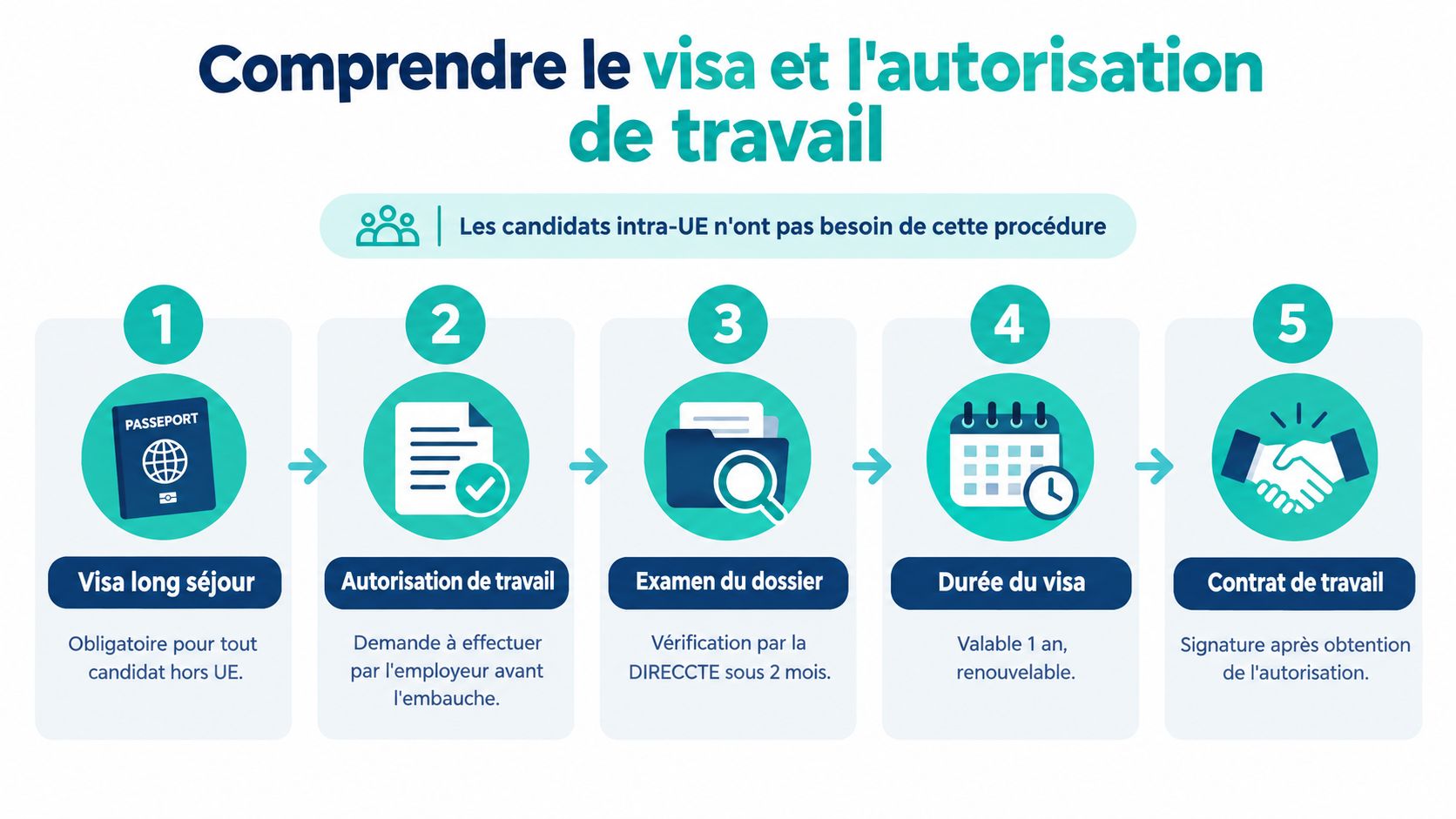
If you’re a non-EU, EEA, or Swiss national, assume you generally need a work permit, unless exempt due to your visa or residence permit Service-Public. The employer usually handles the application. This is the first filter to check because it determines if the offer is truly accessible or just attractive on paper.
In the standard procedure, the job offer must have been published for three consecutive weeks within the six months before the application. Practically, a listing can be serious yet hard to sponsor. Before applying, check if the employer is experienced with these procedures.
Key Exception to Know
The French list of in-demand professions, updated by a decree effective May 23, 2025, changes the game when the profession and geographic area appear on the ministry’s published list. In this case, the labor market situation cannot be opposed to the work permit request. Employers can hire non-EU foreign workers without prior three-week publication, per the ministry’s decree. This logic is both legal and geographic.
Many candidates err here by reasoning only by profession, while the procedure depends on the profession + region pair. A position may be easier to fill in Île-de-France than in Brittany, or vice versa, depending on the applicable list.
What to Check Before Applying
- Your current status: student, employee, job seeker, or candidate abroad.
- Offer compatibility: with your work rights and the employer’s ability to apply.
- Recruitment channel: not all offers go through the same HR circuits.
If you’re already in France, apply with your administrative situation in mind. If abroad, quickly exclude listings requiring immediate presence without sponsorship. This filtering saves weeks of automatic rejections.
Identifying In-Demand Professions and Regions
Searching for "sectors that hire" isn’t enough. For international jobs in France, you must cross three concrete filters: profession, region, and administrative status. This trio decides if your application stands a chance.
Needs are real. The 2025 Labor Demand Survey counts 2.43 million recruitment projects in France, with 50.1% of hires considered difficult by employers, according to France Travail. Some professions exceed 80% difficult hires, notably roofers, carpenters, bodyworkers, and boilermaking technicians. Medical and paramedical professions also remain under pressure.
Recruitment Difficulty Rates by Profession
| Profession Group | Difficulty Rate | Relevance for International Candidates |
|---|---|---|
| Roofers | 82.4% | High, if you have experience and the right location |
| Carpenters | 78.3% | High, especially with proof of skills |
| Bodyworkers | 80.8% | High, for technically ready profiles |
| Boilermaking Technicians | 80.2% | High, if your application is solid and clear |
| Machining Technicians | 79.8% | High, especially in industry |
| Doctors, Nurses, Midwives | 67.3% | High, but with regulatory constraints |
| Pharmacists | 70.9% | High, but highly regulated |
The real sorting happens by region. The in-demand professions list varies across regions, which matters for work permits. According to the Ministry of Labor, regional lists range from 23 professions in Brittany to 41 in Île-de-France. Same job, same profile, sometimes same company, but administrative ease changes by territory.
For a non-EU candidate, this reading is decisive. If your profession is on the regional list, you have a real advantage. If not, you need an employer willing to handle a heavier application. In both cases, targeting the right region beats applying everywhere without filtering.
First, look for regions where your profession is both in demand and administratively useful. Targeting "France in general" wastes time.
Also consider the application channel. An in-demand profession isn’t marketed the same way on LinkedIn, direct applications, or through employers already hiring foreign profiles. For technical jobs, regions with high demand often yield the best results. For healthcare, also verify diploma recognition and practice authorization before pushing further.
Effective Job Search Channels
International profiles save time by choosing channels based on status, not by applying everywhere. If you’re outside the EU, start with offers clearly mentioning mobility, relocation, or international recruitment. If in France, filter for listings accepting status changes or ongoing permits.
General job boards mainly help spot opportunities. LinkedIn, Indeed, and Welcome to the Jungle remain useful for monitoring but don’t always indicate if employers accept international applications. For that, turn to more targeted channels like EURES, specialized job fairs, alumni networks, targeted spontaneous applications, and companies already posting for foreign profiles.
Choosing the Right Channel for Your Situation
- From within France, focus on LinkedIn, direct applications, and local job fairs.
- From abroad, start with EURES, sector events, and mobility programs.
- If you’re a junior, leverage alumni networks and direct contacts, not just volume of listings.
- If targeting a short assignment, prioritize companies experienced with international profiles.
The channel also depends on the profession. Technical roles are found faster via companies already hiring in your field than through broad searches. For healthcare, check diploma, practice authorization, and status before proceeding. For bulk applications, a sorting tool like Jobshift helps keep offers clear and priorities straight.
Targeted spontaneous applications remain underrated. They work when aimed at a specific company, clear need, and identifiable contact. For in-demand professions, direct contact often makes the difference, especially if your profile fits the local market.
Keep it simple: broad monitoring to catch offers, a specialized channel to filter by status, then direct contact to speed up responses. This beats applying everywhere without filtering.
Tailoring Your CV and Application to French Standards
French recruiters read quickly. If your CV is too long, too academic, or too "international" in format, they might miss the key info. Content matters, but first impressions often decide within the first minute.
Keep your foreign experience but avoid word-for-word translation. Keep original degree or job titles, then add a clear French equivalent for recruiters. For cover letters, be direct, show what you bring, and skip a full life story. To move from generic ads to targeted applications, see our guide on adapting your CV to a job offer.
Key Adjustments That Make a Difference
- Readable CV, usually one page with clear sections.
- Contextualized foreign experience, with original title and French equivalent.
- Clarified diplomas, indicating level or equivalence if possible.
- Clearly stated administrative status, especially if you have a permit or application in progress.
Language matters too. Depending on the job, French is required, but some environments accept English, especially in large groups or international startups. Don’t be vague. If your French is intermediate, say so honestly and explain how you compensate.
What to Verify Before Submitting
Recruiters prefer a clear file with acknowledged constraints over a brilliant CV hiding administrative issues.
- Document title, clear and professional.
- French level, stated without exaggeration.
- Work situation, open, in progress, or to be secured.
- Job fit, matching your real availability.
Your application should clearly show your status, language level, and flexibility regarding the position. If recruiters have to guess your status, you waste time.
Your Application Checklist
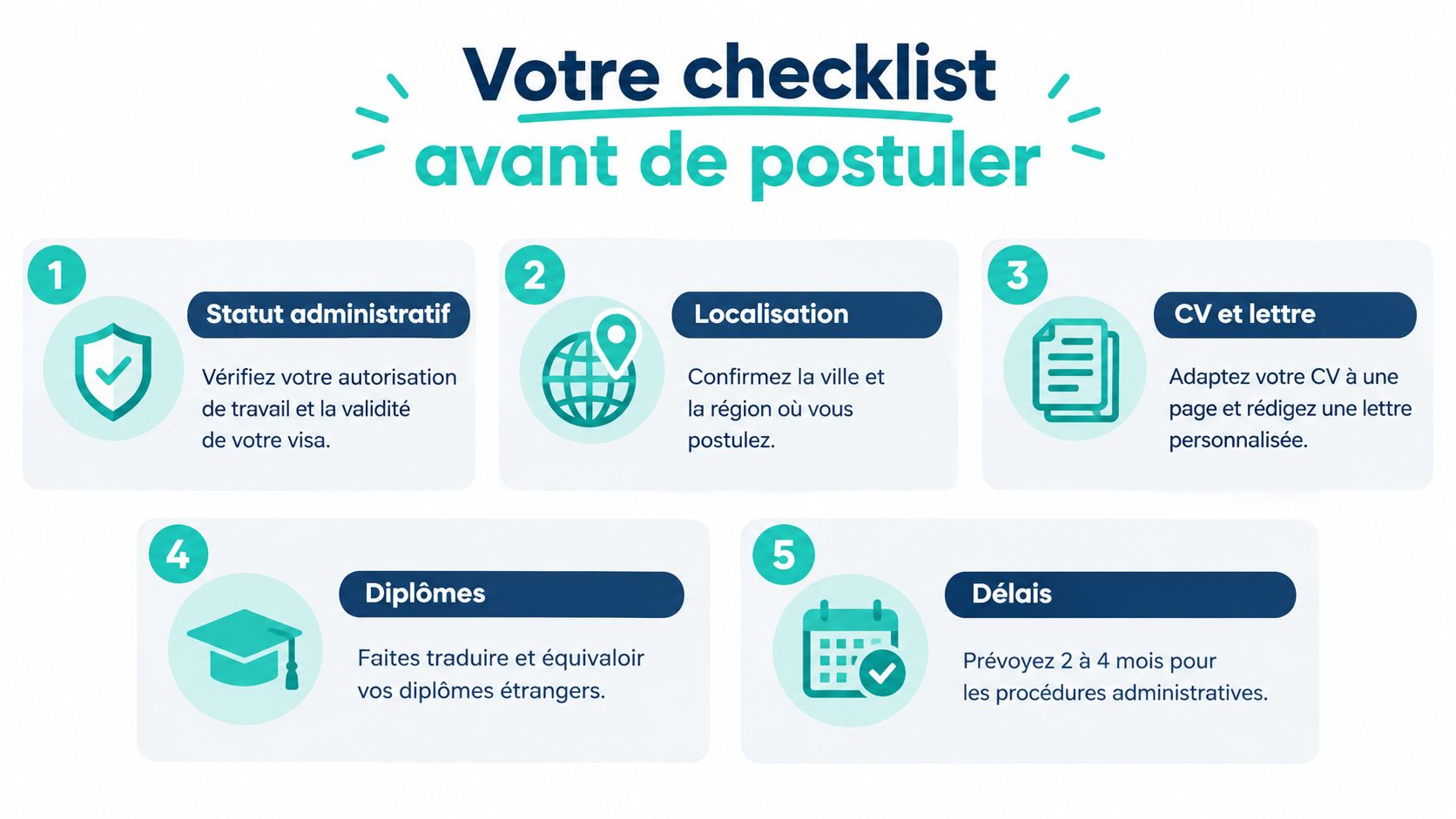
Keep this simple logic. If status blocks you, address status. If the profession is too far from your profile, refocus. If the region doesn’t help, change zones rather than insist on the same offer.
- Administrative status: verify your work permit, visa, and timeline.
- Profession: target jobs with real demand and where you can prove skills.
- Region: choose areas where your profession is administratively and economically useful.
- Channel: apply where your profile has a chance to be read, not just seen.
- Application: tailor CV, cover letter, and equivalences before sending.
If juggling multiple leads, a tool like Jobshift helps sort offers and quickly adapt applications for each. It’s no magic wand, but it avoids repeating the same work ten times.
Frequently Asked Questions About International Jobs in France
Do I need to have my diploma recognized to work in France?
Not always, but for some regulated professions, yes. Check the job requirements before applying.
Is French mandatory everywhere?
No. Some positions accept English, especially in international environments. But if you deal with clients, fieldwork, or healthcare, French quickly becomes essential.
Can I job search from abroad without a network?
Yes, but you must filter more strictly and target channels that genuinely accept international profiles. Mass applications don’t compensate for poor targeting.
Is the VIE program worthwhile?
Yes, for profiles seeking structured first international experience. It’s a distinct channel, especially useful for recent graduates.
What if I like an offer but the status requirements aren’t clear?
Don’t apply blindly. Verify if the employer can sponsor your application before investing time.
If you want to stop wasting time on incompatible offers, go straight to the point with Jobshift. The tool helps you filter jobs, tailor your documents, and manage multiple applications without losing focus. For an international job in France, this kind of organized approach saves weeks.
À propos de l'auteur
Chris Massie, cofondateur de l'appli Jobshift. Il travaille sur l'outil depuis sa première version : analyse du CV face à l'offre, réécriture automatique des blocs faibles, candidatures envoyées en mode swipe. Profil LinkedIn