Internship Cover Letter: A Complete Guide to Stand Out
September 29, 2026

Staring at a blank page with multiple tabs open and feeling like you’ve been rewriting the same thing for twenty minutes? That’s normal. An internship cover letter shouldn’t read like a novel or a copy-paste from a random template. It needs to convince quickly, with few words and clear facts.
The problem is many applicants go the wrong way. They recount their entire background, repeat their resume, or write a letter so generic it could be sent to any company. Recruiters don’t want that. They want a simple sign that you understand the internship, know why you’re applying, and can contribute during the intended period.
Why an Internship Cover Letter Is Different from a Regular Cover Letter
When applying for an internship, recruiters don’t expect a long career demonstration. They know you often lack solid experience, and that’s not the point. What they want to see is your seriousness, your specific motivation, and your ability to learn quickly.
The logic differs from a job application. For a regular job, you project the candidate into an existing role with expected results. For an internship, the question is simpler but more demanding: does your application make sense with the right timing, training, and a clear reason why you’re applying here and not elsewhere?
What Recruiters Actually Look For
A good internship cover letter answers three concrete questions: Why this internship? Why this organization? And why now? Without these answers, the letter reads like an empty statement of intent.
This is why reputable guides emphasize including the dates, duration, current training, and the precise purpose of your application, keeping the letter short and focused on verifiable facts. For example, the U.S. equivalent of Parcoursup recommends a brief format of about 200 to 250 words Parcoursup guide on cover letters. This isn’t just a formality; it signals clarity.
Simple rule: if your letter could be sent to five companies without changing a word, it’s not good enough.
Another useful point: internship applications are more forgiving than regular job applications when your background is still developing. But that doesn’t excuse vagueness. A strong letter doesn’t express vague ambition; it shows coherence between your training, the targeted role, and the timeline.
The Effective Three-Part Structure
The most effective structure is simple and fits into three parts. It’s easy to read, quick to digest, and flexible enough for associate degrees, bachelor’s, master’s, or career changes. For instance, Columbia University’s Career Services recommends a three-step logic: motivation for the organization, your strengths related to their needs, and the mutual benefit of working together Sciences Po Career advice.
The trap is turning these parts into filler. Each paragraph must have a clear purpose. One topic per paragraph, no mixing.
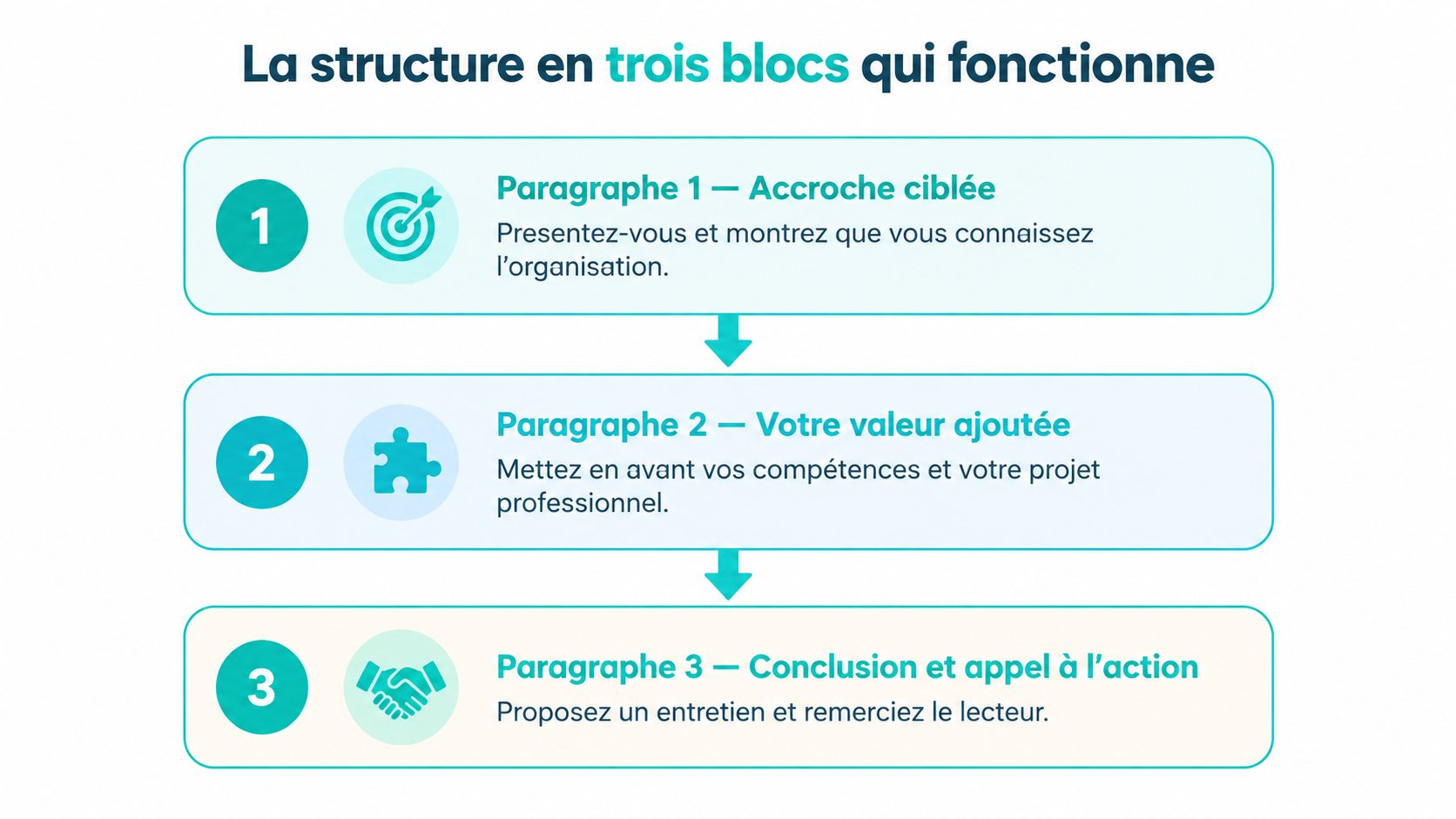
Paragraph 1: Targeted Opening
Here, show you know who you’re addressing. Name the company, the type of internship, and the period if known. One sentence should make it clear this isn’t a generic template.
Paragraph 2: Your Added Value
This part shouldn’t repeat your resume. Select up to two proofs: a project, a course, a part-time job, volunteering, or teamwork, then link them to the internship’s mission. Less is more if chosen well.
Paragraph 3: Useful Closing
The ending should invite further discussion, not pile up empty phrases. Offer an interview, thank the reader, and express your availability. It’s clean, direct, and enough.
Keep it short: one page max, ideally 3 to 4 paragraphs with clear spacing. This framework also serves as your checklist before sending.
If you’re starting from scratch or your path is unclear, keep a basic template handy as a reference, then adapt it to your real case with this cover letter template. The goal isn’t to copy but to save time without losing personalization.
Concrete Details to Include to Show Your Seriousness
Often, the first screening comes down to simple details. If your letter doesn’t clearly state when, how long, in what context, and for which department, you force the recruiter to piece it together. They won’t.
Career advisors emphasize including very concrete markers: the period, duration, training program, and the purpose of your application. This is fundamental, not optional Parcoursup internship letter guidelines. The sooner you provide these details, the faster the recruiter understands if your application fits their needs.
What Should Appear Immediately
Write clearly the key elements for screening. Not in a bureaucratic style, but with precision.
- Internship dates or period. If you know exact dates, state them.
- Internship duration. In weeks or months, as appropriate.
- Current training. Specify your exact degree or program.
- Institution or specialization. Let them situate you.
- Exact department or position targeted. Just saying “internship” isn’t enough.
- Company name. Yes, it must be clearly mentioned.
| Expected Information | Vague Version to Avoid | Precise Version to Write |
|---|---|---|
| Period | I am looking for an internship soon | Internship from June 3 to July 26 |
| Duration | Short internship | Eight-week internship |
| Training | I am a student | As part of my Bachelor’s in Information Technology, Year 2 |
| Target | In your company | In your marketing department, social media team |
| Motivation | I want to discover the profession | I want to contribute to content creation and coordination tasks |
The difference is clear. The vague version wastes time. The precise version shows you understand the context and respect the reader.
If you’re also building your resume from scratch, keep a similar factual and targeted logic, as explained in this guide to writing a resume without professional experience. Your cover letter shouldn’t fix a vague resume; it should complement it.
Good practice: put internship details in the first paragraph or header, not buried in the middle.
Two Short Examples for Different Profiles
A good example isn’t a perfect text; it’s a text that holds up for a specific profile. The same structure produces different letters depending on whether you’re a second-year bachelor’s student or a 35-year-old career changer. The tone changes, but more importantly, how you highlight your existing strengths changes.
Example 1: Bachelor’s Student in Communication
Dear Sir or Madam,
Currently a second-year Bachelor’s student in Information and Communication, I am seeking a six-week internship starting June 2 in a communication agency. Your work on digital campaigns and brand content interests me as it aligns with my coursework in content strategy and copywriting.
During a supervised project, I wrote several pieces for a student association and coordinated their distribution on Instagram and LinkedIn. I learned to tailor messages to specific audiences, meet deadlines, and work with quick feedback.
I would be delighted to discuss the proposed tasks and how I could contribute to your projects during my internship. Thank you for your consideration, and I remain available for an interview.
What Works Here
The applicant clearly states her level, period, and the type of company targeted. She doesn’t say “I’m motivated,” but shows a concrete link between her courses and the agency’s needs. The supervised project serves as proof, not decoration.
The vocabulary is simple but professional. Terms like “digital campaigns,” “brand content,” “schedule,” and “target audience” give the letter substance without exaggeration.
Example 2: 35-Year-Old Career Changer in Project Management
Dear Sir or Madam,
Preparing for an RNCP-certified diploma in project management, I am seeking an internship to apply my skills in an operational environment. Your organization interests me for its coordination tasks and managing multiple stakeholders.
After several years in a service-oriented role, I developed a rigorous work method, experience meeting deadlines, and the habit of documenting actions. In a volunteer project, I helped organize a local event and coordinated several service providers.
I now wish to bring this experience to a structured team and continue improving my project management tools and methods. I would be happy to discuss this further in an interview.
What Works Here
The candidate doesn’t hide his career change. He turns it into an asset by emphasizing methodology, deadlines, and coordination. It’s not just the tone that changes but the hierarchy of evidence.
To Reuse in All Cases
- A clear target. State who you’re addressing.
- A concrete proof. A project, a task, a responsibility.
- A simple promise. What you bring during the internship.
To speed up writing without starting from scratch, you can also use a generator and then personalize the text with Jobshift’s cover letter creation tool. The key is to get a base and then make it truly yours.
Common Mistakes That Get Your Letter Discarded
Recruiters see many letters that all look alike. The most frequent mistakes aren’t serious errors but reveal a lack of targeting. When volume is high, this alone can sink your application.
Six Mistakes to Fix Immediately
Generic opening
Bad: “Dear Sir or Madam, currently a student in…”
Better: “As a BTS NDRC student, I am seeking a six-week internship in your company’s sales department.”
The first says anything to anyone. The second speaks to someone.Repeating the resume
Bad: “As stated on my resume…”
Better: “In a group project, I coordinated content writing for a web page.”
Referring only to the resume means no selection effort.No specific name
Bad: “I want to do an internship in your company.”
Better: “I want to do an internship in your communications department.”
A vague application looks like mass mailing.Skills without proof
Bad: “I am motivated, dynamic, and organized.”
Better: “I managed a publication schedule for a volunteer project.”
An adjective alone means nothing. An action means everything.Misspelling recruiter or company name
Bad: Copy-paste without checking.
Better: Proofread every proper name before sending.
A mistake here shows you didn’t read the ad carefully.Overused polite closing
Bad: “Yours sincerely, Madam, Sir…” thrown in without thought.
Better: A simple, neat closing with a real invitation to talk.
The end should close the letter, not empty it.
A recruiter quickly screening looks mainly for precision, personalization effort, and the ability to write without hiding behind formulas.
French career sources consistently point out the same flaws: generic templates, lack of personalization, typos, poor formatting, and overly casual tone Société Générale career advice and HelloWork internship cover letter page. Just because these mistakes are well known doesn’t mean they’ve disappeared.
Final Checklist Before Sending
Before sending, quickly review and tick each point. Not to reassure yourself, but to avoid a silly mistake that costs you a reply.
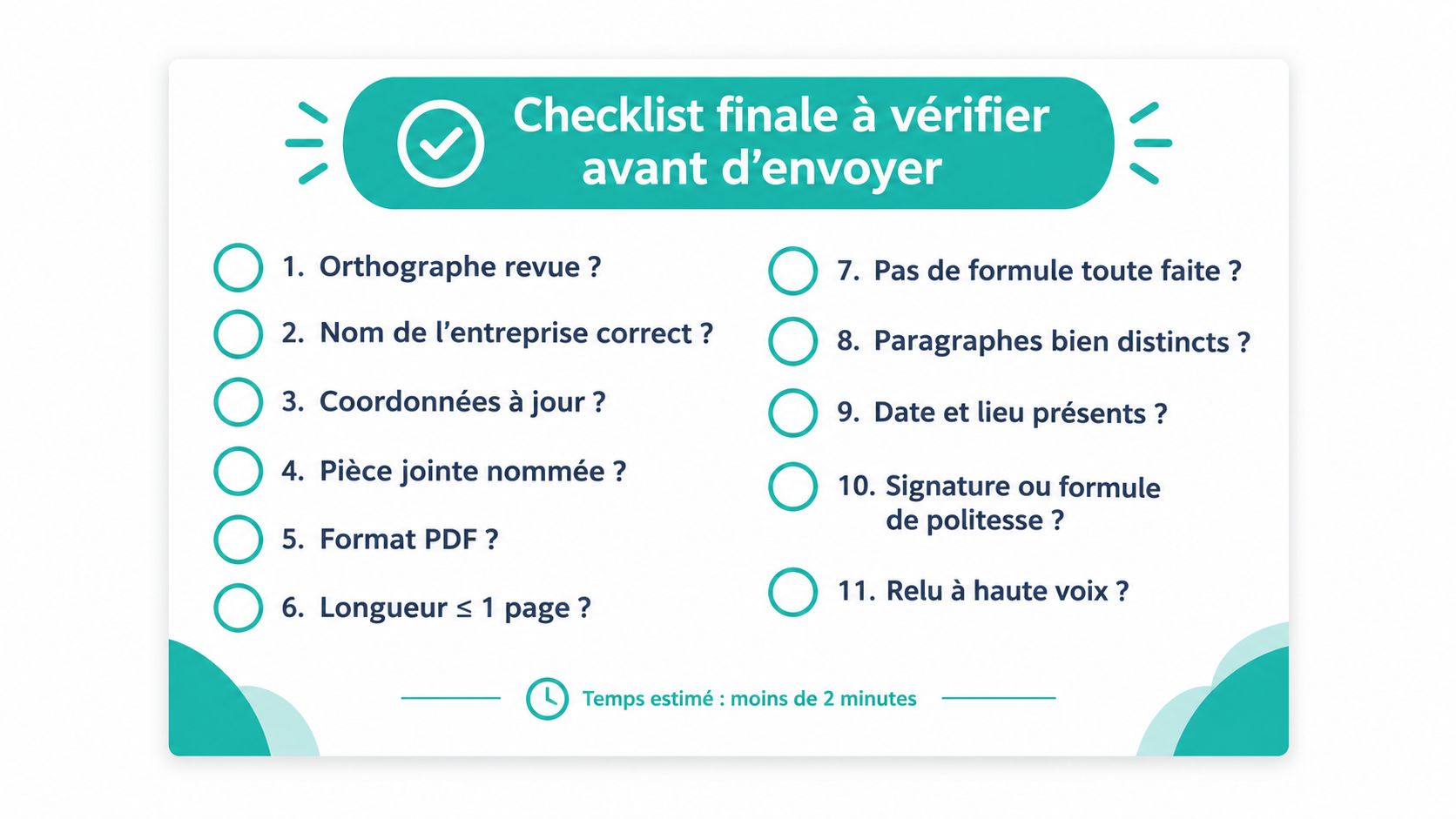
- Is the company name mentioned at least twice?
- Are the internship dates and duration precise?
- Is your degree or training clearly stated?
- Is there a concrete element proving your motivation?
- Is the letter’s purpose clear and error-free?
- Does the letter fit on one page?
- Is the file named professionally?
- Are the resume and letter in the correct format?
- Is the closing personalized?
- Has someone else proofread it?
- Is your email address professional?
Keep this list as a final filter, not a guarantee. A good application can still be rejected, but an imprecise one will be discarded much faster.
Practical Questions on Submission and Format
A strong letter can lose impact if submission is mishandled. Content matters, but format and timing can help you avoid unnecessary mistakes. For internship applications, recruiters expect something simple, neat, and easy to open.
Ideal Length
Aim for one page max. Typically, an internship cover letter should be short, around 250 to 400 words, with short, spaced paragraphs. Longer letters tire the reader and dilute your main point.
PDF or Word?
Choose PDF in most cases. PDF preserves formatting and avoids surprises on opening. Only send Word if explicitly requested by the company.
How to Name the File
Use a clear, simple name, e.g., first-last-cover-letter.pdf. Avoid names like “final-letter-v3” or “cover-internship-new.” A well-named file immediately conveys professionalism.
If the Online Form Doesn’t Allow Attaching a Letter
In that case, turn your letter into a short message focused on three elements: your training, the internship targeted, and your specific motivation. Recent guides note that applications increasingly go through forms, PDFs, and short messages, so condensing skills are important L'Étudiant online application guide. Don’t paste a full letter into a field not designed for it.
When to Follow Up
Politely follow up after one week without response, especially if the start date is near. A short message with your name, application subject, and a simple request for feedback is enough. No pressure or unnecessary insistence.
When to Send
Send when you’re sure you can commit. Avoid last-minute rushed messages or forgotten attachments. Better to send a neat email in the morning with a clear message than a hurried one at the last second.
For Spontaneous Applications
Be even more precise. Without a job posting, you must compensate for the lack of framework with a clear target: a department, type of task, or possible period. Vague spontaneous applications almost always end up forgotten.
If you want to save time on these short formats, use a tool that adapts your letter to your target, then personalize it with Jobshift’s cover letter generator. This is useful when sending similar messages to multiple internships without falling into copy-paste.
Jobshift helps you transform a basic cover letter into a truly targeted version, tailored to your training, the company, and the internship type. If you want to stop starting from scratch for every application, visit Jobshift and use it to write faster without sacrificing the precision that makes the difference.
Written with
À propos de l'auteur
Chris Massie, cofondateur de l'appli Jobshift. Il travaille sur l'outil depuis sa première version : analyse du CV face à l'offre, réécriture automatique des blocs faibles, candidatures envoyées en mode swipe. Profil LinkedIn