Spontaneous Cover Letter Examples: How to Write a Winning Unsolicited Application
October 5, 2026

About 30% of job openings are never advertised, and some studies suggest up to 57% of hires happen without a public posting. A strong spontaneous cover letter doesn’t copy-paste; it connects a clear company need with concrete evidence from your background, then invites a conversation.
A generic template might save you a few minutes but will mostly make you blend in with other applicants. Since unsolicited applications target companies without a visible vacancy, you must create the link between their business, a potential challenge, and what you bring to the table.
The method is straightforward. Pick the example that fits your situation, identify its structure, then tailor the introduction, supporting evidence, your availability, and call to action. An effective cover letter typically fits on one page, is well spaced, and organized into three or four paragraphs, following the guidelines from Onisep on cover letter basics.
1. Spontaneous Cover Letter for Students
You might not have an extensive professional background yet. That’s no reason to fill your letter with vague statements about motivation. Your education, school projects, and ability to learn can already provide useful proof—if linked to the job you want.
A student studying International Business contacting a local logistics provider could mention a case study on import-export document management, work on Incoterms, or a team project. An engineering student in industrial training might cite a design study, prototype, or process analysis. A web development apprentice could present a frontend feature built for a personal project and explain the environment where they want to grow.

Key Approach
Your letter should highlight observable potential, not apologize for lack of experience. Start by linking the company to your background, then provide evidence from your studies.
Practical tip: replace “I want to discover the professional world” with the name of a project, tool, or challenge you’ve already tackled.
Example:
Currently in my second year of BTS International Business, I studied coordination of import-export operations through a project focused on European supply chains. Your local logistics services particularly interest me as they put into practice the challenges of document tracking and client relations I wish to deepen.
Next, specify what you can already do, even at a beginner level. Mention software you know, a working method, a language used in a project, or a responsibility you took on in a group. Don’t turn your letter into a skills list; explain the context in which you applied them.
Then state a realistic availability, for example from September or as soon as possible, depending on your academic calendar. Flexibility can help but avoid vagueness. Finish by proposing a conversation about an internship, apprenticeship, or assignment matching your training.
To deepen your student application, see this guide on cover letters for internship requests. Jobshift can also help you quickly adapt academic contexts to SMEs and startups. Always proofread each version to ensure the cited project truly fits the company.
2. Spontaneous Cover Letter for Recent Graduates
Recent graduates have an advantage your letter should highlight. Their knowledge is fresh, initial internships have exposed them to real situations, and their career plans can still be long-term.
A marketing graduate contacting a local creative agency shouldn’t just say they love communication. They can mention a campaign recommendation made during an internship, a target analysis, or building a customer database. A business school graduate aiming for a fintech scale-up should show understanding of commercial or analytical challenges, not just a desire to join an innovative company.

Proofs That Replace Experience
Pick one experience and describe it with an action verb. You designed, analyzed, structured, coordinated, wrote, or presented something. The recruiter must understand what you produced, for whom, and why.
If you have measurable, verifiable results, use them. Growth in social media engagement, a created database, improved procedure, or client-approved presentation add weight to your application. Don’t add numbers you can’t explain in an interview.
Your introduction can follow this logic:
- Your company: mention a product, news, or challenge motivating your approach.
- Your experience: link this to an internship, final project, or concrete mission.
- Your contribution: indicate what you could handle quickly without promising to transform the whole organization.
For an assistant recruiter role in a regional industrial group, an HR graduate might explain participation in resume screening, interview preparation, and improving job descriptions. This is better than listing qualities like “serious, motivated, versatile.”
Personalization really matters. A tailored letter can improve response rates by 30% compared to a generic one, according to Skwiz’s advice on cover letters. Use Jobshift to identify SMEs and mid-sized companies in your sector, then adapt each letter’s vocabulary to the company’s activity and assumed needs.
3. Spontaneous Cover Letter for Experienced Candidates
An unsolicited application from an experienced candidate shouldn’t recount your entire career. It should select one achievement that makes your profile relevant to the company’s current situation.
A sales director contacting a group undergoing restructuring might open with reorganizing a sales network, taking over a portfolio, or supporting teams through change. A senior automation engineer could highlight an innovation developed, a production line optimized, or ability to structure an R&D function. A finance manager targeting a bank should link experience with complex operations to a need for managerial stability or oversight.

Right Level of Confidence
Your tone should be confident without arrogance. No need to list all your roles. Focus on experiences addressing a clear challenge for the targeted company.
An example introduction:
Your group is undergoing a commercial offering reorganization. My experience leading teams and launching new activities leads me to propose a discussion about development challenges you might face during this period.
This phrasing doesn’t claim insider knowledge but starts from a public signal and invites dialogue. It’s more credible than saying you are “the ideal candidate.”
What to Prove
Support your value with precise achievements:
- Scope: specify the team, market, client, or project type involved.
- Action: explain your personal role without attributing collective results solely to yourself.
- Result: use verifiable data when available; otherwise clearly describe the improvement.
- Transfer: show why this experience benefits the targeted company.
If leaving a stable position, avoid criticizing your current employer. Instead, explain your search for new challenges, a different sector, or more strategic responsibility. This reassures the recipient about your coherence.
To avoid obvious overqualification, select companies whose size, sector, or responsibility level match your project. Jobshift can help filter opportunities and tailor your letter around the most relevant achievements instead of listing your whole career.
4. Spontaneous Cover Letter for Career Changers
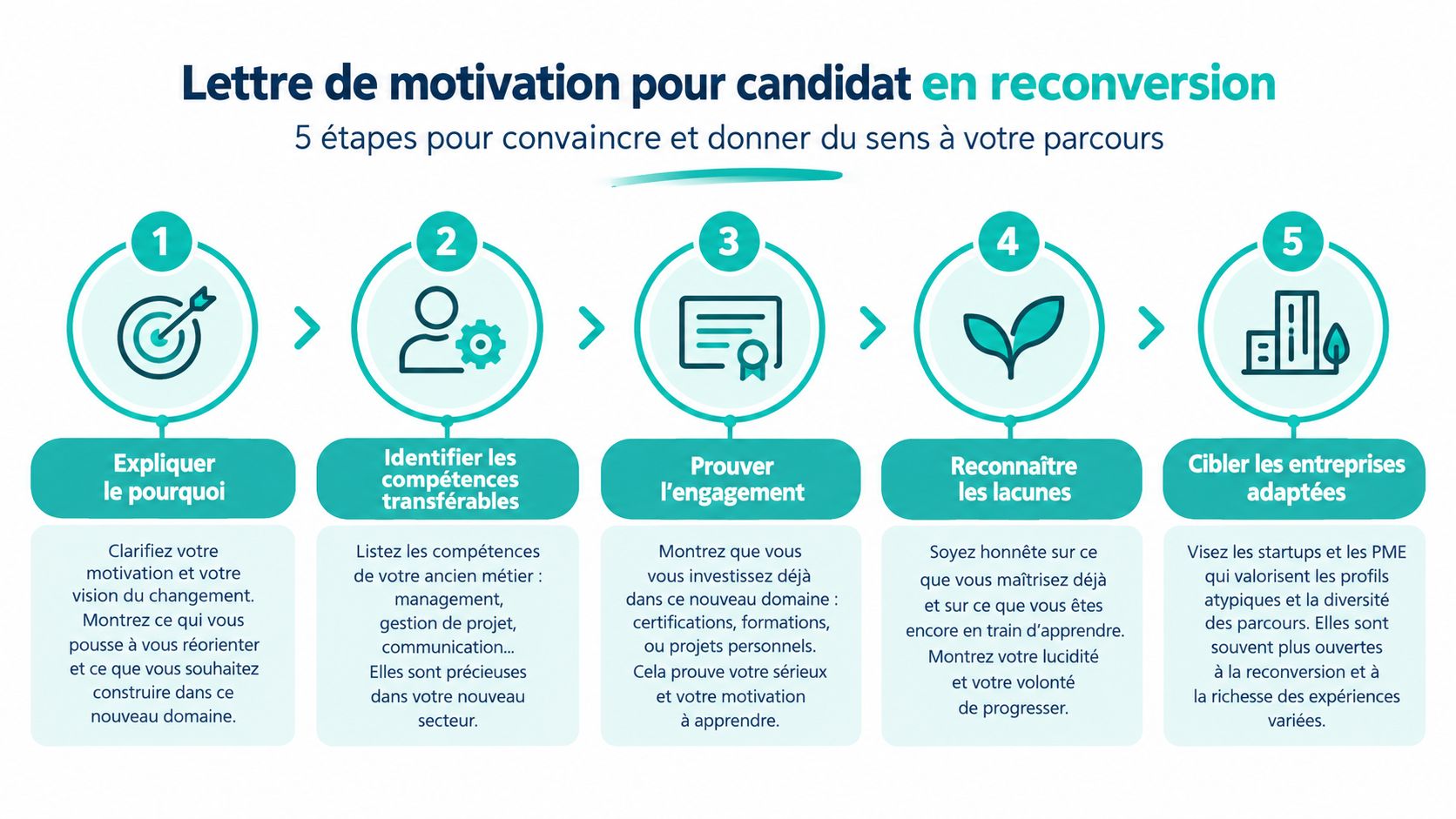
A career change isn’t justified by enthusiastic phrases. Recruiters want to understand your choice, see what you’ve learned, and identify how your past experience adds value to the new role.
A former logistics manager training in data analysis might contact an e-commerce SME by linking knowledge of flows, stock, and operational issues to new technical skills. A journalist becoming a content strategist can highlight research, interviewing, and editorial structuring experience. A real estate portfolio manager aiming for digital project management might emphasize stakeholder coordination, deadline tracking, and risk management.
Telling a Coherent Transition Story
Start with the why, then explain the how. Your letter should make the transition clear in a few lines:
After several years managing logistics flows, I chose to train in data analysis to better solve operational problems through measurement. My training allowed me to work with datasets, build dashboards, and present recommendations based on concrete results.
Don’t hide skills still developing. Saying “I’m proficient with this tool, deepening this method, and want to consolidate this skill professionally” sounds more reliable than claiming mastery without proof.
List transferable skills but link them to situations. Methodological rigor, client relations, project management, and ability to simplify complex topics can be valuable in a new role if you show how you developed them.
Choosing the Right Company
SMEs, startups, and transforming sectors may be open to less linear paths, but your letter must stay targeted. An e-commerce company won’t receive the same message as a SaaS agency or a consulting firm. Adapt the project example, tools mentioned, and type of contribution proposed.
The Jobshift page on career change can help you multiply applications in your new sector and adjust your documents. The tool doesn’t replace your reflection on your career plan but reduces repetition when adapting multiple applications while you control the coherence of each argument.
5. Spontaneous Cover Letter Sent by Email
An email isn’t a long letter pasted into a message. It’s the first filter. It must entice opening your CV, viewing your profile, or replying—without forcing the recipient to wade through dense text blocks.
The subject “Application” says almost nothing. Prefer a phrase linking your specialty to a visible challenge, e.g., “Backend Developer, potential contribution to your data projects.” For sales roles, specify the sector and value you bring. For an HR consultant, clarify the topic, like recruiting technical profiles or structuring a process.
Mobile-Friendly Structure
Limit the message body to three paragraphs:
- Who I am: your profession, specialty, and context of your approach.
- Why you: a project, product, or news motivating your contact.
- Let’s talk: a proposal for a conversation, your availability, and attachments.
A backend developer might note a technical challenge in a public product of the SME, then attach a CV and GitHub profile. A field sales rep could contact the sales director on LinkedIn before sending the application to the company email. An HR consultant might attach light, clearly named files, with a signature including phone and a single LinkedIn link.
Find the contact on the company website, LinkedIn, a professional directory, or by calling the switchboard. Tools like Hunter can help identify professional emails, but always verify the recipient is relevant to your role.
A precise subject and contextualized first line beat a long motivation statement. Send a test email to yourself, open it on mobile, and check links, attachments, and readability. Recommendations from France Travail for clear, proofread letters align with this: a clean layout and careful proofreading remain essential.
Jobshift offers support to adapt letters and application responses. Use its cover letter generator to prepare a base, then manually revise the introduction and company-specific proof. Automated personalization shouldn’t produce identical messages sent to all SMEs.
Here’s a helpful visual guide to check the steps of a career change application:
You can also review writing and targeting principles in this video:
Comparison: 5 Spontaneous Cover Letter Examples
| Letter Type | Implementation Complexity 🔄 | Required Resources ⚡ | Expected Results ⭐📊 | Ideal Use Cases 💡 | Key Advantages ⭐ |
|---|---|---|---|---|---|
| Student Letter | Low, simple structure, light customization 🔄 | Low, academic projects, availability ⚡ | ⭐⭐⭐, internship/apprenticeship; shows potential and motivation 📊 | Applications to SMEs/startups for internships or apprenticeships 💡 | Shows eagerness to learn; compensates for lack of experience ⭐ |
| Recent Graduate Letter | Medium, illustrate internships and projects, quantify results 🔄 | Medium, measurable examples, diplomas, portfolio ⚡ | ⭐⭐⭐⭐, junior roles; quick integration and concrete contribution 📊 | Junior positions in agencies, scale-ups, or SMEs 💡 | Recent diplomas; proof via internships; adaptability ⭐ |
| Experienced Candidate Letter | Medium-high, select strategic achievements 🔄 | High, data, impact proofs, network ⚡ | ⭐⭐⭐⭐⭐, senior roles; immediate impact and credibility 📊 | Managerial, executive, R&D, or business transformation roles 💡 | Proven track record; autonomy; negotiation skills ⭐ |
| Career Changer Letter | High, coherent storytelling and change justification 🔄 | High, training, personal projects, skill proofs ⚡ | ⭐⭐⭐, entry into new sector often at revised level 📊 | Startups/SMEs valuing atypical profiles and diverse experience 💡 | Brings fresh perspective; motivation and maturity ⭐ |
| Email Cover Letter | Low, short format, catchy subject, mobile readability 🔄 | Low, personalization time, email search ⚡ | ⭐⭐⭐, better open rates if subject and hook effective 📊 | Quick, targeted applications; direct HR/manager contact 💡 | Fast, traceable, allows follow-up; adaptable per recipient ⭐ |
Your Cover Letter Is Ready to Be Tailored
A spontaneous cover letter example is only valuable if you turn it into a personal message. Before sending, check that every sentence answers a concrete question from the recipient: why this company, why this role, why now, and why you?
Pre-Send Checklist
- Target company: you mentioned its activity, a project, product, or real challenge.
- Contact identified: you researched the recruiter, manager, or relevant department name.
- Explicit subject: the role or field appears in the header or email subject.
- Personalized hook: the opening lines couldn’t be sent as-is to another company.
- Concrete proof: you cited a project, mission, achievement, or skill used in a specific context.
- Link to need: you explain how this proof benefits the company.
- Clear availability: you specify a realistic timeframe without overpromising.
- Consistent application: CV, letter, and online profile share the same positioning.
- Clean files: attachments are readable, properly named, and checked.
- Call to action: you propose a conversation instead of passively waiting for a reply.
If you hesitate between a letter for a specific role and one without, still name a job, team, or skill area. France Travail explains why spontaneous applications must be tailored to the company and its needs. An overly broad letter shifts all qualification work onto the recruiter.
FAQ
How long should a spontaneous cover letter be?
Aim for one page maximum and around 200 to 350 words, with short sentences and spaced paragraphs, as reminded by this guide on unsolicited applications. If your background is long, select proofs linked to the company instead of summarizing everything.
What subject line to use for a spontaneous application?
Use “Spontaneous Application” plus the job, department, or field targeted. A subject like “Spontaneous Application, Recruitment Assistant” helps sorting better than just your name.
Can I send a cover letter without a published job?
Yes. That’s precisely the point of a spontaneous application. France Travail reminds that not all jobs are posted and spontaneous approaches can uncover hidden opportunities. Your message must demonstrate knowledge of the company and propose a plausible contribution.
How to personalize a letter based on experience?
A student should rely on education and projects. A recent graduate should highlight internships and early achievements. An experienced candidate should select a strategic accomplishment. A career changer should explain the coherence of their transition and transferable skills.
Should I follow up after a spontaneous application?
You can follow up after a reasonable delay with a brief message recalling the targeted role and your availability. Don’t resend the whole letter. Add useful info like a recent relevant project or updated availability.
Can Jobshift write my entire cover letter for me?
Jobshift can help spot opportunities and adapt CVs, letters, or responses based on role requirements. Always proofread results, replace generic phrases, and verify facts before sending. The choice of angle, proof, and recipient remains yours.
Jobshift helps you find opportunities, tailor your CV and cover letters to each company, and speed up sending spontaneous applications. Use Jobshift to prepare targeted versions, then focus your human review on details that make the difference.
À propos de l'auteur
Chris Massie, cofondateur de l'appli Jobshift. Il travaille sur l'outil depuis sa première version : analyse du CV face à l'offre, réécriture automatique des blocs faibles, candidatures envoyées en mode swipe. Profil LinkedIn