Effective Online Job Search: Smart Filtering That Works
October 23, 2026

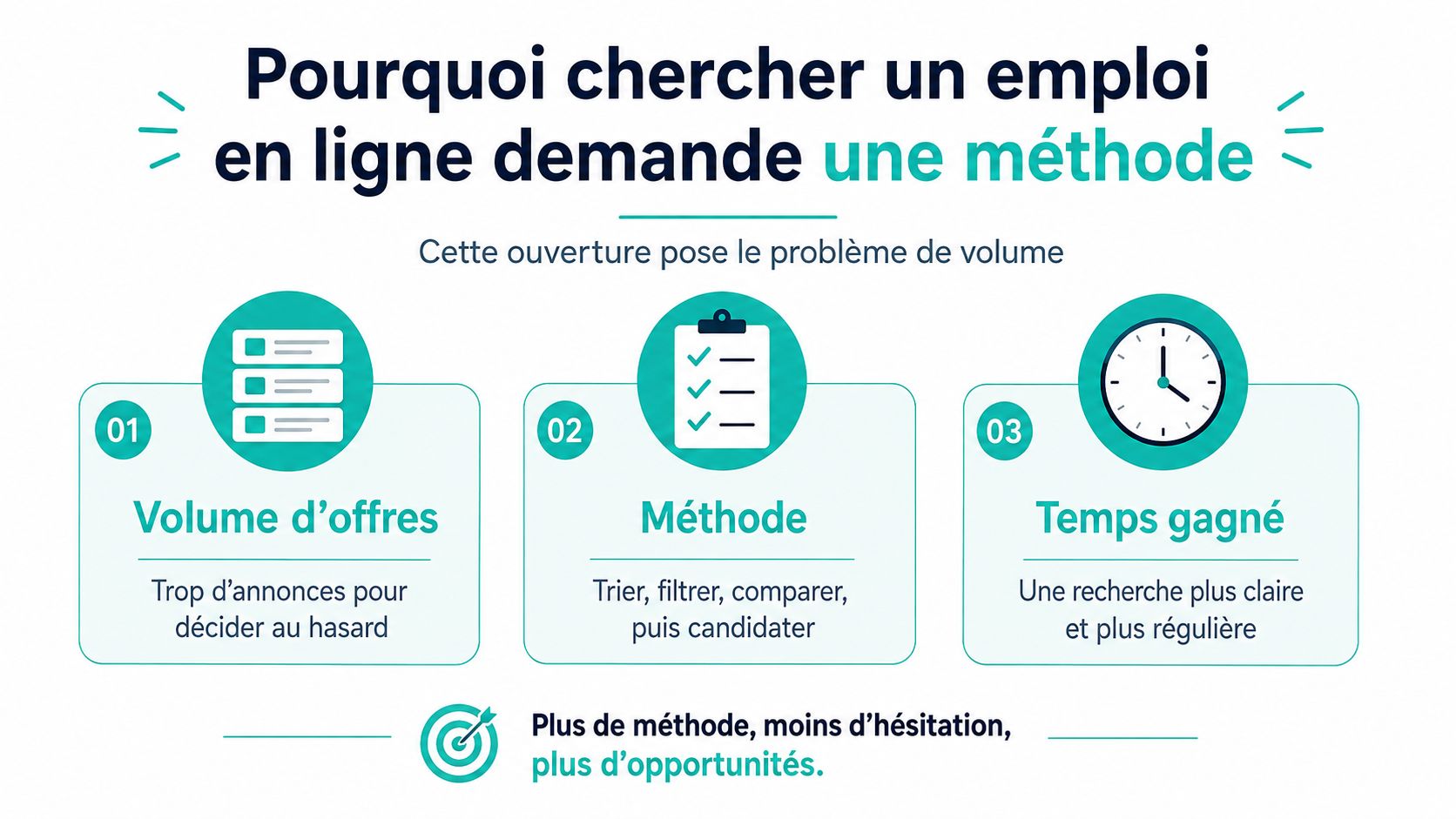
In Q2 2025, France Travail published 2.5 million new job listings, either directly posted or shared by partner sites. This volume changes everything. Searching for jobs online is no longer about internet access—it's about smart filtering.
Opening listings one by one will exhaust you before you find a suitable match. Applying broadly isn’t the same as applying smartly. I recommend reversing the usual approach: first narrow down by job title, location, contract type, and skills. Only then spend time on a short list, verifying each listing’s authenticity before submitting your information.
Why a Methodical Approach is Essential
For students, recent graduates, or career changers, the sheer volume makes a linear approach ineffective. You don’t have time to read hundreds of listings “just in case.” Each poorly chosen listing costs you time reading, tailoring your resume, and often following up with no result.
The difference is simple. “I apply a lot” measures activity. “I recognize a compatible offer” measures judgment. Recruiters don’t reward clicks—they read applications that fit a specific need or move on.
The Key Filter for Your Search
Keep one reading filter for your search: first reduce the pile, then personalize.
Four criteria suffice for the initial pass:
- Job title. Two to four specific titles, not the entire job dictionary.
- Location. An area you can realistically commute to or relocate within.
- Contract type. Internship, fixed-term, permanent, freelance. Exclude others.
- Skills. Those repeated in the listing and that you can demonstrate.
Filtering rule. A listing missing two or more of these criteria doesn’t deserve an application, even if the title sounds appealing.
Blind volume is the most common trap for busy profiles. Sending the same resume everywhere causes you to lose track of what you promised, making it hard to defend your application in interviews. Better a short, reviewed list than dozens of identical applications.
The process is a chain, not a list of sites. Choose where employers really post. Set alerts to reduce noise. Maintain a defendable profile and resume. Adapt each application without inventing skills. Verify listings and track follow-ups. None guarantees a job, but all save your valuable time.
Where to Find the Best Job Listings
Having multiple tabs open isn’t a strategy. Allocate your time based on employer behavior, not site popularity.
Among employers posting online, 69% use France Travail’s site. 40% post online offers, 17% consult external CV databases, 14% use social networks, and 11% post on their own career pages, according to France Travail’s study on digital recruitment. These figures show posting habits, not response rates.
Which Channel for Which Purpose
| Channel | Purpose | Limitations |
|---|---|---|
| France Travail | Access a large, structured flow of listings | High volume if filters are broad |
| Job boards and aggregators | Quickly spot listings for the same job type | Original listing may be elsewhere or outdated |
| Employer career site | Confirm listing and company identity | May miss jobs not posted there |
| CV databases | Stay visible without waiting for listings | Generic resumes remain invisible |
| Professional network | Contact someone linked to the need | Not a substitute for a written application |
France Travail is your base since most employers post there. Job boards expand your search but don’t replace it. Employer sites serve as verification. If the listing isn’t there and no one confirms it, slow down.
CV databases and networks cover what listings don’t. A visible profile lets recruiters find you without your active search. A brief, targeted contact to someone involved complements your application. Avoid mass outreach: one person, clear reason, relevant link.
Listings copied only on aggregators often miss the original posting. Text is shortened, source is incorrect, and team names disappear.
Léa, a communications graduate, used only two aggregators. She applied three times to a copied listing without realizing the employer required applications on their site. Her applications never reached the right place. Checking the employer site and messaging the contact would have saved time.
To compare platforms without opening many tabs, start with a comprehensive overview of French job sites, then focus on your top two or three channels. Close the rest.
Filtering Listings and Setting Effective Alerts
Choose your channels once. Daily, focus on selection. Poorly set alerts flood your inbox with noise.
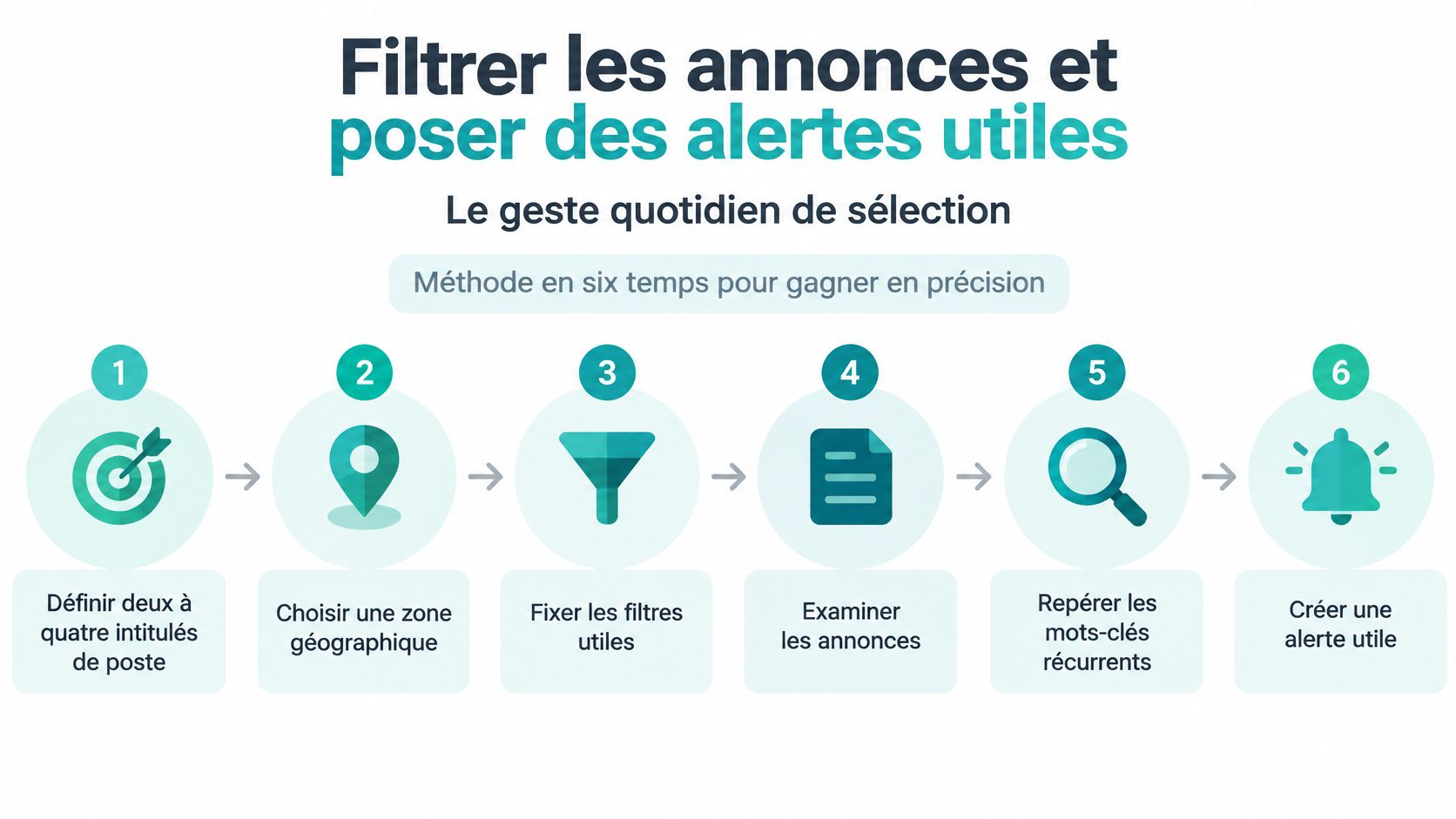
Six Steps in This Order
- Two to four job titles, one location. For a first marketing role, use “communications assistant,” “marketing assistant,” and “junior community manager.” In data, try “junior analyst,” “research assistant,” and “reporting assistant.” No more.
- Strict filters. Contract type, salary if shown, skills, posting date. Listings older than three weeks without updates come last.
- Recurring skills. Note repeated keywords across five listings. These are what your resume should prove, not the entire job dictionary.
- Resume and brief responses. Tailor these texts to your chosen filters. Don’t rewrite your life story.
- Submission and tracking. Record job title, date, channel, and status. Without this, follow-ups become fuzzy memories.
- Scheduled follow-up. Set a date when you send. Don’t follow up “when you remember.”
Effective alerts use the same boundaries: narrow title, city or region, contract type, freshness. A broad alert like “marketing” recreates the problem in your inbox. Better three precise alerts than one catch-all.
Listings don’t cover the whole market. 80% of employers use networks or former employees, while 55% seek applications directly, mostly online, according to France Travail’s research on digital recruitment. Don’t abandon alerts. Allocate time to them alongside your resume submissions and targeted contacts.
Alerts filter the flow. They don’t replace networking or a resume recruiters can access without a listing.
This video shows how to set filters and alerts without drowning in listings.
If you want help moving from flow to short list, see how an app supports job searching. It speeds filtering but doesn’t decide if a job suits you.
Preparing a Strong Profile and Resume
Filtering listings is useless if your documents are unclear. Prepare your profile and resume before your first application of the week, not during.
Recruiters and you in interviews should read the same story: clear job titles, experiences ordered from most relevant to oldest if you’re starting out, and skills only when you can prove them. A tool mentioned without example is a weak line.
Three documents, three roles. The resume in databases stays stable and readable without a listing in front of you. Your network profile follows the same thread with a one-line clear title. The version sent for an offer is the only one that changes, and only slightly. Don’t maintain three different narratives.
Three Time-Saving Tips
Manual rewriting for each listing is safest but slowest. Reserve it for your short list, not the entire flow.
Copy-pasting a template is fast but often unnecessary. Recruiters see generic text that could apply anywhere. In interviews, you may forget which version you sent.
Adaptation help mid-process strikes a balance. Keep your facts. The tool rewrites based on the listing. You review.
This is what Jobshift offers in-browser. You scan listings to keep or discard. The tool assists with resume, cover letter, and brief responses based on the listing. Submission happens from the browser, and the interface supports five languages. The tool doesn’t pick your job or guarantee interviews.
In Q3 2025, 4.9% of France Travail’s tracked listings were abandoned due to lack of candidates, according to recruitment abandonment data. This isn’t a promise, but shows some jobs remain unfilled. A dossier proving requested skills has a better chance than a generic resume. It doesn’t guarantee the job.
For career changers, “data analysis with Excel” only works if the project exists. A reporting table done in an internship or association with measurable results suffices. A tool listed without proof doesn’t.
For software and human readers, use a free ATS-compatible resume builder. Simple titles, readable dates, skills linked to experience. Prepare this base once. Don’t reinvent it for every click.
Customizing Applications Without Fabricating Skills
Your short list is ready. Now work offer by offer. Don’t rewrite your entire profile.
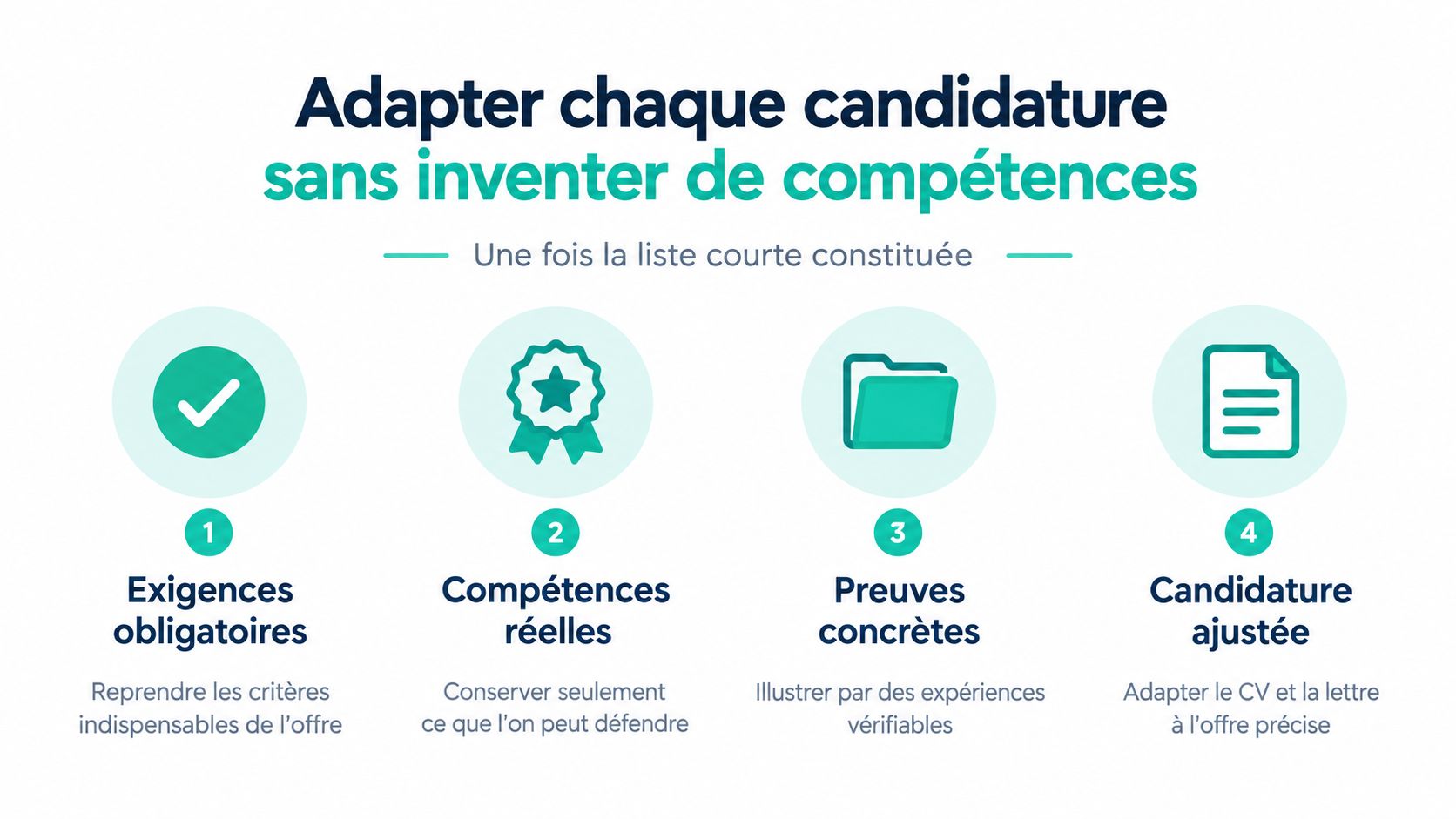
Separate mandatory requirements from desired criteria. Mandatory ones decide if you apply. Desired ones help if you can prove them; otherwise, leave them out.
Each skill kept must link to a fact: university project, internship, student job, freelance mission, or volunteer work. No orphan skills.
Keep It Short and Clear
A reporting job requires Excel. Your cover letter can be a few lines: you tracked association registrations, maintained attendance sheets, and produced a monthly report for the board. Name the tool, volume tracked, and decision supported. Stop there.
Don’t add software you’ve never used, even if three listings mention it. Interviewers will ask, “Show me.” If you can’t, your whole application loses credibility.
AI speeds up rewriting but isn’t the author. In October 2024, among 5,300 job seekers, 77% had used AI in their search, 40% to improve resumes or letters, and 31% through advice chatbots, according to France Travail’s infographic. Usage is widespread; control is not.
Before sending, ask yourself five questions:
- Accuracy. Are all facts yours with correct dates?
- Proof. Does each skill have an example?
- Consistency. Does the text align with your background?
- Personalization. Is the offer clearly referenced? Would the paragraph be useless elsewhere?
- Interview readiness. Can you say it aloud confidently?
If rewriting starts from the listing, review and keep the final version, not the draft. Cross out overpromising phrases like “expert,” “full mastery,” “I led” when you contributed, or “exceptional results” without your own numbers. Keep listing words only if true; remove if exaggerated.
Verifying Listings and Tracking Follow-ups
A great application sent to the wrong contact is useless. Before clicking or submitting your resume, spend a few minutes verifying. This isn’t new targeting; it’s routine protection of your data and time.
In 2025, the French Ministry of Economy warned about fake offers via SMS, internet, and social media. France Travail reports thousands fall victim annually. Quick filtering reduces risk when sending.
Five Minutes Before Submission
- Identifiable employer. Name and verifiable existence, not just a copied logo.
- Email address. Domain matches official site. Generic email for a big company’s HR is a red flag.
- Confirmed listing. Job appears on career site or is confirmed by someone in the company.
- No payment. No fees, mandatory training, or upfront equipment costs.
- Limited documents. Resume and cover letter only unless employer is confirmed.
At first contact, don’t provide bank details, ID copies “to reserve the job,” or health documents. Unrequested photos don’t belong in online submissions. Also review platform data usage before leaving a permanent resume.
The Tracking Table That Guides Next Steps
Record employer, job title, date, channel, highlighted skills, and follow-up date for each submission. After weeks, compare channels by responses, interviews, and offers. Silent channels lose priority; active ones gain.
Keep a copy of your sent application, even if an app centralizes discovery. Interviews focus on this version, not earlier drafts.
Keep follow-ups brief: remind the job, submission date, and a relevant fact. Don’t resend a new resume “just in case.” If no progress by your set date, archive and return to your short list.
Frequently Asked Questions Before Applying
How Many Targeted Applications Per Week
If you’re a student without a network, aim low and keep consistent. Three to five well-tailored applications beat a dozen copies. Spend the rest of your time filtering, making targeted contacts, and tracking.
Should I Have a Public Profile for Short Internships or Missions
Yes, if the mission might come unsolicited. No, if you can’t keep it updated. For short internships, a submitted resume and two narrow alerts usually suffice. For repeated freelance missions, a stable profile with recent examples avoids re-explaining each time.
What Language for the Resume if the Listing is in French
Follow the listing’s language for your application. If the team is mixed but the listing is French, keep your resume in French. Attach an English version only if requested or if part of the role explicitly requires it.
What to Change After a Month Without Response
Don’t multiply sites. Adjust your resume title and experience order. The first third should show the link to your short list offers. If that link is only at the bottom, readers miss it.
Which Documents to Avoid in Online Submissions
Don’t add a photo unless requested. Don’t send bank details, ID, or pay slips at first contact. Resume and relevant proofs suffice until employer confirmation. Then open a filtered series by job and location. Keep a few offers, verify one, tailor one application, and note follow-up dates. This is the next step, not a volume race. Jobshift helps you filter listings already narrowed by your search, then tailor your resume, cover letter, and brief responses to chosen listings. You remain the one verifying facts and employers before sending. To apply this method on your next short list, visit Jobshift .
À propos de l'auteur
Chris Massie, cofondateur de l'appli Jobshift. Il travaille sur l'outil depuis sa première version : analyse du CV face à l'offre, réécriture automatique des blocs faibles, candidatures envoyées en mode swipe. Profil LinkedIn