Sales Cover Letter: The Complete 2026 Guide
October 20, 2026

The most common advice is to talk about your motivation. For a sales position, that's not enough. Your cover letter must demonstrate that you know how to sell — meaning you understand a need, select a key argument, and back it up with proof.
Are you just starting out, switching industries, or have never managed a client portfolio? You can still convince employers without inventing results. Just base your letter on what you have genuinely done, rather than using a template that makes you sound like a seasoned sales pro.
Why Sales Cover Letters Still Matter
"No one reads cover letters." This statement mostly excuses skipping the personalization work. A generic letter adds little value. An application that clearly explains why you meet the employer’s needs deserves careful attention.
Data from early 2026 shows 39,830 sales job postings over 12 months versus 16,110 job seekers for B2B sales roles, according to the Employment Observatory citing France Travail. These numbers don’t measure your individual chances or the quality of positions available.
High Volume Hiring But Fit Is Key
Commercial recruitment data for 2024 recorded 20,310 hiring projects with an average difficulty rate of 42.3%, according to commercial recruitment data presented by Prestance. Don’t assume employers will accept any profile. Instead, highlight what makes your application relevant to their clientele and business.
Your resume describes your background. Your cover letter must explain why a specific experience matters for this particular job.
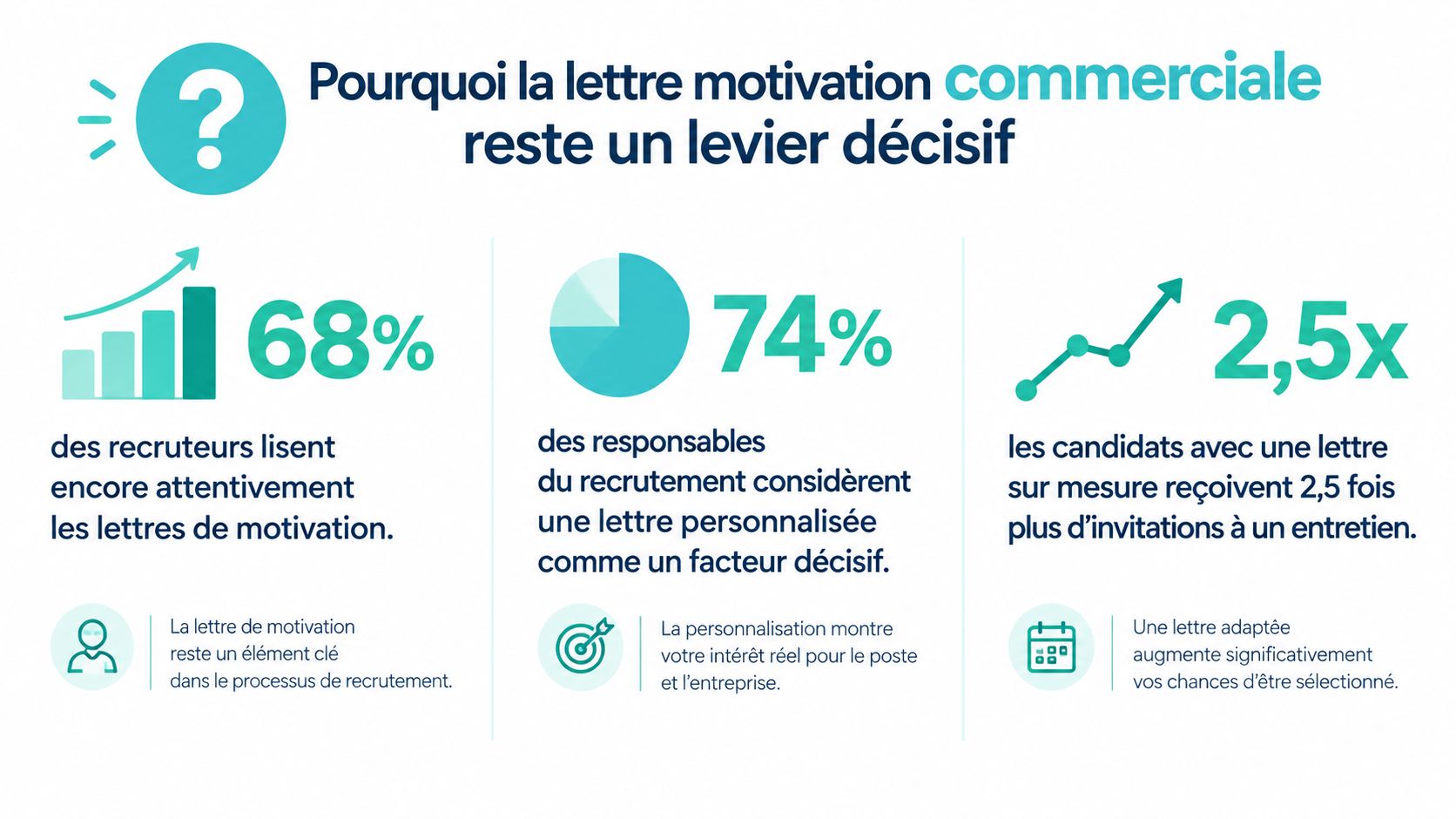
The infographic below illustrates the importance recruiters place on cover letters. Note: The figures are illustrative and not cited as references here. Rely on the sourced data in the text above.
The right approach is not to write more, but to select a useful angle:
- Prospecting: how you find and qualify leads.
- Client Retention: how you maintain ongoing relationships.
- Organization: how you avoid losing opportunities.
If you’re targeting a sales support role, the same logic applies. Our Sales Assistant Resume Guide helps you highlight experiences that support your sales argument.
Minimum Structure of a Winning Sales Cover Letter
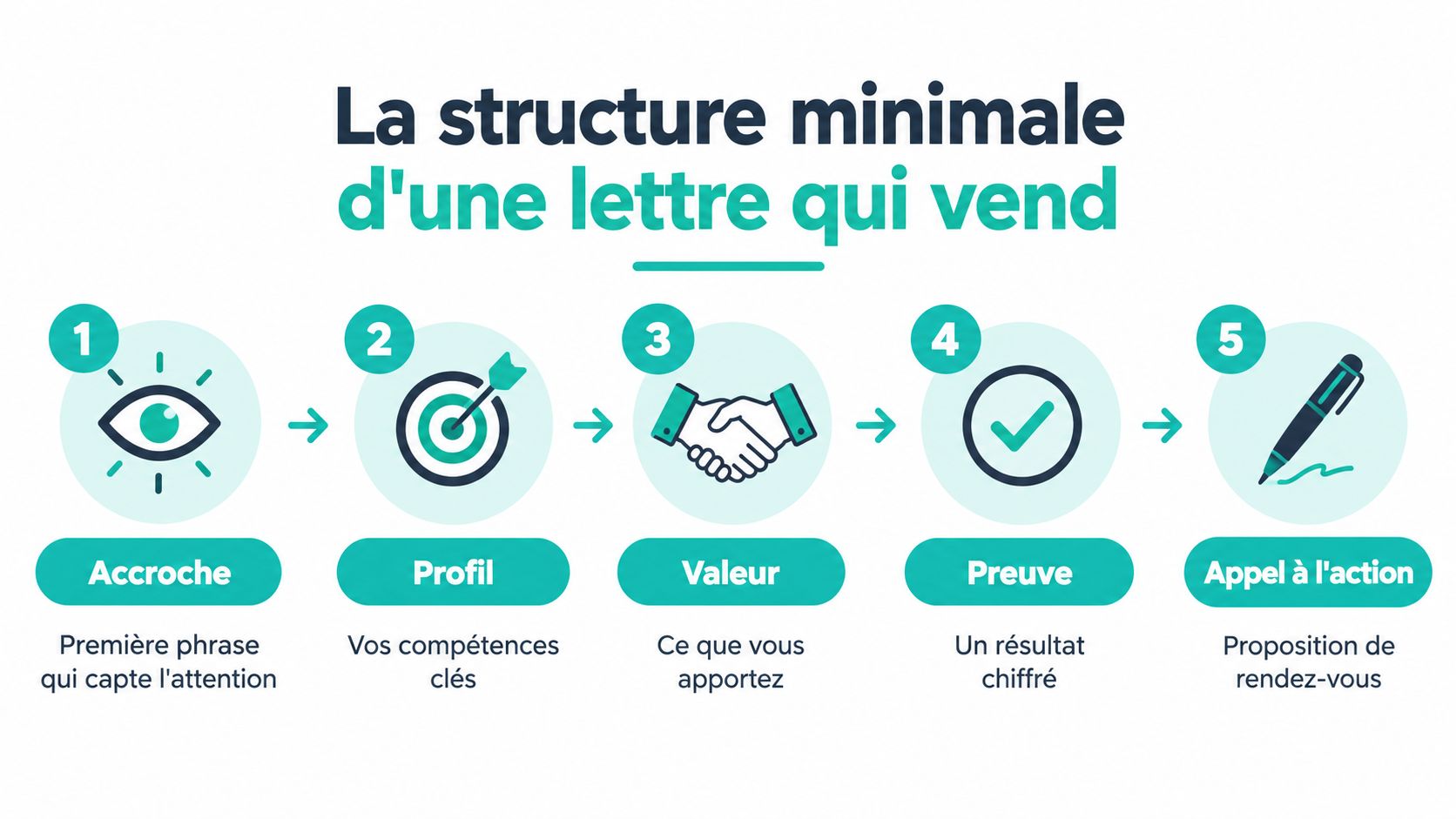
Forget the mechanical "you, me, us" format unless it helps your argument. Each section should answer a recruiter's question, not just fill a box.
The diagram below outlines the key functions to cover without forcing a paragraph for each.
Hook That Starts From the Job
Start with a need stated in the job ad, then connect it to your experience. Avoid statements about your passion for sales—they don’t explain what you can do.
An adaptable example: "Your ad highlights field prospecting and professional client follow-up. My internship allowed me to work on lead generation and appointment preparation." This is concise and opens a concrete discussion.
Proofs Followed by a Call to Action
The body should clearly distinguish your action, scope, and results. If you contributed to a team success, say "I contributed" and specify your role. Don’t claim the entire team’s achievement.
| Section | Question to Answer |
|---|---|
| Hook | What need did you understand? |
| Argument | What have you done that’s comparable? |
| Projection | What can be transferred to this job? |
| Conclusion | What do you propose to discuss? |
Address obvious objections too. If switching careers, explain what transfers and what you still need to learn. For experienced roles, highlight your decision-making scope rather than listing responsibilities.
The video below offers additional tips on writing your letter.
End with a precise interview request: "I would welcome the opportunity to discuss my qualification methods and how they fit your client base." This is more effective than promising impossible growth before knowing the company. Close with a professional salutation without extending the conclusion.
4-Step Method to Personalize Every Application
In 2024, half of French companies hiring managers requested at least one cover letter for executive roles, down from nearly 70% before 2022. The rate was 49% in SMEs and 56% in large companies, according to an Apec recruitment practices study published in 2025. This shift calls for selective, useful letters—not automatic documents.
1. Identify Key Requirements
Take the exact job title and pick 3 to 5 key skills. This selection method is recommended by Apec’s application guidelines.
Organize them in a draft: prospecting, negotiation, portfolio management, for example. Then ask which you can genuinely demonstrate. Do the same for tailoring your resume to a job offer so your documents tell a consistent story.
2. Match Each Skill With Evidence
Link each requirement to a traceable example of your work. The France Travail profile for key account sales reps highlights prospecting, sales analysis, negotiation, portfolio management, and CRM tool use.
- Nonprofit prospecting: contacts reached, responses received, memberships gained.
- Retail internship: tracked sales, average basket size, upsells identified.
- Student project: partners approached, meetings secured, proposals accepted.
- Freelance work: repeat clients, renewed contracts, converted quotes.
These are measurement ideas, not results to claim. To calculate conversion rates, divide results by contacts over the same period and scope.
3. Link Evidence to Target Clientele
Explain the transferability: following up on quotes suits sales with multiple exchanges, while retail advising shows quick need identification. Don’t equate very different sales cycles.
The France Travail profile for commercial studies roles emphasizes identifying target clientele and data analysis. Apply this logic to your letter but focus only on employer priorities.
4. Propose a Work-Focused Discussion
Don’t promise future results without diagnosis. Instead, offer to present your method, a past achievement, or your approach to managing the portfolio.
Writing rule: if you can’t explain a sentence with a spoken example, remove or clarify it.
Three Commented Examples Based on Your Profile
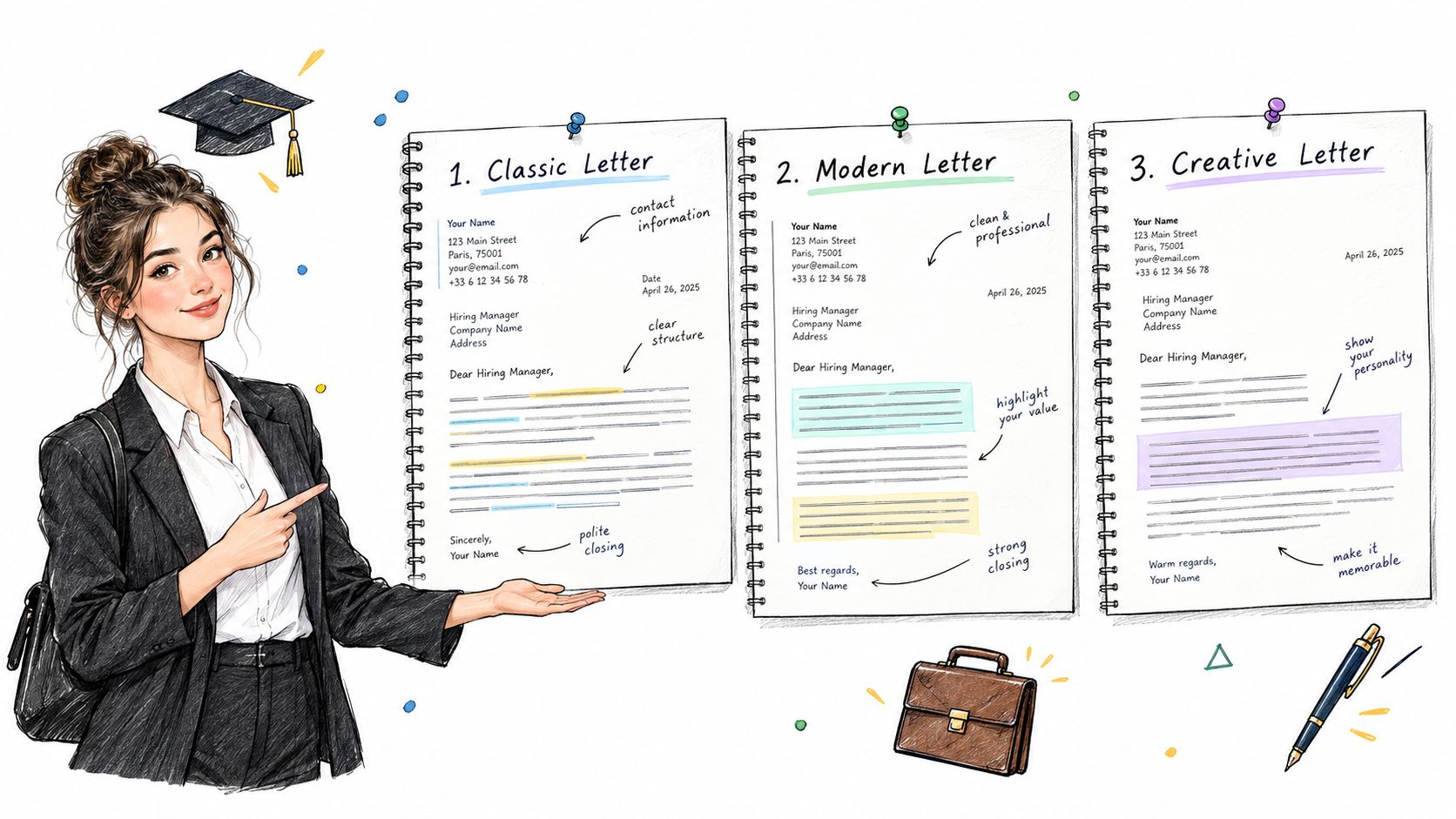
The following letters are illustrative templates, not real candidate testimonials. Replace bracketed items with verifiable information. If you lack a metric, remove it rather than estimate.
Student Finishing Internship Moving to Field Sales
Subject: Application for Field Sales Representative Position
Dear Sir or Madam,
Your job posting emphasizes prospecting and professional client follow-up. Nearing the end of my internship at [company], I wish to continue in a role combining direct contact and sales development.
Over [period], I qualified [verified number] contacts and secured [verified number] appointments. I prepared communications and recorded relevant information in [tool actually used], under my supervisor’s guidance.
I would be glad to present this method and discuss how it can be adapted to your geographic sector. Yours sincerely,
Why this works: The opening names key tasks, the body separates action from results, and the conclusion stays realistic. Mentioning supervision clarifies autonomy without diminishing experience. Remove any extra sentences about your enthusiasm.
Career Changer from Customer Service to Sales
Subject: Application for Sales Advisor Position
Dear Sir or Madam,
I am seeking to transition from customer service to consultative sales. Your ad caught my attention because of its focus on needs analysis and client support.
At [company], I handled [verifiable number] requests over [period]. I restated client expectations, explained available solutions, and ensured follow-up until resolution. This experience provides a foundation for conducting discovery interviews.
I aim to develop negotiation skills and would like to share situations I can already draw upon. Yours sincerely,
The right choice: Don’t rename customer service as sales artificially. The first paragraph acknowledges the transition, the next shows transferable skills, and the last states learning needs. For more on this, see our career change cover letter guide.
Experienced Salesperson Aiming for B2B Sales Management
Subject: Application for Sales Manager Position
Dear Sir or Madam,
Your posting combines portfolio growth and team support. These responsibilities align with my experience as [actual role] at [company].
Over [period], my portfolio represented [verifiable revenue], achieving [documented result vs. target]. I managed [exact responsibility] and supported [actual team activities], without hierarchical duties if none were assigned.
I propose a discussion on my opportunity tracking and sales coaching methods. Yours sincerely,
Key point: Results show performance, but scope shows responsibility. For management roles, document what you have delegated, organized, or arbitrated. Individual success alone doesn’t prove leadership ability.
Using AI Without Producing Artificial Letters
AI can help draft your letter but should not decide your experience. Its value lies in organizing arguments and spotting connections with the job ad—not filling gaps in your background.
France Travail reports that 77% of job seekers have used AI to optimize their search, and 40% use it to write personalized CVs or cover letters, according to their infographic on AI and job search. The question is no longer if you can use AI, but how to maintain control over your text.
Set Clear Limits Before Requesting Text
Provide your resume, the job ad, and a separate list of authorized achievements. Add explicit instructions: "Do not add any skills, results, or responsibilities not in my information. Flag missing evidence."
First ask for a match between requirements and experiences. You can then correct weak links before they become convincing but false sentences.
Check Content Before Style
A survey found 68% of HR professionals notice letters have become more similar since AI use rose, yet 71% still consider them important in decisions, according to France Travail’s candidate preparation resources. Don’t just seek smooth phrasing.
- Skills: remove those not in your background or document them before keeping.
- Promises: replace vague intentions with actual situations and actions.
- Numbers: verify values, timeframes, and comparison bases.
- Tone: use vocabulary you master, suited to the job and clientele.
- Interview: prepare a spoken explanation for each achievement mentioned.
The best version isn’t the most impressive-sounding. It’s the one you can defend without needing to correct your letter during the interview.
Finally, read your letter aloud. If a phrase doesn’t sound like you, rewrite it simply. You don’t need to "deploy a differentiated sales approach" if you mean you prepare calls and follow up quotes.
Final Checklist and Common Mistakes That Get Your Letter Discarded
A neat letter can still be useless if it doesn’t fit the job. Check relevance first, then presentation. Spelling errors don’t compensate for a generic argument.
Self-Evaluation Grid for Sales Cover Letters Out of 10
This grid is an editorial tool for self-review, not a recruiter scoring system.
| Criterion | Points | Control Question |
|---|---|---|
| Fit to Job | 3 | Do my examples address the priority tasks? |
| Quantified Results | 3 | Are my metrics accurate, contextualized, and explainable? |
| Understanding of Company | 2 | Did I use precise, verifiable info about the job or clientele? |
| Clarity | 2 | Can my contribution be understood without rereading? |
| Total | 10 | Can I defend every claim in an interview? |
Don’t automatically give yourself points just because a keyword appears. "Prospecting" alone isn’t proof of prospecting. Look for the action that justifies your claim.
If you have no reliable metric, don’t invent one to boost your score. Describe your method, autonomy, and available traces, then seek data you can legitimately access.
Mistakes to Fix Before Sending
- Paraphrasing the job ad: replace mission lists with an experience that addresses one.
- Overusing superlatives: remove "excellent," "exceptional," or "perfect" without supporting facts.
- Overloading details: cut secondary experiences that don’t clarify your application.
- Misnaming attachments: use clear filenames like "CoverLetter_FirstName_LastName_Sales.pdf".
- Forgetting the recipient: verify company, job title, and contact info after each edit.
- Sending without follow-up plan: note the send date, contact, and any announced deadline.
Final test: hide the company name. If your letter could be sent as-is to a different employer, your adaptation is too superficial. Rework the main argument, not just the hook.
Frequently Asked Questions About Sales Cover Letters
Should I Send My Cover Letter as a PDF or in the Email?
Follow the format requested in the job ad or platform first. Without instructions, a personalized message in the email body may suffice; if attaching a letter, prefer a readable PDF and verify the file after export. Don’t copy the entire attachment into the email.
Ideal Length for a Sales Cover Letter?
Aim for quick reading with a useful hook, selected proofs, and a precise conclusion. If you must reduce font size to fit everything, cut repetitions and secondary details. Your letter doesn’t need to recount your entire career.
Do I Need a New Letter for Each Application?
You can keep a base presentation and a library of achievements. However, proof choices, order, and links to the job must change per offer. Simply swapping the company name isn’t personalization.
When and How to Follow Up with the Recruiter?
Follow any deadline mentioned during communication or in the ad. Without a stated timeframe, give the recruiter time to process applications, then send a brief message reminding them of the role and your availability. Avoid multiple channels or demanding immediate replies.
What If the Job Post Does Not Request a Cover Letter?
Don’t force adding a document if the process doesn’t require it. Use the message space to briefly explain how your experience matches the need. If a letter is explicitly requested, submit it in the specified format.
Jobshift helps you tailor your resume and cover letter to job requirements with AI assistance. Visit Jobshift with your job ad and verified achievements to prepare a first draft, then refine each argument until you can confidently defend it in interviews.
À propos de l'auteur
Chris Massie, cofondateur de l'appli Jobshift. Il travaille sur l'outil depuis sa première version : analyse du CV face à l'offre, réécriture automatique des blocs faibles, candidatures envoyées en mode swipe. Profil LinkedIn