Cover Letter Examples for Work-Study Internships: 7 Effective Templates
October 6, 2026
A strong cover letter for a work-study internship doesn’t need to tell your entire story. Contrary to popular advice, you don’t have to repeat every detail from your resume or overuse adjectives about your motivation. A copy-pasted letter often feels vague, even if well written. An effective template connects your background, the targeted program, the company’s tasks, and concrete evidence of your skills.
This targeted approach is essential given the context. In 2024, over 889,400 apprenticeship contracts started in France, marking a 4% increase year-over-year, with 1,048,800 contracts ongoing as of December 31, according to Dares. Here are seven cover letter examples for work-study internships, sorted by situation and experience level. For each, note the hook, proof, company connection, and conclusion, then adapt the phrases to your own path rather than copying mechanically.
1. Cover Letter for Work-Study in BTS Commerce or Management
At the Bac level, your letter should compensate for limited experience with a clear project and professional attitude. France Travail recommends explicitly stating the desired position, schedule, targeted tasks, and a specific recipient, in a concise format of about 15 lines according to their work-study application advice.
Hook and Proof to Prioritize
Start with your training, availability, and the company’s activity that interests you. A hook like this is more effective than “I am very motivated”:
“Admitted to BTS Operational Commercial Management, I am seeking a work-study position in your store to develop my skills in customer relations and sales promotion. Your activity in ready-to-wear particularly interests me as it combines personalized advice and sales monitoring.”
If you completed an observation internship in a store, mention what you actually saw or did. A Bac STMG student can also strengthen their application by linking a school project in management, marketing, or administration to the company’s announced tasks.
Then explain that you understand the demands of the school-company rhythm. “I know work-study requires regular organization and I am ready to commit during company periods” works better than a general promise.
Company Connection and Conclusion
Replace “your company is renowned” with a detail visible in the job offer or on the employer’s website. For an SME, you can mention the sought versatility. For a store, talk about customer reception, stocking, or advising only if these tasks appear in the listing.
Your conclusion can be direct: “I would be happy to present my project and discuss my work-study schedule in an interview.” Also verify your availability date, company days, and consistency with your resume. To quickly adapt your text to each offer, you can use the Jobshift cover letter generator, then rewrite the parts that must remain personal.

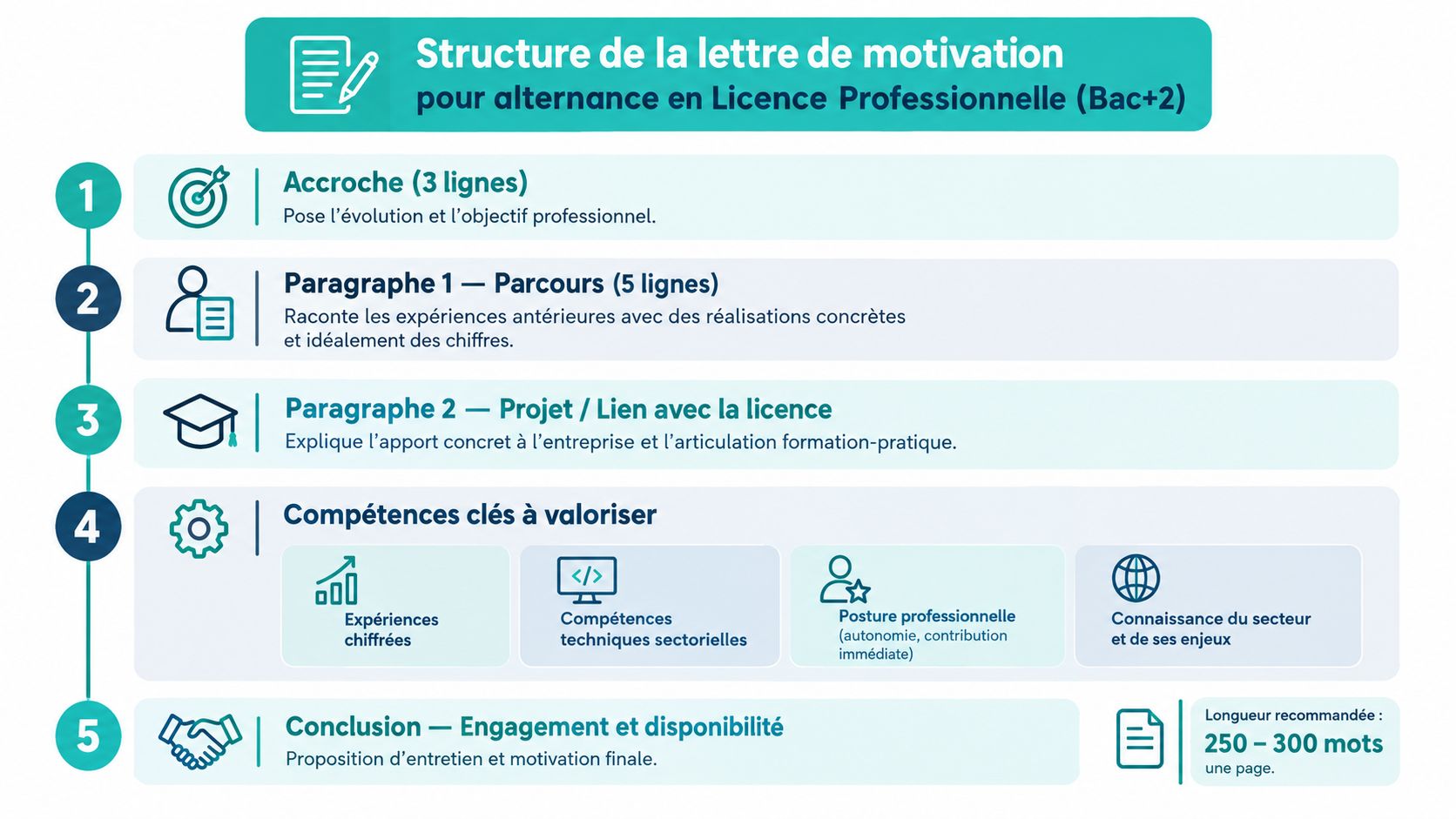
2. Cover Letter for Work-Study in Professional Bachelor’s Degree
At the professional bachelor’s level, recruiters expect a more developed application. You usually don’t start from scratch. Your BTS, second-year university, internships, projects, or student jobs should show progression toward the targeted profession.
Hook and Proof to Prioritize
The hook should explain why this bachelor’s degree is the logical next step. For example, after a BTS Logistics and an internship with a carrier, you might write:
“After a BTS Logistics and initial experience in shipment tracking, I wish to join a professional bachelor’s program focused on supply chain in work-study. Your regional transport activity attracts me because it would allow me to connect my skills in flow organization with the daily constraints of a delivery network.”
Proof can come from an internship, university project, or temporary mission. Describe an action, tool, and verifiable result without inventing achievements. You might write “I tracked shipments using a monitoring spreadsheet” or “I prepared the presentation of a group project on time.” If you have a measured result, add it with context.
Company Connection and Conclusion
Your central paragraph should answer a simple question: what task can you handle with reasonable guidance? A law student in second year might link internships to regulatory monitoring, document filing, or case processing without claiming mastery before practice.
Avoid presenting the degree only as what you hope to learn. Also explain what your background already allows you to contribute. The conclusion can state your goal: “This work-study fits my objective to work in operations coordination and would let me contribute quickly to case follow-up. I would be available to discuss this progression further.”
3. Cover Letter for Work-Study in Master’s or Bac+4 Level
At this level, a too academic letter works against you. The recruiter must understand your specialization, professional project, and technical skills you can bring to a finance, consulting, or audit team.
Hook and Proof to Prioritize
Start with a challenge related to the position, not a long personal intro. For a Master’s in Finance, you could say: “In Master’s Finance, I wish to join your analysis team to apply my skills in financial modeling, research, and data presentation.” For consulting, link your application to a problem type the company handles, avoiding vocabulary you don’t master.
Proof must be precise. Mention an evaluation project, sector analysis, Excel work, or a presentation to a group. If you used Power BI, Python, or another tool, specify what you produced. A skill alone proves nothing; a skill linked to a deliverable helps the recruiter place you.
Company Connection and Conclusion
Check the company’s activity pages and spot a project, specialty, or value clearly visible. You can mention clientele, mission types, or team organization. Don’t claim knowledge of news you haven’t verified.
For a Master’s profile, personalization should focus on the work to be done, not just the employer’s reputation.
Your conclusion can be ambitious without promising results: “I want to build my project in financial analysis and bring my rigor and synthesis skills to your missions. I would be glad to discuss your team’s needs and my work-study schedule.” A dense letter fits one page with short sentences and chosen proofs.
4. Cover Letter for CAP or Trade Apprenticeship
For a CAP in Electricity, an apprenticeship in hairdressing, plumbing, or baking, the letter should mainly reassure the mentor about your seriousness. You don’t need to give the impression of knowing everything. Show that you understand the trade realities and are ready to learn professionally.
Hook and Proof to Prioritize
A letter to an artisan can be more natural than one addressed to a large company. Explain what led you to the trade, whether a career change, family experience, or interest discovered during an internship. Avoid overly long personal stories.
For a neighborhood salon, you might write: “I want to prepare a CAP in Hairdressing because client interactions and manual work match what I seek in a trade. Your salon interests me for its diverse clientele and emphasis on advice.” Proof can be immersion, personal practice, a school project, or public contact experience.
Company Connection and Conclusion
Show you’ve considered schedules, physical effort, punctuality, and teamwork. If possible, call the artisan or visit before sending your application. This doesn’t replace a letter but helps personalize content and identify the right recipient.
The conclusion can suggest a concrete meeting: “I would be happy to meet you to explain my project and learn more about your working methods.” Use respectful language without artificial formality. To find artisans or small businesses likely to recruit, Jobshift can help locate offers and tailor your approach.

5. Cover Letter for Career Change to IT or Tech
A career change shouldn’t be presented as a confusing break. Your letter should tell a coherent transition story, prove your commitment, and show how your previous job can be an asset in the new role.
Hook and Proof to Prioritize
Start with an honest, positive sentence. An HR manager aiming for a DevOps work-study might write: “After several years in human resources, I chose to train in cloud environments and automation to transition to DevOps roles.” A graphic designer learning frontend development can link visual culture to web integration interest.
Don’t just cite a bootcamp or online course. Add proof: GitHub repo, personal project, certification, app made, or documented exercise. Briefly describe the problem addressed and your contribution. If your previous job taught you to manage priorities, communicate with diverse stakeholders, or document processes, connect these skills to expected tech team collaboration.
Company Connection and Conclusion
The company must understand why you target it. A scale-up might interest you for its product environment, technical organization, or role nature, but choose a feature truly present in the offer. Don’t present your career change as an abstract certainty. Show actions already taken and your ability to continue learning.
The conclusion might say: “I now want to embed this transition in a long-term company experience where I can contribute concretely while strengthening technical skills. I would be available to present my projects and work-study schedule.” One page is enough. The link between your past and project should be visible but not dominate the letter.

6. Cover Letter for International Work-Study Internship
An international application shouldn’t give the impression you just want to travel. It must reassure the company about your ability to work in another language, understand a different culture, and handle mobility logistics.
Hook and Proof to Prioritize
Immediately specify the program or mobility framework. For a Belgian SME, you could write: “As part of my professional bachelor’s, I seek a work-study position in Belgium to develop project management skills in a francophone and international environment.” For a German company, prepare an English or German version if requested.
Your proof can come from a stay, job, university project with foreign students, or regular language use. Indicate your level only if based on evaluation or verifiable experience. Adaptability also shows through lived situations, like remote collaboration or preparing work in another language.
Company Connection and Conclusion
Explain why you choose this country, sector, and company. Check local conventions, as letter expectations may differ. Clarify the program, contract, timeline, working language, and administrative steps you’ve started without claiming a visa or document is secured if not yet.
The conclusion should reassure about your commitment: “This mobility is a well-constructed professional project, not just a discovery experience. I would be happy to discuss contract terms and my ability to integrate your team.” To find opportunities, check Erasmus+, LinkedIn, and the dedicated work-study job board. Jobshift can also help filter offers and adapt vocabulary to the language and context of the listing.
7. Cover Letter After a Gap or Career Redirection
A gap in your path doesn’t need to be the main letter topic. Address it briefly, explain actions taken since, and quickly steer the reader toward your current project.
Hook and Proof to Prioritize
A simple phrase suffices: “After a period of career redirection, I chose to train in digital marketing and build a professional project more aligned with my interests.” If related to health, you don’t need to provide medical details. Stay factual and protect your privacy.
Proof should focus on what you’ve done to move forward. Mention online courses, volunteering, personal projects, refreshers, or regular activity. Changing courses after several semesters can be presented as a thoughtful decision if you show what confirmed your new direction.
Company Connection and Conclusion
The employer mainly wants to know if you’re ready to commit now. Link your new direction to a specific task in the offer. For example, someone targeting an administrative work-study can explain their project taught them to organize documents, track deadlines, or use management tools if accurate.
Don’t try to erase the gap. Frame it, prove what you built, then return to the value you can bring.
End on the present: “This new direction is now clear and I want to realize it in a team where I can learn, contribute, and stay long-term. I would be available to discuss it.” One page is enough. To complete your application, also check advice on the resume without professional experience, then tailor both resume and letter to the same offer.
Comparison of 7 Work-Study Cover Letter Templates
| Type of Work-Study | Complexity 🔄 | Required Resources ⚡ | Results / Impact 📊 | Key Advantages ⭐ | Quick Tips 💡 |
|---|---|---|---|---|---|
| BTS (Bac level) | Low: simple formal structure | Low: school projects, motivation, some internships | Fast insertion in work-study, operational junior profile | Accessible for beginners, compensates lack of experience | Personalize each letter, 1 page, show understanding of rhythm |
| Professional Bachelor (Bac+2) | Medium: experience proofs needed | Internships with data, achievements, technical skills | Quick autonomy in company, strong employability | Highlights skills and allows negotiation | Include numbers/results, link path and role, 250–300 words |
| Master (Bac+4, finance/consulting) | High: focused, sector-specific message expected | Targeted research, technical projects/analysis, networking | Strong CDI potential, significant career impact | Strong differentiation, attractive salaries | Quote insight on company, concrete results, max 250 words |
| CAP / Trade Apprenticeship | Low-medium: direct and honest tone | Visit/contact artisan, availability, clear motivation | Immediate local hiring possibility, practical trade training | Mentors favor motivation | Offer visit or call, natural tone |
| Career Change to IT/Tech | Medium-high: tell a credible transition story | Proofs: bootcamp, GitHub, projects, certifications | Distinctive profile; access to junior tech roles | Previous experience valued as unique asset | Show technical proofs (links), link transferable skills |
| International Work-Study | High: administrative & cultural constraints | Language level, visa/accommodation, local knowledge | High CV value; marked intercultural skills | Strong differentiation; possible aids (Erasmus+) | Write in requested language, specify logistics/visa |
| After Gap / Career Redirection | Medium: explain briefly and honestly | Concrete actions: training, volunteering, projects | Can demonstrate resilience and commitment if well presented | Allows turning the page and valuing restart | Mention gap in 1–2 sentences, emphasize recent actions |
Turn the Template into a Credible Application
A template is only a starting point. The quality of your letter depends on the adaptation work before sending, especially when recruitment conditions may be less favorable. By July 2025, 141,600 apprenticeship contracts had started since January, a 2.7% decrease year-over-year, with a 30.1% drop in the public sector; these data are in the Dares economic report. Your letter must clearly answer “why this company and position now?”
Use this four-step check:
- Use the job offer’s words. Identify missions, tools, skills, and constraints truly mentioned, then use them naturally.
- Prove each quality. Replace “rigorous” with a task done methodically, a delivered project, a tool used, or responsibility taken.
- Personalize the company. Explain why its activity, team, or mission fits your project without interchangeable compliments.
- Check the form. Verify length, subject, school-company rhythm, availability date, recipient, spelling, and consistency with the resume.
Frequently Asked Questions About Work-Study Cover Letters
What length should a work-study cover letter be?
One page is enough for most applications. Remove repetitions and keep information that helps the recruiter understand your training, availability, proof, and link to the role.
How to write a good hook?
Don’t start with a general motivation formula. State your training, targeted position, availability or schedule, then connect your application to a company mission or activity.
Should each letter be personalized?
Yes. At minimum, change the subject, company name, hook, and paragraph about tasks. Identical applications don’t explain why you target that employer.
What to include if you have no experience?
Use a school project, association activity, student job, volunteering, or personal achievement. Describe what you did and link it to a skill useful for the program or role.
Can Jobshift help write my cover letter?
Jobshift can help find offers, filter opportunities, and tailor your resume or letter to a listing’s criteria. Always proofread and replace generic phrases with your own facts.
How is this different from a motivation training project?
The work-study cover letter addresses a company and shows what you can contribute during company periods. The motivation training project addresses an institution and explains why the program fits your path.
Now find offers matching your level, select those truly aligned with your project, and tailor each letter before sending. You’ll gain coherence and give recruiters a concrete reason to meet you.
Jobshift helps you discover offers, create targeted selections, and adapt your resumes and cover letters to each job’s requirements. Visit Jobshift to prepare your work-study applications and move faster from found offer to submitted file.
À propos de l'auteur
Chris Massie, cofondateur de l'appli Jobshift. Il travaille sur l'outil depuis sa première version : analyse du CV face à l'offre, réécriture automatique des blocs faibles, candidatures envoyées en mode swipe. Profil LinkedIn