Handwritten cover letter: when to write it by hand, and 3 templates
 Chris Massie
Jobshift
November 12, 2026 · 16 min read

Partager l'article
A handwritten cover letter is only written today when the employer asks for it explicitly in the job ad: in every other case, a typed letter in PDF or an email is enough. If you are asked for one, write it on a plain white A4 sheet, in blue or black ink, with no crossings-out, keeping it to one page, after a complete draft written on a computer.
This guide tells you when a letter by hand is still expected, how to prepare it and lay it out cleanly, how to send it (by post or as a scan), what the law says about graphology, and gives you 3 short templates designed to be copied out by hand.
In short
- By default, type your letter. A handwritten letter is justified only if the ad asks for it in so many words (“handwritten letter”, “letter written by hand”).
- Draft first: write and have the text proofread on a computer, then copy it out. A crossing-out or a typo on a handwritten letter means starting the whole page again.
- Materials: plain white A4 paper (no lines or squares), a blue or black ink pen that does not bleed, and a lined guide slipped under the sheet to write straight.
- Format: a single page, front only, about 15 to 20 lines of text, with the same structure as a classic letter (contact details, subject line, three paragraphs, closing, signature).
- Graphology: an employer may analyse your handwriting only after informing you in advance, with a method that is relevant to the role, and the results must remain confidential (articles L1221-6 to L1221-9 of the Code du travail).
- Online applications: if the ad asks for a handwritten letter but a reply by email, scan it as a readable PDF rather than sending a crooked photo.
Contents
- When is a handwritten cover letter still required?
- Handwritten letters and graphology: what the law says
- Before you write: the draft and the materials
- The layout of a handwritten cover letter
- 3 handwritten cover letter templates to copy out
- Sending a handwritten letter: post, in person, or a scan
- The mistakes that ruin a letter written by hand
- Checklist before it goes in the envelope
When is a handwritten cover letter still required?
The rule is simple: you write by hand only if the employer asks for it. Official advice on cover letters all assumes that the letter is typed. France Travail recommends, for example, “a single typeface”, such as Times New Roman or Arial 12 point, and Onisep notes that, for an application by email, “about ten lines are enough”. Sending a handwritten letter that nobody asked for will not earn you points: it will be slower to read, impossible to copy into a recruitment system, and often scanned at an angle.
You may, however, come across a request for a handwritten letter in these situations:
- The ad says so: “CV + handwritten cover letter”, “letter written by hand”. This is the only really reliable signal. In that case, follow the instruction to the letter: a typed letter will be seen as an unread instruction.
- Small organisations and local hiring: some shops, practices, craft businesses or associations still recruit by post or in person and may ask for a letter written by hand to get a sense of the care the candidate has taken.
- The recruiter uses a graphologist: this has become rare, and it is framed by law (see the next section). The employer must then inform you before any analysis.
- Some enrolment or selection files (training programmes, schools, competitive exams) may ask for a handwritten letter in their rules. Trust the official text of the file, not the habits of previous years.
If you are unsure (for example an ad that only says “cover letter” and a postal address), do not guess: send a typed, signed letter, or ask the contact named in the ad. A typed letter has never been held against a candidate when nothing else was requested.

Handwritten letters and graphology: what the law says
If you are asked for a handwritten letter, it is sometimes so that it can be analysed by a graphologist. You have rights, set out in articles L1221-6 to L1221-9 of the Code du travail.
1. The information requested must serve to assess your skills. Article L1221-6 provides that information requested from the candidate, “in whatever form”, may have no purpose other than “to assess their ability to hold the job offered or their professional aptitudes”, and that it must have “a direct and necessary link” with the job.
2. You must be told in advance. Under article L1221-8, the candidate “is expressly informed, prior to their implementation, of the recruitment methods and techniques used in their regard”. The results “are confidential”, and these methods “must be relevant to the purpose pursued”. A handwriting analysis carried out without your knowledge therefore does not comply with this text.
3. Graphology is not an unrestricted method. The official Service-Public.fr fact sheet on authorised recruitment methods states that “recourse, in particular, to astrology, graphology or numerology is prohibited, except where there are relevant justifications”, that the methods used must be brought to the attention of the candidate and of the CSE if there is one, and that the results are given to the candidate if they ask for them.
4. Your application data are protected. The CNIL also recalls the rules that govern how recruiters collect and keep candidates’ data.
Before you write: the draft and the materials
A successful handwritten letter is decided before you pick up the pen. The content itself does not change: it is a classic cover letter, with the “you, me, us” structure described by France Travail. Only the medium changes.
Write the draft on a computer
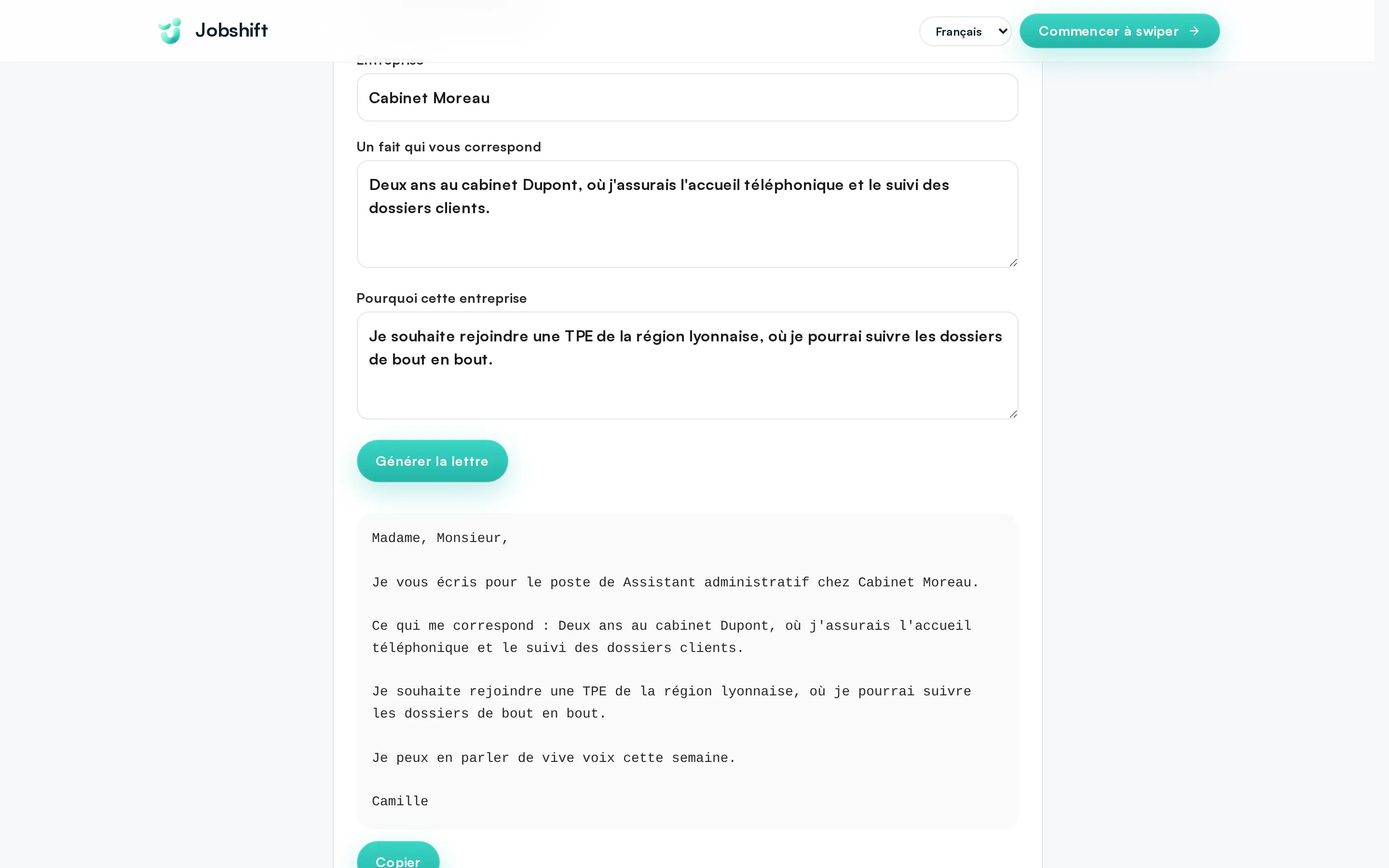
- Write the full text on a computer or phone. That is where you correct, shorten and move sentences, without wasting paper. You can start from a first version made with the free cover letter generator, then personalise it.
- Shorten it. A handwritten page holds far less text than a typed page. Aim for about 15 to 20 lines of text, that is three short paragraphs. Our guide to the short and simple cover letter gives the method for cutting without losing what matters.
- Have it proofread. Onisep advises avoiding repetition and spelling mistakes, and asking a third person to proofread. On a handwritten letter this matters even more: a mistake found afterwards means a new sheet.
- Print or display the final draft next to you so you can copy it word for word, without improvising.
The right materials
- Paper: plain white A4, of a reasonable weight so the ink does not show through. Avoid squared or lined paper, torn-out notebook sheets, and coloured paper.
- Pen: blue or black ink, a pen that does not bleed and that you are used to. Test it on a spare sheet. No thick felt-tip, no fancy colour, no pencil.
- Lined guide: a sheet with strong black lines slipped under your white page helps you write straight and keep even margins. You can draw one yourself with a ruler.
- Several spare sheets: plan to spoil one or two.
- No correction fluid: a letter with white-out or a crossing-out has to be started again.
Your handwriting
The recruiter must be able to read you at first glance. Write more slowly than usual, with an even size and well-formed letters. If your joined-up handwriting is hard to read, careful print (script) handwriting is perfectly acceptable: the goal is readability, not calligraphy.
The layout of a handwritten cover letter
The layout follows that of a classic letter. France Travail recalls the expected structure: your contact details on the left, those of your addressee on the right, then the subject line repeating the job title and the ad reference, on a single page and with an airy layout.
The page diagram
First name SURNAME
Address
Phone
Email
                                     Company name
                                     For the attention of Ms / Mr Name
                                     Address

                                     City, 12 November 2026

Subject: application for the position of [job title] – ref. [reference]

Dear Sir or Madam,

[Paragraph 1 – you: the role, the company, why this company]

[Paragraph 2 – me: one or two pieces of evidence linked to the role]

[Paragraph 3 – us: the next step you propose]

[Closing]

                                                    Signature
                                                    First name SURNAME
The handwriting layout rules
- Margins: leave about two to three centimetres on each side, and a little more at the bottom for the signature. The lined guide helps you keep them.
- Contact details: you may write them by hand at the top left. If the ad only asks for a “handwritten letter”, the body of the letter must be handwritten in full; do not mix a printed header and a handwritten body unless you know that is accepted.
- Paragraphs: leave a blank line between each paragraph. Three clear blocks read better than a dense block of text.
- Front only: the letter fits on one page. If you overflow, shorten the draft rather than writing smaller.
- Signature: sign by hand under the closing, then write your first name and surname clearly.
- Date and place: at the top right, under the addressee block.
3 handwritten cover letter templates to copy out
These three templates are deliberately short (about 15 to 20 lines by hand) so they fit comfortably on an A4 page. Replace everything in square brackets, and change the example in the second paragraph so that it matches your own path. Do not invent any experience: the recruiter may ask you about it in the interview.
Template 1: reply to an ad that asks for a handwritten letter
Subject: application for the position of administrative assistant – ref. [reference]

Dear Sir or Madam,

Your advertisement for an administrative assistant role at [company]
caught my attention, in particular the front-desk work and the follow-up
of client files that you describe.

For [duration] at [previous company / internship / association], I was responsible
for [a concrete task: answering the phone, entering invoices, keeping
a manager’s diary]. I learned to handle several requests at once
without losing track, and to deliver work that is neat and checked.

I would be glad to explain in person what I can bring
to your team and remain available for an interview at your convenience.

Yours faithfully,
Template 2: a speculative application dropped off in person or sent by post
Subject: speculative application – [job title] role

Dear Sir or Madam,

As a customer of your [shop / bakery / agency] in [city] for [duration],
I appreciate [a precise reason: the advice on the floor, the quality of the products,
the welcome]. That is why I am offering my application for a
[job title] role, [full / part] time, from [date].

[Experience or evidence: a first job, an internship, volunteer work]
taught me to [a skill useful for the role: welcome and advise customers,
run a till, work in a team at the weekend].

I would be glad to come and meet you at a time that suits you.
I can be reached on [phone].

Yours faithfully,
For more examples of this kind, see our guide to the speculative cover letter.
Template 3: internship or work-study (a file that requires a handwritten letter)
Subject: work-study application – [qualification prepared] – start [year]

Dear Sir or Madam,

As a student in [programme] at [school], I am looking for a host company
for a work-study programme to prepare [qualification] from [month year], on a
[school / company] schedule. Your work in [sector] matches
exactly the occupation I want to practise.

During [an internship / project / job], I [a concrete, verifiable result].
I want to develop these skills on the ground, in a team
such as yours.

I would be delighted to talk with you in an interview.

Yours faithfully,
Still looking for a host company? Jobshift’s work-study openings are organised by occupation and by city. For a longer typed version, see our work-study cover letter examples and our 3 complete cover letter templates.
Sending a handwritten letter: post, in person, or a scan
By post
Fold the letter in three (or use a large envelope so you do not fold it), enclose your printed resume, and write the address clearly, with the addressee’s name if the ad gives it. Keep a photo or a copy of your letter so you can remember it before the interview.
In person
For a speculative application in a shop or a small company, handing in your letter in person is a chance for a first contact. Come at a quiet time (not during the rush), ask for the manager’s name, and keep the letter and resume in a folder so they stay clean.
By email or on an application site
If the ad asks for a handwritten letter but a reply online:
- Scan it rather than photographing it. A phone scanning app straightens the page and produces a clean PDF. Check that the document is readable on screen, in full, with no shadow and no finger on the page.
- Name the file clearly:
Handwritten-letter-Firstname-Lastname.pdf. - Add a few lines in the body of the email: the role, the reference, and a mention of the attachments. The application email generator can give you a first version, and our guide to the speculative application email covers the subject line and the closing.
- Also send your resume as a PDF, ideally compatible with recruitment software: you can check it with the free ATS test.
Whatever the channel, note the date you sent it and the planned follow-up in your application tracker.
The mistakes that ruin a letter written by hand
- Writing by hand when it was not asked for, thinking it will help you stand out. The recruiter generally expects a typed document.
- Copying without a proofread draft: a spelling mistake on a handwritten letter is just as visible as on a typed one, and it cannot be corrected.
- Crossing out or using correction fluid: if you make a mistake, start the sheet again.
- Writing too small to make everything fit: shorten the text instead.
- Using a notebook sheet, squared paper or coloured paper, or a fancy ink.
- Writing at an angle because you had no lined guide, with margins drifting down the page.
- Sending a blurry photo of the letter instead of a PDF scan.
- Copying a template without personalising it: the company name, the role and the example must be yours. France Travail advises adapting each letter to the addressee and to the role you are aiming for.
Checklist before it goes in the envelope
- The ad does ask for a handwritten letter (otherwise, send a typed letter).
- The draft has been proofread by someone else and contains no mistakes.
- The letter fits on one page, front only, with even margins.
- No crossings-out, no correction fluid, handwriting readable from start to finish.
- The subject line repeats the job title and the ad reference.
- The company name and the addressee are spelled correctly.
- The letter is dated and signed.
- The resume is enclosed (printed or as a PDF, depending on the channel).
- If sending online: a readable PDF scan, a clearly named file, and a short accompanying email.
- The application is recorded in your tracker, with a follow-up date.
Apply faster to the openings that do not ask for a handwritten letter, with Jobshift
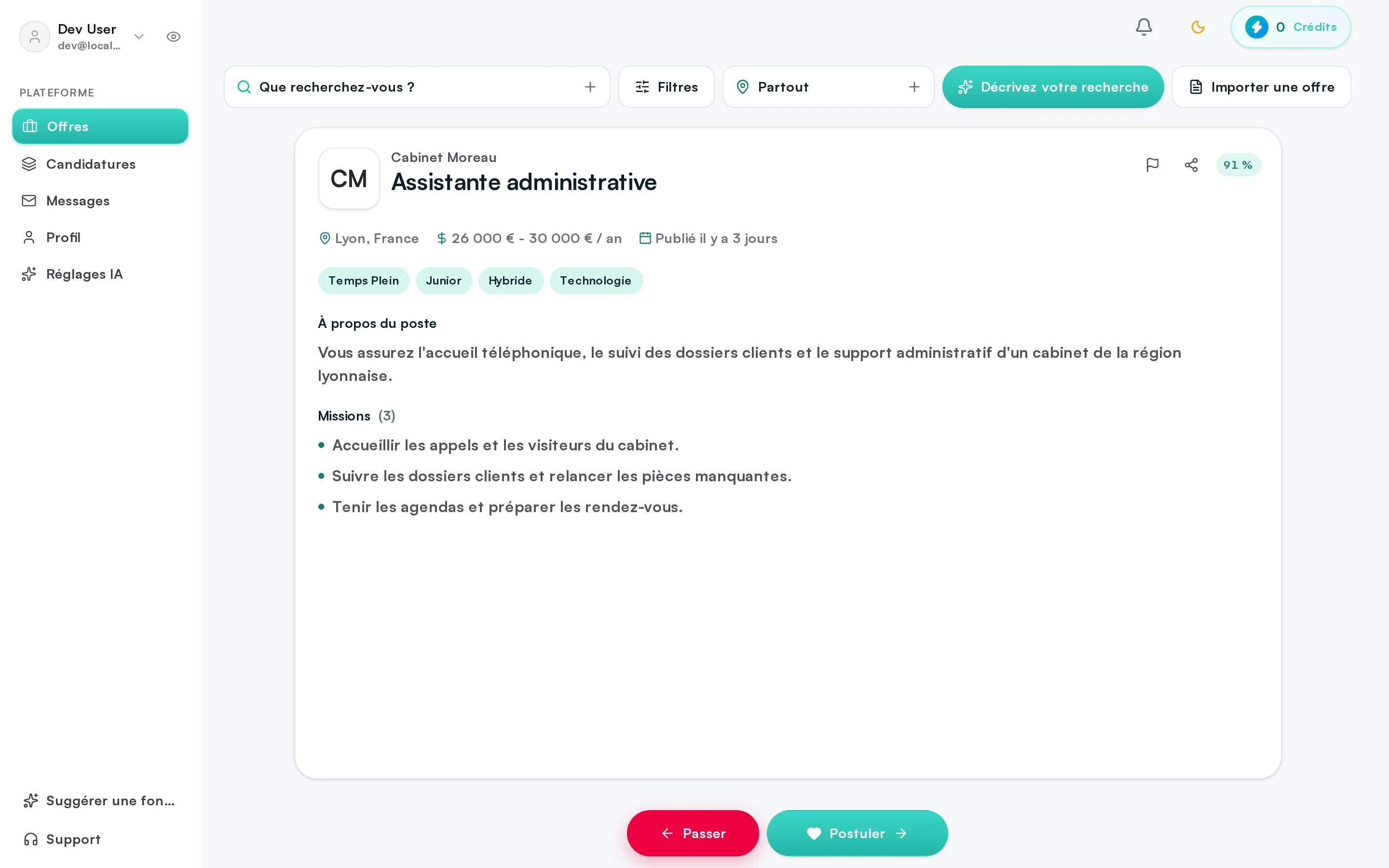
Handwritten letters remain the exception: the large majority of openings are applied for online, with a resume and a message tailored to the role. That is where Jobshift saves you time, with an app that lets you apply to jobs by swiping.
- Swipe right on an opening you like: Jobshift prepares the application for you.
- A resume and message tailored to each opening, with the role’s keywords, that you keep control of and can review.
- Centralised tracking of all your applications, so you know who to follow up with and when.
Keep your energy (and your best pen) for the few openings that really require a letter by hand.
Apply to dozens of openings while you take care of the one that asks for a handwritten letter. Create your profile in a few minutes and start swiping. Try Jobshift for free
Related articles
- Cover letter template: 3 complete letters to personalise
- Short and simple cover letter: 10 templates ready to copy
- How to write a convincing cover letter
- Cover letter for a speculative application: examples
FAQ
Do you still need to write a handwritten cover letter?
Only if the employer asks for it explicitly in the ad or in the application file. In every other case, a typed letter in PDF or an application email is the norm, and that is what the official advice from France Travail and Onisep assumes.
What pen and paper should you use for a handwritten cover letter?
A blue or black ink pen that does not bleed, and a plain white A4 sheet, with no lines or squares. Slip a lined guide under the sheet to write straight, and keep spare sheets ready: a crossing-out or correction fluid means starting again.
Can an employer have my handwriting analysed by a graphologist?
Only in compliance with the Code du travail: you must be informed of the method before it is used, it must be relevant to the role, and the results must remain confidential (articles L1221-6 and L1221-8). Service-Public.fr states that graphology is prohibited except where there are relevant justifications, and that the results are given to you if you ask for them.
How do you send a handwritten cover letter by email?
Scan it as a PDF with a scanning app rather than photographing it, check that it is readable on screen, name the file clearly, then attach it with your resume as a PDF and a few accompanying lines in the body of the email.
How long should a cover letter written by hand be?
One page, front only, that is about 15 to 20 lines of text in three paragraphs. If your text overflows, shorten the draft rather than writing smaller.
Can you write a handwritten letter in print (script) handwriting?
Yes. What matters is that the recruiter can read you without effort. Even, careful print handwriting is better than joined-up writing that is hard to decipher.
Sources
- Methods and techniques for assisting recruitment (Service-Public.fr)
- Article L1221-6 of the Code du travail (Code du travail numérique)
- Article L1221-8 of the Code du travail (Code du travail numérique)
- 10 tips for writing your cover letter (France Travail)
- Adapt your cover letter to your application (France Travail)
- The cover letter: the basic rules (Onisep)
- Answering a job offer: the steps of an application (Onisep)
- Recruitment (CNIL)