Data analyst apprenticeship in France: skills, CV and how to land a contract
 Chris Massie
Jobshift
November 13, 2026 · 18 min read
Partager l'article
To land a data analyst apprenticeship, you have to prove three things on the CV from the start: that you can query a database in SQL, that you can clean and analyse data (advanced Excel, Python or R), and that you can turn the result into a dashboard a non-data colleague can read. The best way to prove it when you do not yet have experience is 2 or 3 concrete projects published online, cited at the top of the CV and talked through in the interview.
This guide explains what a data analyst apprentice actually does, the skills to show, the degrees that can be prepared in alternance, the minimum salary of an apprentice, then the full method: portfolio, junior data analyst CV, application and technical test. To go straight to the openings, visit the data analyst apprenticeship listings page.
In short
- The role: prepare, clean and structure data, then produce analyses, dashboards and reporting that help people decide (marketing, customer relations, production, logistics…), as described in the Onisep occupational profile.
- The skills to prove: SQL (the number-one filter), a solid spreadsheet, Python or R for analysis, a dataviz tool (Power BI, Tableau, Looker Studio…), basic statistics and the ability to explain a result simply.
- The degrees: Onisep notably cites the BUT in data science (bac + 3), bachelor's and master's degrees in data science, statistics or business intelligence, and engineering schools. Many can be prepared through apprenticeship, to be checked programme by programme.
- Pay: on a contrat d'apprentissage, it is a minimum percentage of the Smic that depends on your age and your year of the contract (official grid on Service-Public.fr). Estimate yours with the apprenticeship salary calculator.
- The method: 2 or 3 published projects, a one-page results-oriented CV, an application adapted to each posting's keywords, and serious preparation for the SQL test.
Contents
- What does a data analyst apprentice do?
- The skills to show for a data analyst apprenticeship
- Which degrees prepare you for a data analyst apprenticeship?
- Contract, schedule and salary of a data analyst apprentice
- The method to land a data analyst apprenticeship
- The mistakes that cost a data analyst apprenticeship
- Checklist before you send your application
What does a data analyst apprentice do?
According to Onisep, the data analyst “prepares the data, cleans it, structures it, writes processing automation rules, develops algorithms, creates dashboards and reporting or statistical models” that help improve the company's strategy. The role exists in banking, insurance, retail, e-commerce, industry and healthcare.
In alternance, you split your time between school (or the CFA) and the company. On the company side, the duties given to an apprentice often look like this:
- Extract data from a database or an internal tool with SQL queries, to answer a team's question (sales, marketing, customer service, HR…).
- Clean and make it reliable: duplicates, missing values, inconsistent date formats, joins between several sources.
- Build and maintain dashboards in Power BI, Tableau, Looker Studio or an equivalent, and automate their updates.
- Produce one-off analyses: how an indicator has evolved, a before/after comparison after an action, customer segmentation.
- Present the results to people who are not in data, orally or in a short note.
It is often this last point that makes the difference: the company is not only hiring someone who can write a query, but someone who can say “here is what this means, and here is what I recommend”.
Data analyst, data scientist, data engineer: do not apply to the wrong posting
The three titles overlap in “big data” apprenticeship postings, but the expectations are not the same:
| Role | Core of the work | Tools often cited in postings |
|---|---|---|
| Data analyst | Analyse, visualise, explain to help people decide | SQL, spreadsheet, Power BI / Tableau, Python or R |
| Data scientist | Build predictive and advanced statistical models | Python, machine-learning libraries, statistics |
| Data engineer | Build and run data pipelines and infrastructure | SQL, Python, pipeline and cloud tools |
If you are starting out, the data analyst role is generally the most accessible, because it rests first on SQL, rigour and communication. Always read the list of duties rather than the title alone: some “data analyst” postings actually describe pure reporting, others engineering work.

The skills to show for a data analyst apprenticeship
Onisep sums up the essentials: “mastery of databases, tests and statistical methods, programming languages, visualisation, mining and data-analysis tools”, plus an aptitude for “communicating, listening, explaining, summarising” and respect for personal-data protection rules. Here is how to turn that into concrete skills for your CV.
Technical hard skills
- SQL:
SELECT,WHERE,GROUP BY,HAVING, joins (JOIN), subqueries, and ideally window functions (ROW_NUMBER,SUM() OVER). This is the skill most often tested in interviews. - Advanced spreadsheet: pivot tables,
XLOOKUPorINDEX/MATCH, conditional formatting, Power Query if possible. - Python or R: in Python, the pandas library to manipulate data tables, and a charting library. A clean notebook is worth more than a long list of libraries.
- Dataviz: at least one dashboard tool (Power BI, Tableau, Looker Studio, Metabase…) and the right habits: one chart per message, titles that state the conclusion.
- Basic statistics: mean and median, dispersion, correlation, the idea of a statistical test, and knowing when a gap is not significant.
To present these skills cleanly on a CV, with examples by sector, see our guide to hard skills to put on a CV.
The soft skills that actually matter in data
- Knowing how to ask the question before diving into the data: who will use the result, and to decide what?
- Explaining simply: describe a result in two sentences to a marketing manager or a plant director.
- Rigour: check your figures, document your queries, flag doubtful data rather than hide it.
- Business curiosity: understanding how the company makes money makes your analyses much more useful.
The GDPR reflex
A data analyst often handles personal data (customers, employees, users). The CNIL recalls that personal data is any information relating to an identified or identifiable natural person, directly or indirectly. Showing in the interview that you know the main GDPR principles (data minimisation, purpose limitation, security, pseudonymisation when possible) is a real plus, especially in banking, insurance or healthcare.
Which degrees prepare you for a data analyst apprenticeship?
The Onisep occupational profile gives a minimum entry level of bac + 3 and cites several pathways:
- Bac + 3: the BUT in data science (exploration and statistical modelling track), a bachelor's degree with a data-science pathway, or some specialised bachelors.
- Bac + 5: a master's in statistics and information processing, data mining, econometrics, business intelligence or applied mathematics, or an engineering degree specialised in statistics, big data or artificial intelligence.
Many of these programmes exist in apprenticeship, but not all, and not on every campus. Check on the programme page (Onisep, the school's website) that the “apprentissage” or “alternance” track is actually open, with which schedule (for example alternating weeks or a few days a week), and from which year.
Two practical points to know:
- You can look for your company before you are fully admitted on some programmes, but the contract can only be signed once you are enrolled with a training organisation. Ask the school about its timetable.
- If you come from another field (management, marketing, economics, biology…), your domain knowledge is a real asset in data: an analyst who understands marketing or logistics is often more useful than a purely technical profile. Our guide to IT alternance in France also details the different entry routes into digital roles.
Contract, schedule and salary of a data analyst apprentice
Apprentissage or contrat de professionnalisation
Two contracts make alternance possible:
- The contrat d'apprentissage: a written employment contract, open in principle from 16 to 29 years of age inclusive (with exceptions up to 35 inclusive and with no age limit in some cases, for example for an apprentice recognised as a disabled worker). According to Service-Public.fr, training at the CFA must represent at least 25 % of the total duration of the contract, and this training time counts as effective working time.
- The contrat de professionnalisation: another alternance contract, with its own rules on who can sign and on pay, detailed on the dedicated Service-Public.fr fact sheet.
In higher-education data programmes, the contrat d'apprentissage is the most common case, but the school will tell you what it accepts.
The minimum salary of an apprentice
In apprenticeship, the minimum salary is a percentage of the Smic that depends on your age and your year of the contract. Here is the grid published by Service-Public.fr (fact sheet verified on 8 September 2026):
| Année de contrat | 16-17 ans | 18-20 ans | 21-25 ans | 26 ans et plus |
|---|---|---|---|---|
| 1re année | 27 % du Smic | 43 % du Smic | 53 % du Smic* | 100 % du Smic* |
| 2e année | 39 % du Smic | 51 % du Smic | 61 % du Smic* | 100 % du Smic* |
| 3e année | 55 % du Smic | 67 % du Smic | 78 % du Smic* | 100 % du Smic* |
\* From age 21, it is the higher of this percentage of the Smic and the same percentage of the conventional minimum wage for the job occupied.
These are minima: a collective agreement or a company agreement may provide more, and the company is free to pay more. Euro amounts are updated on the Service-Public.fr fact sheet; to get your estimate directly, use Jobshift's apprenticeship salary calculator.
As a reference for afterwards, Onisep indicates that a junior data analyst (after the degree) starts from 2 900 euros gross per month, depending on the place of work and the status.
The method to land a data analyst apprenticeship
Step 1: build 2 or 3 projects that prove your skills
Without experience, your projects are your experience. Choose public datasets (for example on data.gouv.fr, the French public-data platform) and take each project from end to end:
- A clear question: “Which departments have the most…?”, “How do sales change by season?”.
- Documented cleaning: what you corrected and why.
- The analysis: SQL queries or a readable Python notebook.
- The write-up: a dashboard or 3 charts, and a 3-line conclusion.
Publish everything (a GitHub repository with a clear README, an online dashboard if the tool allows it) and put the links in your CV. A project related to the target company's sector (retail, banking, healthcare, transport…) stands out much more than a generic exercise. The free tracks on Kaggle Learn or the official pandas documentation are good starting points to progress.
Step 2: a one-page junior data analyst CV
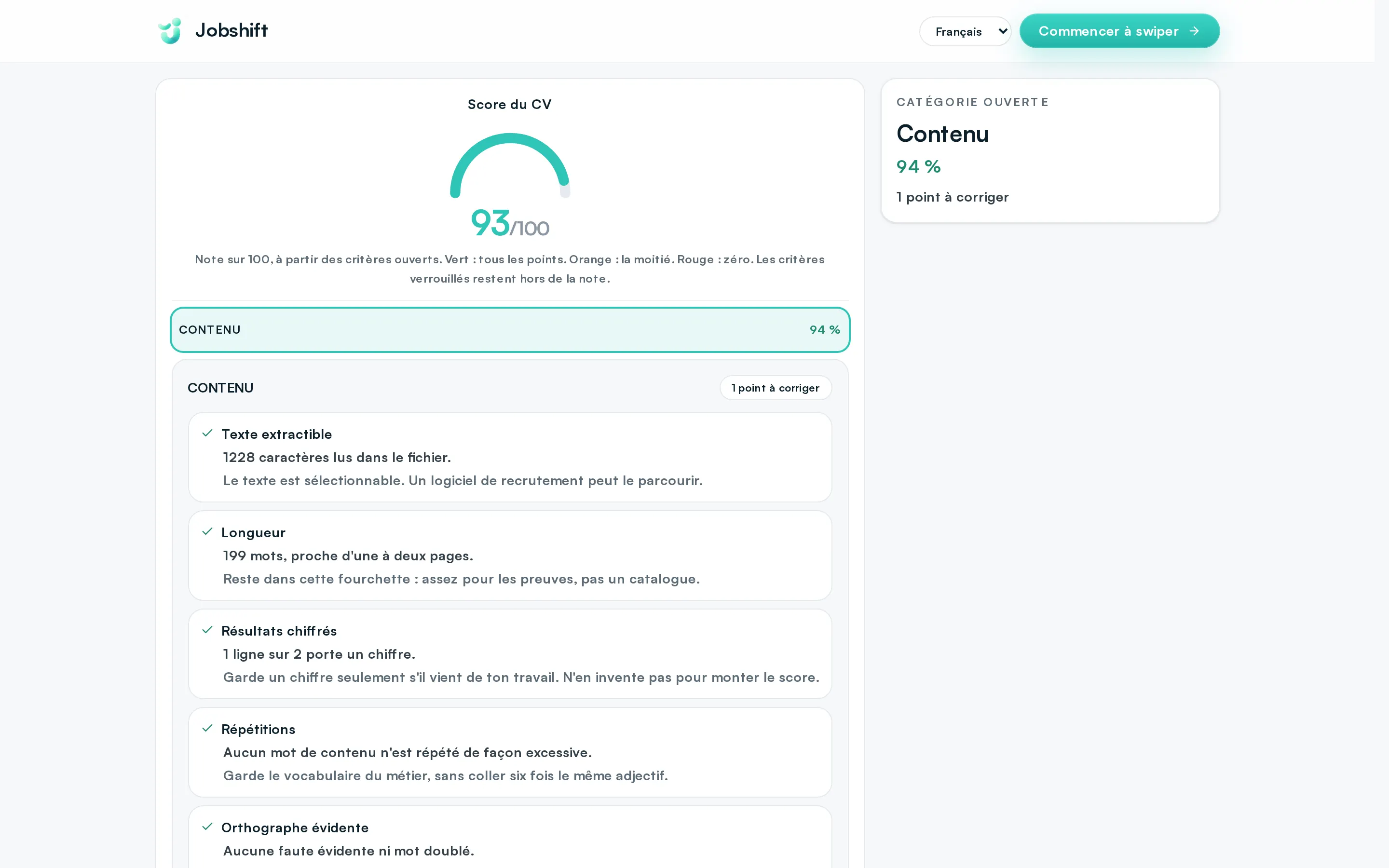
Your CV has to pass two filters: the screening software (ATS) that looks for the posting's keywords, then the recruiter who reads it in a few seconds. The principle: put your skills and projects at the top, and quantify what you can genuinely quantify (number of rows processed, number of sources combined, update time saved…), without ever inventing figures.
Here is a typical structure, with a fictional profile:
FIRST NAME LAST NAME
Data analyst apprenticeship - 1 week at school / 3 weeks at the company - from September
City · phone · e-mail · linkedin.com/in/… · github.com/…

PROFILE
Student on a BUT in data science (2nd year). I am looking for a 2-year
data analysis apprenticeship to build dashboards and analyses that are
useful to marketing or sales teams.

SKILLS
SQL (joins, aggregations, window functions) · Python (pandas) ·
Advanced Excel (pivot tables, Power Query) · Power BI · descriptive statistics ·
GDPR basics · technical English

DATA PROJECTS
Analysis of [public dataset] - SQL + Power BI          link
- Cleaning and joining [X] source files, documented in the README
- Dashboard of [N] indicators with filters by region and by month
- Conclusion: [what the analysis shows, in one sentence]

Customer segmentation on an e-commerce dataset - Python  link
- Commented notebook: preparation, segmentation, visualisations
- Written recommendations for a (fictional) marketing team

EDUCATION
BUT in data science - [IUT], [years]
Baccalauréat [special subjects] - [lycée], [year]

EXPERIENCE
Student job / internship / volunteering - [duties that show rigour,
customer contact or handling figures]
A few rules that change everything:
- Reuse the exact wording of the posting (if it says “Power BI” and “SQL Server”, write them as they are, if you master them).
- One CV per type of posting: a version oriented toward reporting and dataviz, another more oriented toward Python and statistics.
- No progress bars and no score out of 5 for your skills: they say nothing and do not pass well through ATS software.
- The free ATS test analyses your CV (PDF or DOCX) on format, readable text, section headings, contact details and dates: it does not compare the CV to a job posting. Start from the CV generator if you do not yet have a clean base.
For the general rules of an apprenticeship CV (layout, sections, schedule), also read how to write a CV for an apprenticeship.
Step 3: target the right postings and apply in smart volume
Data apprenticeship openings are published throughout the year, with a concentration around the start of the academic year, and they appear on several types of sites:
- Jobshift's dedicated pages: data analyst apprenticeship openings, all apprenticeship openings and the 2026 apprenticeships and 2027 apprenticeships selections according to your start date. If you are hesitating with a more technical role, also look at IT apprenticeship openings.
- La bonne alternance, the public service that lists openings and companies likely to hire in alternance.
- The career sites of companies that have a data team (banks, insurers, retail, e-commerce, industry, consultancies).
- Your school: many apprenticeship programmes relay openings from partner companies.
Adapt each application: a few lines on the company's sector and on one of your projects close to its issues are worth more than a long generic letter. The application-email generator and the cover-letter generator give you a first version to customise. Then track all your applications and follow-ups in one place with the application tracker.
Step 4: prepare the interview and the technical test
A data analyst apprenticeship interview often includes a technical part, in one of these forms:
- A SQL test live or remote: write queries on a small schema (customers, orders, products). Practise joins, aggregations and “top N per group”.
- A case study: “Sales fell this month, how would you analyse it?”. They expect an approach (check the data, break it down by segment, compare with the same period…) more than a single answer.
- The presentation of one of your projects: prepare a 3-minute version, with the question, the method, the result and what you would do next.
On classic questions, prepare at least:
- “Why data, and why our sector?”
- “Tell us about a time when your figures did not add up: what did you do?”
- “How would you explain this chart to someone who is not in data?”
- “How will you organise your time between school and the company?”
To practise out loud with questions adapted to the role, use the interview simulator. If the posting is in English (international groups, start-ups), the English CV translator helps you prepare a clean English version.
The mistakes that cost a data analyst apprenticeship
- Listing 15 tools with no evidence: 4 skills demonstrated by projects are better than 15 logos.
- Projects with no conclusion: a notebook that stops on a chart has not done an analyst's job.
- Neglecting SQL in favour of machine learning: for a data analyst role, the opposite is expected.
- Applying to data engineer or data scientist postings with a beginner analyst profile, without adapting the CV.
- An empty or messy GitHub link: the recruiter clicks, and a repository with no README does more harm than no link at all.
- Waiting until the start of term to look: start as soon as your admission is under way, with a calendar of applications and follow-ups.
Checklist before you send your application
- [ ] I have read the posting's duties and checked that it is really an analyst role.
- [ ] My CV fits on one page and reuses the exact keywords of the posting that I actually master.
- [ ] My 2 or 3 projects are online, with a README and a clear conclusion.
- [ ] My apprenticeship schedule, my programme and my start date are at the top of the CV.
- [ ] I have run my CV through the ATS test.
- [ ] My application message cites the company and a project linked to its sector.
- [ ] I have practised SQL joins and aggregations for the technical test.
- [ ] I have logged the application and the follow-up date in my tracker.
Apply faster to data apprenticeships with Jobshift
Jobshift works like a dating app, but for work: each opening appears as a card, you swipe right to apply and left to skip. For a data analyst apprenticeship, that lets you cover quickly the postings that match your profile, while you keep your energy for the applications that deserve a highly personalised message and for SQL-test preparation.
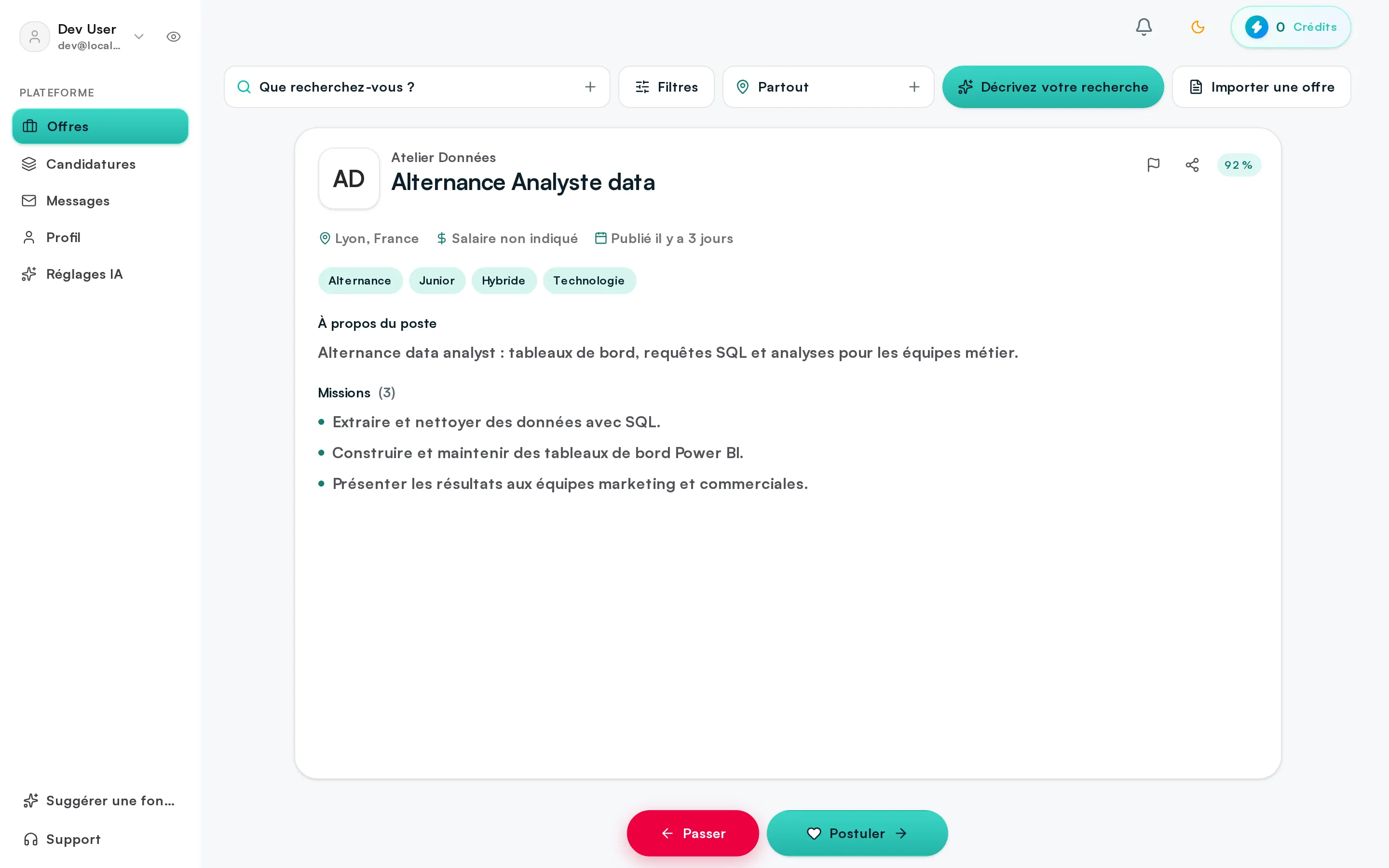
Find your data analyst apprenticeship without spending your evenings filling in forms. Create your profile in a few minutes and start swiping. Try Jobshift for free
Related articles
- IT alternance in France: degrees, roles and how to land the contract
- How to write a CV for an apprenticeship
- Hard skills: definition, 50 examples by sector and how to put them on your resume
- Cover letter for an apprenticeship: examples
FAQ
Which degree do you need for a data analyst apprenticeship?
The Onisep occupational profile gives a minimum entry level of bac + 3, for example the BUT in data science or a bachelor's degree in data science, then master's degrees in statistics, data mining, econometrics or business intelligence, and specialised engineering degrees. Check each programme page to confirm that the apprenticeship track is open.
What is the salary of a data analyst apprentice?
On a contrat d'apprentissage, the legal minimum is a percentage of the Smic that depends on your age and your year of the contract: for example 53 % of the Smic in the first year between 21 and 25, and 100 % of the Smic from age 26, according to Service-Public.fr. A collective agreement or the company may provide more. Jobshift's apprenticeship salary calculator gives an estimate for your situation.
Which skills should you put on a CV for a data analyst apprenticeship?
In priority, SQL, an advanced spreadsheet, Python or R, a dataviz tool such as Power BI or Tableau, and basic statistics, using the exact wording of the posting. Add the ability to explain a result simply and some GDPR familiarity. Each skill is more credible when an online project demonstrates it.
Can you do a data analyst apprenticeship with no experience?
Yes: that is the point of an apprenticeship. Without professional data experience, replace it with 2 or 3 concrete projects on public datasets, published online with a clear conclusion, and put them at the top of the CV.
What is the difference between a data analyst apprenticeship and a big data apprenticeship?
“Big data” is a broad term used in many postings. Behind it you will find data analyst roles (analysis and dashboards), data scientist roles (predictive models) or data engineer roles (data pipelines and infrastructure). Read the list of duties to see which role you are actually applying for.
What is the technical test like in a data apprenticeship interview?
Most often it is a SQL exercise on a small table schema, a case study in which you are asked for your analysis approach, or a presentation of one of your projects. Practise joins and aggregations, and prepare a 3-minute presentation of your strongest project.
Sources
- Data analyst (analyste de données) : fiche métier (Onisep)
- BUT science des données parcours exploration et modélisation statistique (Onisep)
- Contrat d'apprentissage (Service-Public.fr)
- Contrat de professionnalisation (Service-Public.fr)
- Le contrat d'apprentissage (ministère du Travail)
- L'alternance (Onisep)
- La bonne alternance (service public)
- Donnée personnelle : définition (CNIL)
- data.gouv.fr, plateforme des données publiques françaises
- Kaggle Learn
- Documentation pandas