IT alternance in France: degrees, roles and how to land the contract
 Chris Massie
Jobshift
November 3, 2026 · 16 min read
Partager l'article
An IT alternance in France combines a diploma programme (BTS SIO, BUT informatique, licence professionnelle, master's or engineering school) with an employment contract at a company, either as an apprenticeship (contrat d'apprentissage) or as a professionalisation contract (contrat de professionnalisation). To land one, you choose the right diploma level, target a precise role (development, systems and networks, cybersecurity, data) and arrive with proof: projects, a GitHub repository, a CV that recruitment software can read.
The aim is to raise your chances without dubious shortcuts and without hurting your credibility: a project you can explain in an interview is worth more than a list of technologies copied from a posting.
This guide starts with the myths that waste months, then sets out the contract rules, the application method, three sample profiles and the mistakes to avoid. To browse the openings directly, go to our page of IT alternance openings.
In short
- Two possible contracts: apprenticeship (6 months to 3 years, up to age 29 in the general rule) and the professionalisation contract (a minimum of 6 to 12 months), according to Service Public.
- The diploma sets the role: BTS SIO (two years after the bac) for support, networks or application development; BUT informatique (three years after the bac) with four pathways; a master's or an engineering degree for engineer roles.
- The minimum pay depends on age and year: in an apprenticeship, from 27 % to 100 % of the Smic on the official grid.
- IT recruiters judge the work: one or two documented projects and a clean GitHub repository weigh more than a long list of languages.
- School and company are searched in parallel: the apprentice must start training at the latest 3 months after the contract begins.
5 myths about an IT alternance in France
"You already need to be a good developer to be hired"
False for most entry roles. An alternance is a training contract: the company expects a solid base and the ability to learn, not a confirmed profile. What makes the difference is proof that you have already built something, alone or in a team, even a modest one: a site, an automation script, a small server you set up at home.
"Finding the school is enough, it will find the company"
Some schools help with the search, but the contract is signed between you and the employer. Service Public states that the apprentice must enter the training centre within 3 months of the contract start: if no company has signed, the place at the school can be lost. Run both searches at the same time.
"IT is only code"
The programmes say so themselves. According to Onisep, the BUT informatique covers development, systems and network administration, databases and project management, with four distinct pathways from the second year. The BTS SIO splits into two options: SISR (infrastructure, systems and networks) and SLAM (software solutions and business applications). An alternance in support, networks or data is just as formative as a developer alternance.
"The pay is the same for everyone"
No. The minimum pay of an apprentice depends on age and year of the contract, and the pay of a professionalisation contract depends on age and diploma level. A collective agreement can set a higher amount. The official detail is in the next section.
"One well written application is enough"
A good application is still necessary, but an alternance search plays out over time and across several openings at once. The point is not to send the same CV everywhere: it is to adapt it to each opening and to track each send so you follow up at the right moment.

Apprenticeship or professionalisation contract: the rules to know
Both contracts allow an IT alternance in France, but they do not work the same way. Here are the key points, as described by Service Public.
| Criterion | Apprenticeship contract | Professionalisation contract |
|---|---|---|
| Aim | Diploma or professional title registered on the RNCP | Professional qualification (diploma, title or recognised qualification) |
| Age | 16 to 29, up to 35 in some cases | Young people and adults, including jobseekers aged 26 and over |
| Length | Fixed term of 6 months to 3 years, or a permanent contract with an apprenticeship period | Minimum length of 6 to 12 months, up to 24 or 36 months in some cases |
| Training | At least 25 % of the contract length in a training centre | In a training organisation, according to the contract |
| Ending the contract | Free during the first 45 days of practical training in the company | According to the rules of the fixed-term or permanent contract |
The minimum pay of an IT alternant in France
In an apprenticeship, Service Public publishes the following grid of minimum gross monthly pay (page checked on 8 September 2026, on the basis of a Smic of 1 867,02 € gross):
| Year of the contract | Age 16 to 17 | Age 18 to 20 | Age 21 to 25 | Age 26 and over |
|---|---|---|---|---|
| 1st year | 27 % of the Smic (504,09 €) | 43 % (802,82 €) | 53 % (989,52 €) | 100 % of the Smic |
| 2nd year | 39 % (728,14 €) | 51 % (952,18 €) | 61 % (1 138,88 €) | 100 % of the Smic |
| 3rd year | 55 % (1 026,86 €) | 67 % (1 250,90 €) | 78 % (1 456,27 €) | 100 % of the Smic |
From age 21, the higher amount applies between this percentage of the Smic and the same percentage of the collective minimum wage for the job held. An apprentice preparing a one-year licence professionnelle is paid as in the 2nd year.
On a professionalisation contract, the minimum is 55 % of the Smic before age 21, 70 % from 21 to 25 (65 % and 80 % for a holder of a baccalauréat professionnel or an equivalent diploma) and at least the Smic from age 26, again according to Service Public.
For your own estimate from your age and your year, use the alternance salary calculator.
Which diploma and which role to target in an IT alternance
The diploma sets the level of role you can aim for. The lengths and levels below are those given by Onisep.
| Diploma | Length and level | Typical alternance roles |
|---|---|---|
| BTS SIO, option SISR | 2 years, bac + 2 (RNCP 5) | Support technician, junior systems and network administrator |
| BTS SIO, option SLAM | 2 years, bac + 2 (RNCP 5) | Application developer, web developer |
| BUT informatique | 3 years, bac + 3 (RNCP 6), licence grade | Developer, database administrator, application integrator |
| BUT réseaux et télécommunications | 3 years, bac + 3 | Network technician, cybersecurity, cloud |
| Licence professionnelle | 1 year after a bac + 2 | Web and mobile developer, systems administrator |
| Master's or engineering degree | Bac + 5 | Software engineer, DevOps, data, cybersecurity |
Onisep lists five BUT programmes that let you specialise in IT: informatique, génie électrique et informatique industrielle, métiers du multimédia et de l'internet, réseaux et télécommunications, and sciences des données.
Four families of roles to know
- Development: web, mobile or business applications. Openings often ask for one main language, a framework and Git.
- Systems, networks and cloud: user support, server administration, virtualisation, automation scripts.
- Cybersecurity: monitoring, access management, system hardening. Openings are grouped on our page of cybersecurity alternance openings.
- Data: data preparation and analysis, dashboards, databases. See the data analyst alternance openings.
Pick one family before you apply. A CV that lists "full stack developer, network administrator and data analyst" at the same time reads like a profile that does not know what it wants.
The method to find an IT alternance in France, step by step
1. Set your target in one sentence
Example: "Web developer alternance, BUT informatique year 2, school and company rhythm, in Lyon or partial remote, from September 2027." That sentence is the title of your CV and the filter for your search. The hiring calendar for the next intake is set out on the alternance 2027 page.
2. Prepare two pieces of technical proof
An IT recruiter wants to see what you can do. Prepare one or two projects you can present in five minutes:
- a GitHub repository with a clear README (what the project does, how to run it, what you learned);
- regular, readable commits, rather than one repository imported in a single block;
- for a network or cybersecurity profile: a documented lab (server, firewall, virtual machine) with screenshots and explanations;
- for a data profile: an analysis notebook on public data, with the question asked and the conclusion.
3. Write a CV centred on the projects
Put the title of the alternance you want, your programme and the rhythm at the top, then your projects before your experience if that experience is not related to IT. Group skills by category (languages, tools, systems) and cite only those you can defend in an interview. Our guide on how to write a CV for an alternance sets out the structure, and the IT CV examples show the version by specialty.
Create your base with the free CV generator, then check that recruitment software reads the file correctly with the ATS test. If you are aiming at an international company, the English CV translator converts your French diplomas into English-speaking equivalents.
4. Adapt each application
Take the exact words of the opening (the language, the tool, the type of mission) into your CV and your message. A short letter is enough: the role, one piece of proof from a project, what attracts you in the company, your rhythm and your start date. The cover letter generator gives you a first draft, and our alternance cover letter examples show the expected tone. For an email send, structure the message with the application email generator.
5. Use several channels
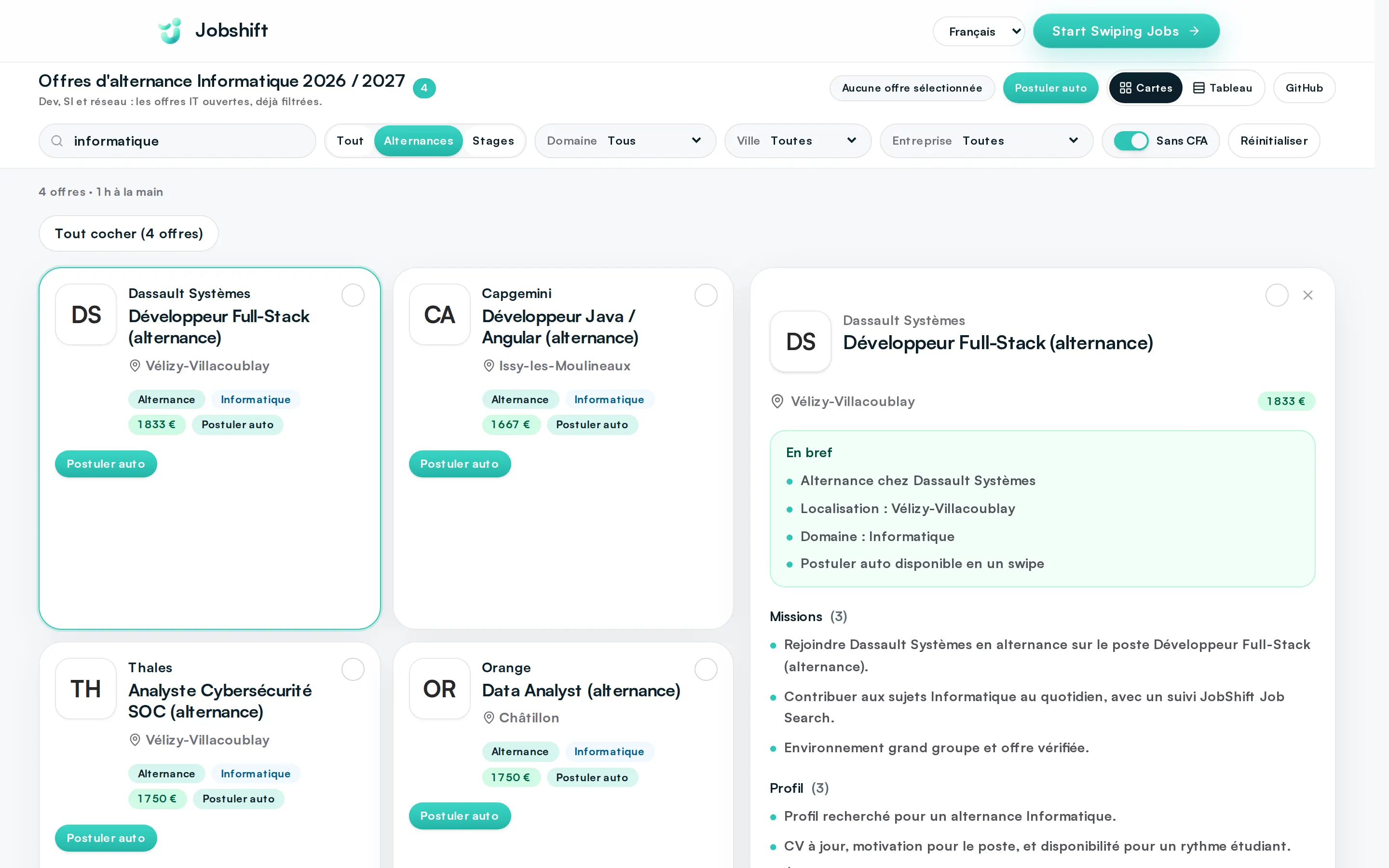
- Published openings, browsed on our page of alternance openings, which groups roles, cities and large groups.
- The public platform La bonne alternance, which shows both programmes and alternance employers near you.
- Speculative applications to companies that have published nothing: our guide to the speculative application gives the method.
- School forums, technical meetups and your network.
Our comparison of alternance job boards helps you choose where to look.
6. Track, follow up, prepare the interview
Note each application in the application tracker, with the send date and a follow-up date. For the interview, expect two parts: a conversation about your motivation and your rhythm, then technical questions on your projects, sometimes a small exercise. Practise telling a project with the STAR method (situation, task, action, result) with the interview simulator.
Three sample profiles and their strategy
The three situations below are fictional examples, built to illustrate the method. No result is guaranteed.
Inès, in terminale, aiming at a BTS SIO option SLAM
With no experience, she relies on a small site built during the year (HTML, CSS, a little JavaScript) published on GitHub with a README. Her CV fits on one page: target programme, rhythm, project, skills, summer job. She applies to schools and companies in parallel, and targets local SMEs and web agencies, as well as large companies.
Lucas, BUT informatique year 2, aiming at a developer alternance
He already has projects from the IUT. He picks two he actually owned, rewrites the READMEs to explain his technical choices and removes from his CV the languages he saw only once in class. He adapts each application to the technologies of the opening and practises presenting his main project in five minutes.
Sofia, changing careers, aiming at an RNCP title as a systems and network technician
She is 31 and has ten years of experience in logistics. Apprenticeship is in principle limited to age 29, except for exceptions set by the law: she also looks at the professionalisation contract. Her asset is her work experience: she puts it forward as proof of rigour and of managing priorities, and she sets up a network lab at home to show her technical skills. For this kind of path, see Jobshift for people changing careers.
The mistakes that cost an IT alternance
- Listing twenty technologies. The recruiter cannot tell what you really master, and the technical questions will be about what you wrote.
- An empty or messy GitHub. A link to a profile with no README and no finished project weakens your application more than no link.
- Forgetting the rhythm and the start date. The company needs to know when you are present. Put your school's rhythm and the start month at the top of the CV.
- Looking for the school, then the company. With the 3 month deadline to enter training, a sequential search often misses the intake.
- The same CV for every opening. A developer opening and a support opening do not expect the same keywords: a generic CV is ranked poorly by recruitment software.
- Never following up. Without tracking, an application left without a reply is often a lost application.
Checklist before you send your IT alternance application
- Your target fits in one sentence: role, diploma, rhythm, city, start date.
- You have one or two projects you can present, with an up to date README.
- Your CV puts the target title, the programme and the rhythm at the top of the page.
- The skills listed are those you can defend in an interview.
- The CV passes the ATS test without losing information.
- The letter or the message uses the words of the opening and cites one concrete piece of proof.
- You know the contract type (apprenticeship or professionalisation) and the matching minimum pay.
- Each application is noted with a follow-up date.
Apply to IT alternance openings with Jobshift
Adapting a CV and a letter to each opening takes time, especially when you are also looking for a school. Jobshift is a job and alternance search app built around a swipe, designed in particular for juniors, alternants, developers and people changing careers. Here is how it works:
- You import your CV once to create your candidate profile.
- You swipe the openings that match your role, your level and your search area, including alternance openings.
- On each swipe right, Jobshift prepares a CV and a cover letter adapted to the opening, then submits the application in the recruiter's ATS (including Greenhouse and Lever). You can reread, edit or cancel each application before it is sent.
- Your applications are saved in your candidate space, with the company, the role and the date.
See Jobshift for developers, Jobshift for juniors and the detail on how Jobshift works. If you have just finished your studies, our guide recent graduate: land your first job takes over after the alternance.
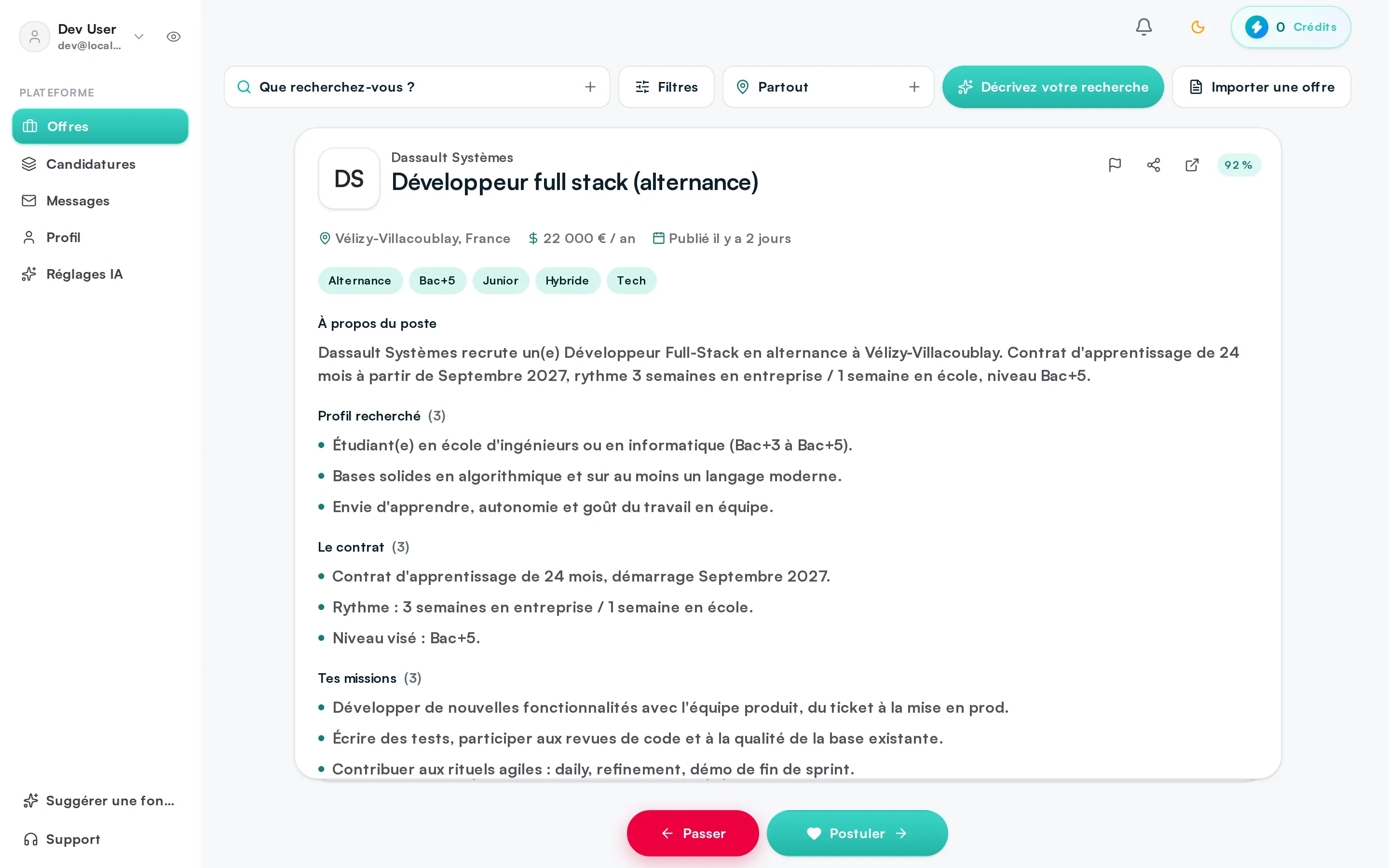
Jobshift: apply to IT alternance openings in one swipe. Swipe the openings that match you and reread each application before it is sent. Try Jobshift for free
Related articles
- How to write a CV for an alternance: a concrete guide
- IT CV example: 8 models ready to adapt
- Cover letter for an alternance: examples
- Alternance job boards: where to look for openings
- Recent graduate: how to land your first job in 2026
FAQ
Which diploma should you prepare in an IT alternance?
It depends on the role. The BTS SIO (bac + 2) leads to support, to networks (SISR option) or to application development (SLAM option). The BUT informatique (bac + 3) offers four pathways, from development to data management. A master's or an engineering degree (bac + 5) opens engineer roles.
What is the pay of an IT alternant in France?
In an apprenticeship, the legal minimum goes from 27 % of the Smic (age 16 to 17, 1st year) to 100 % of the Smic (age 26 and over), according to the Service Public grid. From age 21, the collective minimum wage for the job can apply if it is more favourable. The company can always pay more.
Do you need to know how to code to find an IT alternance?
For a developer role, yes: you need a base in one language and one or two projects to show. For support, networks or cybersecurity, recruiters expect a base in systems and networks instead, which you can prove with a documented lab.
Apprenticeship or professionalisation contract: which one to choose?
Apprenticeship prepares a diploma or an RNCP title and is aimed, as a general rule, at ages 16 to 29. The professionalisation contract is also open to adults, in particular to jobseekers aged 26 and over. The programme you choose often decides which contract is possible: ask the school.
Can you start an IT alternance without a school?
No. An alternance always pairs a company and a training programme. In an apprenticeship, you must enter the training centre at the latest 3 months after the contract starts, according to Service Public. Look for the school and the company at the same time.
How do you make an IT alternance CV more convincing?
Put the target title, the programme and the rhythm at the top, then one or two projects with a link to your GitHub repository. Cite only the technologies you can explain, and check that recruitment software reads the file with an ATS test.
Sources
- Apprenticeship contract, Service Public (page checked on 8 September 2026)
- Professionalisation contract, Service Public (page checked on 22 July 2026)
- BTS services informatiques aux organisations, option SISR, Onisep
- BUT informatique, application pathway, Onisep
- Which programmes to work in IT?, Onisep
- La bonne alternance, the public platform for alternance openings and programmes