Recent graduate: how to land your first job in 2026
 Chris Massie
Jobshift
October 31, 2026 · 13 min read

Partager l'article
To land your first job as a recent graduate, you need to do three things at the same time: present your internships, work-study placements (alternance) and projects as real experience in a resume that recruitment software can read, apply regularly to roles that are actually open to beginners, and use the support schemes reserved for young people. The degree opens the door, but the method makes the difference.
This guide goes through each step in order: the support you are entitled to, the recent-graduate resume, where to look, the choice between job ads and speculative applications, then the interview. No miracle promise and no dubious shortcut: only what concretely increases your chances of getting replies.
In short
- Your experience already exists: internships, alternance, student jobs, final-year projects and volunteering are presented as experience, with concrete results.
- Target the right roles: titles such as "junior", "beginners welcome", "graduate program" or "0 to 2 years of experience" are made for you. A posting that asks for 2 years of experience often stays reachable if you meet the essentials.
- Get support: France Travail, Apec for graduates at bachelor's level and above (bac+3), the mission locale, and the contrat d'engagement jeune (CEJ) for people under 26.
- Combine the channels: online ads, speculative applications, your school's network and job apps.
- Keep a pace: a weekly goal of targeted applications, written tracking and follow-ups beat random waves of sends.
Recent graduate: what to expect from a first job
The first job is often the hardest application: you do not yet have a permanent or fixed-term role to put forward, and many ads ask for "a first experience". The paradox is real, but it can be worked around. Recruiters who hire beginners are not looking for a long career history; they are looking for signs that you will be operational quickly: skills used in a real situation, motivation for that specific role, and an ability to learn.
How long the search takes varies a lot with the degree, the sector, the region and the time of year: there is no "normal" delay that applies to everyone. Rather than comparing yourself, set goals you control (number of suitable applications per week, follow-ups, interviews prepared) and take stock every two weeks. If nothing moves after a few weeks, our guide "I can't find a job" helps you identify the stage that is blocked.

Support and schemes for recent graduates
Several public bodies support young people toward their first job for free. They do not replace your applications, but they bring advice, openings and sometimes financial support.
France Travail
Registering with France Travail gives access to an adviser, to jobs posted by companies, to workshops (resume, interview, professional social networks) and to training. It is also the entry point for several schemes. Register as soon as your studies end if you do not have a role yet: you lose nothing by doing it early.
Apec for graduates at bac+3 and above
Apec, the association for executive employment, offers support dedicated to recent graduates at bachelor's level and above (bac+3): a meeting with a consultant, workshops, openings for junior executive roles and tools to prepare your plan. Its site is the right front door if you are aiming at an executive or engineering role.
The mission locale and the contrat d'engagement jeune
Missions locales support young people aged 16 to 25 on employment, but also on training, housing or mobility. The network is presented on the site of the Union nationale des missions locales.
The contrat d'engagement jeune (CEJ) is aimed, under certain conditions, at young people from 16 to 25 inclusive, and up to 29 inclusive for people recognized as disabled workers. It offers intensive, regular support, with an allowance possible depending on your situation. The exact conditions and the amount are detailed on Service-Public and on the CEJ page of 1jeune1solution.
The VIE to start internationally
The volontariat international en entreprise (VIE) lets young people aged 18 to 28, French or nationals of the European Economic Area, start their career abroad inside a French company. Openings are published on the Mon VIE-VIA platform of Business France. If you are aiming abroad, also prepare your file in English with our guide to the job application in English and the English resume translator.
What if you want to keep studying?
If you are hesitating between a first job and a year of specialization, alternance lets you do both: you are an employee, you are paid, and you earn an extra degree. Browse our alternance openings by occupation and estimate your pay with the alternance salary calculator.
The recent-graduate resume: show what you have already done
A recent graduate's resume is not an "empty" resume. It is a resume whose blocks need reordering so that what proves your skills comes first.
The structure that works
- Title of the role you want, identical or very close to the posting title ("Junior digital marketing officer", not "Motivated recent graduate").
- A two- or three-line hook: your degree, your specialty, what you can already do and the role you are looking for.
- Experience: internships, alternance, student jobs, freelance assignments, final-year project. For each, one or two concrete achievements with an observable result.
- Education: degree, school, year, and only the courses or projects useful for the role.
- Skills: tools, software, languages with a level, job skills taken from the postings you are targeting.
- Commitments: associations, volunteering, competitive sport, if it brings a useful skill.
Making the resume readable by ATS
Many companies receive applications in an ATS, software that records and sorts resumes. A layout in complex columns, text inside images or fanciful section titles can stop the software from reading your information correctly. Keep a simple structure, classic headings (Experience, Education, Skills) and check the result with our free ATS test. To start again from a clean base, the resume generator offers a compatible structure, and our ATS-friendly resume template shows filled examples.
Student resume or recent-graduate resume: what changes
A student resume puts education first because it is still underway and is the main element. Once you have graduated, move professional experience (including internships and alternance) above education as soon as it relates to the role you want, and replace "student in…" with the title of the occupation you are looking for. If you truly have no experience to put forward, follow our method for writing a resume with no professional experience.
Where to look for your first job
Do not limit yourself to one channel: each one gives access to different openings.
Job sites and public platforms
The large job sites and public platforms such as 1jeune1solution, which gathers openings accessible to young people, are a good starting point. Filter on "beginner", "junior" or "0 to 2 years of experience" and create alerts so you hear quickly about new openings. Our comparison of the best job sites in France helps you choose which ones to follow.
Company career sites and graduate programs
Many large companies publish "graduate programs" or junior roles directly on their career site, sometimes before or without posting them elsewhere. List about twenty companies that interest you and check their career pages every week.
Your school's network
The careers service, the alumni network, company forums and your former internship or alternance tutors are precious contacts. Someone who has seen you work can recommend you or flag a role before it is published. Simply tell them you are available and name the role you are looking for.
Job apps
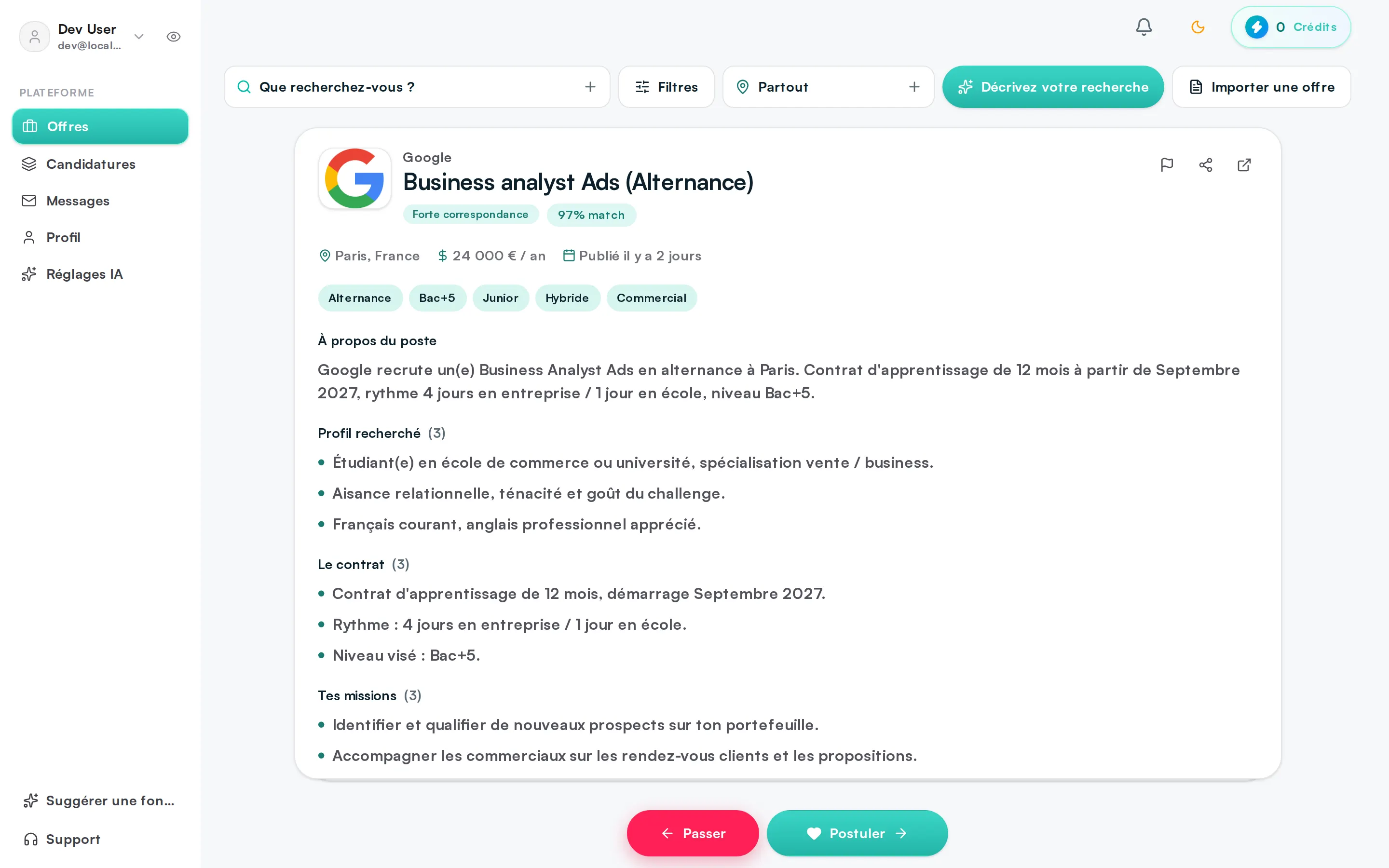
Apps let you spot openings and apply from your phone, in a few minutes a day. Jobshift, for example, shows you openings matched to your profile that you keep or dismiss with a swipe, and prepares a tailored file for each opening you keep. Our comparison of the best apps for finding a job in 2026 presents the main options.
Speculative application or reply to postings?
Both. Published openings give you a precise role and a contact, but also a lot of competition. A speculative application lets you arrive before an ad is published, at companies you have chosen.
Replying to postings: quality first
For each opening, adapt at least the resume title, the hook and the skills list to the words used in the ad, while staying faithful to what you can do. If the opening asks for "1 to 2 years of experience" and you have a year of internships and alternance combined on close assignments, apply: the experience asked for is often indicative.
The speculative application: targeted and short
Send a short message to the right person (the team manager or the recruiter) that explains why this company and what you can bring. Our guide to the speculative application details the method, and our speculative application email templates are ready to adapt. The application email generator and the cover letter generator give you a first version to personalize.
Organize and track your applications
As soon as you apply in several places, note each send: company, role, date, channel and planned follow-up date. Without tracking, it is impossible to know what works. Use our free application tracking tool or the application tracker template in Excel and Sheets. Follow up politely once if you have no reply after one to two weeks.
Succeeding at the interview when you have no experience
A recent graduate's interview is less about your history than about your potential: the recruiter wants to understand how you work, how you learn and why this role interests you.
Prepare concrete examples
For each key skill of the opening, prepare a situation you lived in an internship, in alternance, on a project or in an association: the context, what you did, the result. A group project carried through, a customer handled during a student job or a tool set up during an internship are acceptable examples.
Answering the classic first-job questions
- "Why should we hire you when you have no experience?": rephrase it by talking about your real experience (internships, projects) and how fast you learn, with an example.
- "What are your salary expectations?": look up beginner salaries for the occupation and the region beforehand, and give a realistic range.
- "Where do you see yourself in a few years?": show that the role fits a coherent plan, without reciting a career plan.
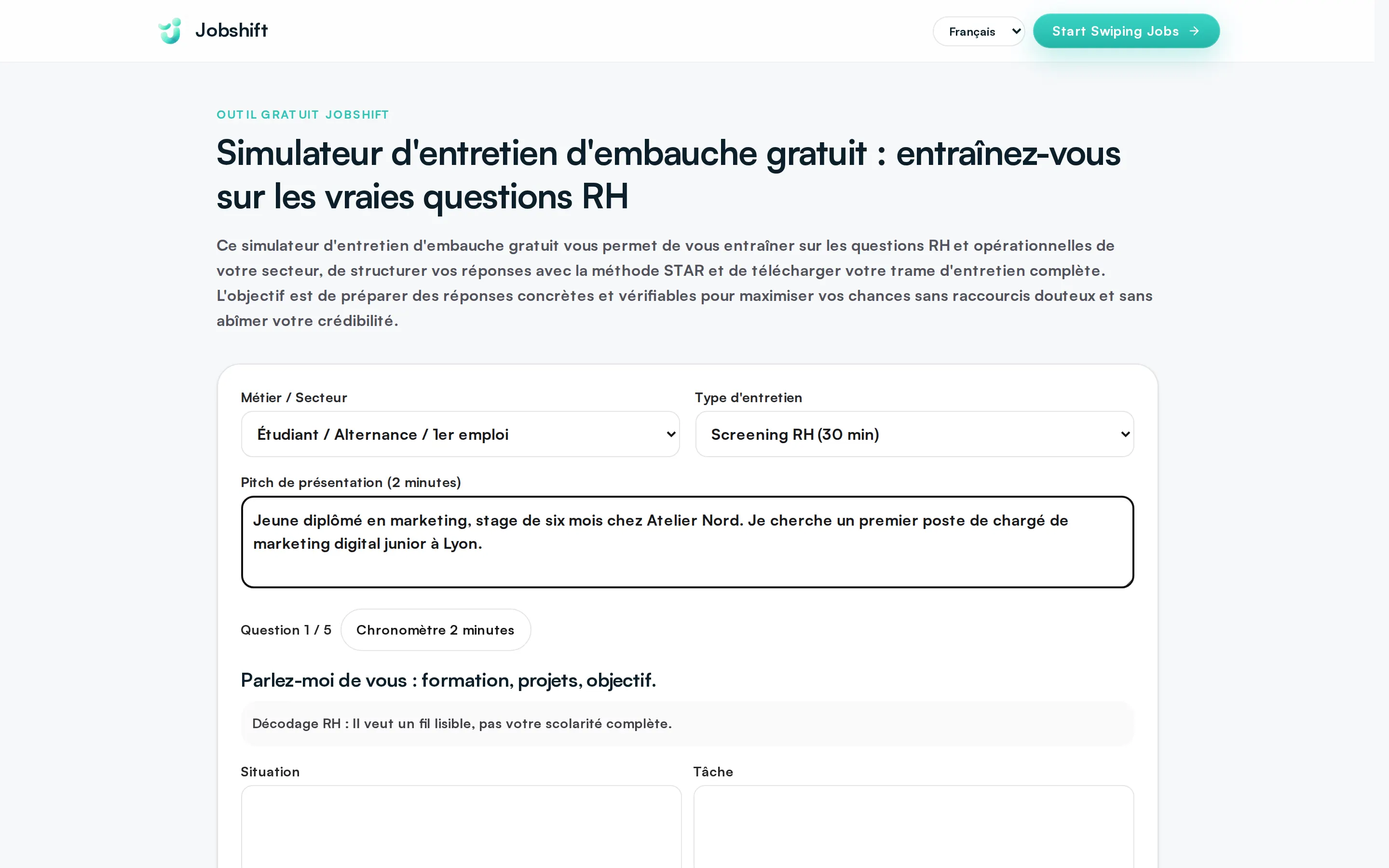
Practice out loud with our free interview simulator, which asks you questions adapted to the role you are targeting, then send a short thank-you email within 24 hours of the interview.
Common mistakes recent graduates make
- Waiting for the "ideal role": a first role close to your goal brings experience you will use later.
- Sending the same resume everywhere: a generic resume does not reuse the skills each opening expects.
- Setting aside openings that ask for a little experience: apply if you meet the essential criteria.
- Neglecting the network: your former tutors, teachers and classmates are often the first to hear about a role.
- Searching without a method: without a weekly goal or tracking, the search stretches and discouragement arrives fast.
Apply to more junior openings, without spending your days on it, with Jobshift
The first job is often won on regularity: sending tailored applications every week, without exhausting yourself rewriting your file for each opening. That is exactly what Jobshift does:
- You import your resume once to create your candidate profile.
- You swipe the openings that match your occupation, your experience level and your location preferences, including roles open to beginners.
- On each swipe right, Jobshift prepares a resume and a cover letter tailored to the opening, then submits the application in the recruiter's ATS (notably Greenhouse and Lever). You can reread, edit or cancel each application before it is sent.
- Your applications are saved in your candidate space, with the company, the role and the date.
See the page Jobshift for juniors and the detailed walkthrough on how Jobshift works.
Jobshift, the app built for juniors: swipe, apply. Keep your energy for the network and for preparing interviews, and let Jobshift adapt your file to each opening. Try Jobshift for free
Related articles
- How to write a resume with no professional experience
- "I can't find a job": 12 concrete reasons and a 30-day action plan
- Speculative application: the method
- Find an internship quickly
FAQ
How do you find a first job as a recent graduate?
Present your internships, alternance placements and projects as real experience in a resume that ATS software can read, target openings open to beginners, combine the channels (job sites, career sites, speculative applications, school network, apps) and set yourself a weekly goal of suitable applications, with tracking and follow-ups.
What support exists for recent graduates?
France Travail supports all job seekers, Apec offers support dedicated to recent graduates at bac+3 and above, and missions locales follow 16- to 25-year-olds. The contrat d'engagement jeune (CEJ) offers, under conditions, intensive support to 16- to 25-year-olds (up to 29 for people recognized as disabled workers). To start abroad, the VIE is open to 18- to 28-year-olds.
How do you write a recent-graduate resume with no experience?
Put the title of the role you want at the top, a short hook, then your internships, alternance, student jobs and projects with concrete achievements. Add education, the skills taken from the openings and your useful commitments. Keep a simple layout and test it with an ATS test.
Should you apply to openings that ask for experience?
Yes, if you meet the essential criteria. A mention of "1 to 2 years of experience" is often indicative, and your internships or alternance can count. Explain in your hook or your message how your experience matches the missions of the role.
How long does it take to find your first job?
There is no standard length: it depends on the degree, the sector, the region and the period. Focus on what you control (suitable applications each week, follow-ups, interview preparation) and take stock every two weeks to correct what is blocked.
Is a speculative application better than replying to openings?
The two complement each other. Published openings give a precise role but attract many candidates; a short, well-targeted speculative application lets you become known before an ad is published.