Logistics and supply chain apprenticeship: roles, diplomas, CV and how to land a contract
 Chris Massie
Jobshift
November 14, 2026 · 19 min read
Partager l'article
To land a logistics or supply chain apprenticeship in France, you first need to choose your entry level (warehouse, transport operations or flow management), aim for the matching diploma (CAP, bac pro, BTS GTLA, BUT MLT or QLIO, professional bachelor's, master's), then prove from the CV onwards three qualities every recruiter in the sector looks for: rigour, a sense of organisation and ease with management tools. The companies that hire apprentices are very varied (logistics providers, carriers, manufacturers, retailers, e-commerce players), which leaves many doors to push if you apply in an organised way.
This guide presents the roles you can access in alternance, the diplomas, what you need to know about the CACES, the minimum apprentice wage, then the complete method: CV, application and interview. To see the vacancies directly, go to the logistics apprenticeship openings page or to the supply chain apprenticeship openings.
In brief
- Three families of roles: warehouse jobs (order picking, receiving, stock management), transport operations jobs (freight forwarding, dispatch, transit) and flow-management jobs (procurement, planning, supply chain).
- Diplomas at every level: the CAP opérateur logistique and the bac pro métiers de la logistique for the shop floor, the BTS GTLA, BUT MLT or BUT QLIO for operations and flow management, then professional bachelor's degrees, master's degrees and schools for steering the chain.
- The CACES is not a diploma: it is a certificate of safe driving of equipment (forklifts, stackers…), valid for 5 years according to the INRS, useful mainly for warehouse roles.
- An apprentice's pay is a percentage of the Smic that depends on age and the year of the contract (Service-Public.fr grid below).
- The CV that works: a clear objective (role + schedule + date), skills taken from the posting, shop-floor experience (even a student job in a warehouse or a shop) written with verifiable facts.
- The method: target by type of company, apply in volume without rushing the quality, track every application and prepare a simple case study for the interview.
Logistics, transport, supply chain: what are we talking about?
The three words are often mixed up in job postings. Telling them apart helps you aim accurately.
- Logistics in the strict sense is everything that happens around stock: receiving goods, checking them, putting them away, picking orders, shipping them. The core of the job is in a warehouse or a platform.
- Transport organises the movement of goods from one point to another: choosing the carrier, planning rounds, transport documents, customs for international shipments.
- The supply chain (chaîne d'approvisionnement) links it all together: forecasting demand, triggering procurement, planning production and deliveries, and balancing stock levels, costs and lead times.
In a small company, a single role can touch all three. In a large group, each link has its own teams. That is why a “supply chain apprenticeship” posting can hide either an assistant buyer role or a flow analyst role: always read the list of duties before the title.

The roles you can access in a logistics apprenticeship
Warehouse roles
- Order picker: according to the Onisep profile, he or she picks the goods that have been ordered, by hand or with electric handling equipment, often guided by a headset and terminals linked to the warehouse management system, then checks, packs and labels the order. The minimum entry level indicated is the CAP, and Onisep mentions a starting salary of €1,867 gross per month. The job requires good physical fitness: shift work, a lot of walking, sometimes the cold of a refrigerated warehouse.
- Warehouse operative / forklift driver (magasinier-cariste): receiving, putting away and moving pallets with a truck. This is the role where the CACES matters most.
- Dock supervisor (chef de quai): coordinates the loading and unloading of trucks and the teams on the docks.
- Warehouse manager: according to Onisep, he or she manages the receiving, storage and shipping of goods, organises the spaces, supervises forklift drivers, order pickers and dock supervisors, and anticipates peaks in activity. Minimum entry level: bac + 2. It is a role people usually aim for after a first experience, but an apprentice on a BUT or a professional bachelor's can perfectly be placed in support of a warehouse manager.
Transport operations roles
- Freight forwarder (affréteur): finds the right carrier for each shipment and negotiates the price.
- Dispatcher or operations agent: plans the rounds, assigns drivers and vehicles, and handles the day's disruptions.
- Transit agent and customs declarant: prepare the documents for international shipments. Onisep notes that these two roles are also accessible with a BTS in international trade.
Flow management and supply chain roles
- Stock or procurement manager: monitors stock levels, places orders with suppliers, and avoids both stockouts and overstock.
- Assistant planner or planning officer: builds the production or delivery schedule from the forecasts.
- Supply chain assistant or flow analyst: tracks indicators (lead times, service rate, stockouts), analyses gaps and suggests improvements. The hiring calendar of manufacturers and the most requested supply skills are set out on the supply chain apprenticeship page. This is the profile closest to data work: if you like dashboards, our guide to the data analyst apprenticeship may also interest you.
Warehouse or office: how to choose
Ask yourself two simple questions. Do you prefer the shop floor, movement and results you can see straight away (orders leaving on time, a tidy dock)? Warehouse and operations roles will suit you. Do you prefer to anticipate, calculate and decide from figures? Aim for procurement, planning and the supply chain. In both cases, knowing the shop floor is a real asset: many supply chain managers say they learned the most on a dock.
Which diplomas should you prepare in a logistics apprenticeship?
The Onisep page on training for transport and logistics sums up the range well. Here are the main paths, by level.
| Level | Diplomas cited by Onisep | Target roles |
|---|---|---|
| CAP / bac | CAP opérateur/opératrice logistique, bac pro métiers de la logistique | Order picker, warehouse operative / forklift driver |
| Bac + 2 | BTS GTLA (gestion des transports et logistique associée), professional title of senior technician in logistics methods and operations | Transport operations, stock management, dock supervisor |
| Bac + 3 | BUT MLT (management de la logistique et des transports, pathways in connected or sustainable mobility and supply chain), BUT QLIO (qualité, logistique industrielle et organisation, including the organisation and supply chain pathway), professional bachelor's degrees, logistics manager title | Deputy warehouse manager, procurement, planning |
| Bac + 5 | Master's degrees and business or engineering schools with a logistics or supply chain specialisation | Supply chain, purchasing, flow management |
Three tips for choosing:
- Check that the apprenticeship route is open on the course page and in the CFA you are considering: that is not the case everywhere.
- Look at the schedule (one week in two, three days / two days, several weeks in a row…): it determines which companies will accept you, especially in warehouses that run in shifts.
- Do not overlook professional titles: they are often prepared in alternance and are read closely by recruiters in the sector.
For the general steps (finding a course, a CFA, understanding the calendar), the Onisep alternance page is a good starting point, and Jobshift's 2026 apprenticeship hubs group the sectors that are hiring.
CACES: what you need to know before you apply
This is the question that comes up most among future warehouse apprentices. Here are the essentials, according to the INRS.
What the CACES is (and is not)
The CACES (certificat d'aptitude à la conduite en sécurité) certifies that you have the knowledge and know-how to drive equipment safely. For forklifts and most rider-operated warehouse trucks, the relevant recommendation is R.489, split into categories. A few examples from the INRS list:
- Category 1A: rider-operated pallet trucks and order pickers without an elevating driving position;
- Category 1B: rider-operated stackers;
- Category 3: counterbalance front forklifts with a capacity of up to 6 tonnes;
- Category 5: reach trucks.
Pedestrian-operated stackers (you walk alongside them) fall under another recommendation, R.485. According to the INRS, CACES certificates are valid for 5 years (10 years for construction equipment) and the certificate belongs to the employee: it follows you if you change company.
The driving authorisation, issued by the employer
The CACES alone is not enough. To drive a forklift, you need a driving authorisation (autorisation de conduite) issued by the employer, which, as the INRS recalls, requires: suitable training, a check of medical fitness by the occupational physician, a check of knowledge and know-how (the CACES is the recommended way to do this check) and knowledge of the site and its rules.
Do you need it before you start looking?
No. Many logistics courses include CACES preparation, and a company can also fund it during your contract. If you already have it, state it clearly on your CV with the recommendation and the categories (for example “CACES R.489 categories 1A, 3 and 5, valid until 2029”). If you do not have it, do not write anything that sounds like you do: say instead that you are ready to take it.
Contract, schedule and pay of a logistics apprentice
Apprenticeship contract or professionalisation contract
- The apprenticeship contract (contrat d'apprentissage): a written employment contract, in principle open from 16 to 29 years of age inclusive, with exceptions (up to 35 in some cases, no age limit for an apprentice recognised as a disabled worker, for example). According to Service-Public.fr, training in the CFA must represent at least 25 % of the total length of the contract.
- The professionalisation contract (contrat de professionnalisation): another work-study contract, with its own rules on eligibility and pay, detailed on the dedicated Service-Public.fr page. It is common for professional titles and career changes.
The minimum apprentice wage
In an apprenticeship, the minimum wage is a percentage of the Smic that depends on your age and the year of the contract. Here is the grid published by Service-Public.fr (page checked on 8 September 2026):
| Year of the contract | Ages 16-17 | Ages 18-20 | Ages 21-25 | Age 26 and over |
|---|---|---|---|---|
| 1st year | 27 % of the Smic | 43 % of the Smic | 53 % of the Smic* | 100 % of the Smic* |
| 2nd year | 39 % of the Smic | 51 % of the Smic | 61 % of the Smic* | 100 % of the Smic* |
| 3rd year | 55 % of the Smic | 67 % of the Smic | 78 % of the Smic* | 100 % of the Smic* |
\* From age 21, it is the higher of this percentage of the Smic and the same percentage of the collective-agreement minimum wage for the job held.
These are minimums: the collective agreement or the company may provide more. In a warehouse, also ask about any bonuses linked to hours (night, weekend) provided for in the applicable agreement. For an estimate based on your age and year, use Jobshift's apprenticeship salary calculator. Pay benchmarks by type of role are detailed on the logistics apprenticeship page.
The method to land a logistics apprenticeship
Step 1: target by type of company
Logistics apprentices are not hired only by “logistics companies”. Make a list in each of these families around your CFA:
- Logistics providers that run warehouses on behalf of other brands;
- Carriers and freight forwarders (parcels, forwarding, transit);
- Manufacturers (food, automotive, aerospace, chemicals…), which have their own procurement and shipping departments;
- Retail and e-commerce, with their platforms and warehouses;
- SMEs in wholesale or distribution, where an apprentice often touches everything.
Think about distance and hours: a warehouse that starts very early must be reachable when you do not yet have a car. The public service La bonne alternance helps you spot companies that hire apprentices near you.
Step 2: a one-page logistics apprentice CV
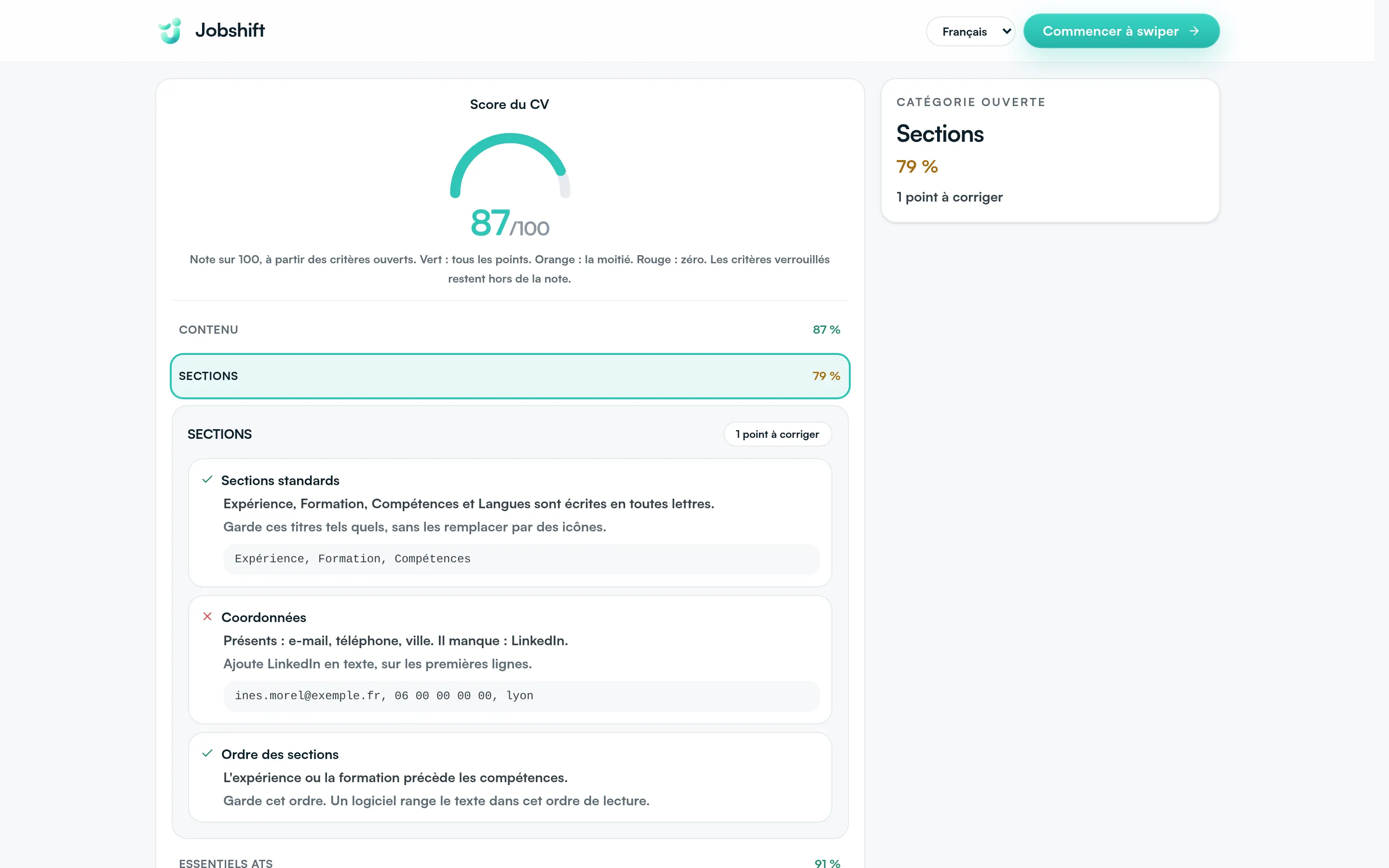
Your CV must pass the screening software (ATS), which looks for the keywords in the posting, then the recruiter, who skims it quickly. In logistics, they want to see straight away: which role, which schedule, from when, and evidence of rigour.
Here is a typical structure, with a fictional profile:
FIRST NAME LAST NAME
Assistant logistics / supply chain apprenticeship — BTS GTLA — 2 weeks / 2 weeks — from September
City · phone · e-mail · driving licence B (if you have it)

PROFILE
Future BTS GTLA student, I am looking for a 2-year apprenticeship in logistics
or transport operations. Used to teamwork and shift hours
thanks to my summer jobs in a warehouse.

SKILLS
Stock management and inventory · Receiving and checking goods ·
Order picking · Excel (pivot tables, XLOOKUP) ·
Basics of a WMS (warehouse management system) · English level B1 ·
CACES R.489 categories 1A and 3 (only if you actually have it)

EXPERIENCE
Order picker (summer job) — [Company], [City] — July-August [year]
- Terminal-guided order picking, checking and wrapping pallets
- Participation in the month-end inventory
- Compliance with the site's safety rules

All-purpose employee (student job) — [Shop], [City] — [dates]
- Receiving deliveries and replenishing shelves
- Reporting stockouts to the section manager

EDUCATION
BTS gestion des transports et logistique associée — [CFA], [City] — [year]
Bac [specialism] — [High school], [City] — [year]

INTERESTS
[1 or 2 concrete items: team sport, association, organising events…]
The rules that make the difference:
- Reuse the words of the posting: if it talks about “procurement management”, “WMS” or “scheduling”, use those terms where they are true for you.
- Value every shop-floor job: retail, fast food, drive-through, delivery… They prove punctuality, teamwork and respect for procedures. Our article on hard skills helps you phrase them.
- Quantify only what you know: number of SKUs handled, size of the team, frequency of an inventory. Never invent figures, they are checked in the interview.
- Keep a simple layout: one column, standard headings, no table and no text inside images.
To go further, our guide how to write a CV for an apprenticeship details every section, and our article logistics manager CV shows how to phrase logistics experience with verifiable results. You can also start from the free CV generator, then run your file through the free ATS test, which scores your CV on how readable it is for screening software.
Step 3: a short, concrete letter or message
Many apprenticeship postings ask for a simple message rather than a long letter. In both cases, three paragraphs are enough:
- The role, the course and the schedule: “I am preparing a BUT MLT in alternance (3 weeks / 1 week) and I am applying for the assistant procurement role.”
- One piece of evidence: a shop-floor experience, a course project (a warehouse layout study, a safety-stock calculation…), or what specifically attracts you in this company.
- The next step: your availability for a conversation.
The cover letter generator and the application email generator give you a base to personalise, and our apprenticeship cover letter examples show the tone to adopt.
Step 4: apply in volume, but with tracking
In alternance, the limiting factor is often the number of companies contacted in time, before the CFA term starts. Set yourself a regular pace, adapt at least the objective and the skills on the CV to each posting, and record every send (company, role, date, planned follow-up) in a spreadsheet or in Jobshift's free application tracker. Follow up politely once if you have had no reply after a week or two.
Step 5: prepare the interview
The questions that often come up in logistics:
- “Why logistics?” Answer with a fact (a job, an internship, a course you liked), not with “it is a sector that is hiring”.
- “How do you react to an unexpected problem?” Prepare a concrete example: a late truck, an order error, an absent colleague. Describe the situation, what you did and the result.
- “Are you comfortable with shift hours / physical work / Excel?” Be honest: a recruiter prefers a frank answer to a bad surprise.
- A mini case study for office roles: reorganise a stock, choose between two carriers, explain what a safety stock is. They expect a logical approach more than a perfect answer.
Practise out loud with Jobshift's interview simulator, and prepare two or three questions to ask (how tutoring is organised, duties in the first year, team schedules).
The mistakes that cost a logistics apprenticeship
- Applying without a school or a precise schedule: many companies want to know straight away when you will be on site.
- A generic “any apprenticeship” CV: without logistics words (stock, flows, receiving, procurement, transport), it does not pass the filters well.
- Overclaiming a CACES or a software tool: it is checked from the first days on the floor.
- Ignoring practical constraints: hours, commute, lifting loads. Better to talk about them in the interview than to resign after a month.
- Targeting only big brands: SMEs and providers also hire many apprentices, often with more variety in the work.
- Not tracking your applications: without a tracking sheet, you forget to follow up and you lose opportunities.
Checklist before you send your application
- [ ] The CV title states the target role, the course, the schedule and the start date.
- [ ] The skills reuse the exact terms of the posting, only when they are true.
- [ ] Your shop-floor jobs are valued with verifiable facts.
- [ ] The CACES and the driving licence are mentioned only if you actually have them.
- [ ] The CV fits on one page, in one column, as a PDF.
- [ ] The file passes the ATS test correctly.
- [ ] The message or letter is three paragraphs long and names the company.
- [ ] The application is recorded in your tracker with a follow-up date.
Apply to logistics apprenticeships faster with Jobshift
Jobshift works like a swipe app for jobs: each opening appears as a card, you swipe right to apply and left to skip. You keep control over the openings you choose, and your applications are grouped in the same tracker. If you are just starting, the Jobshift for juniors page explains how the app helps you find a first contract, and all apprenticeship openings are organised by sector, including logistics apprenticeships and supply chain apprenticeships.
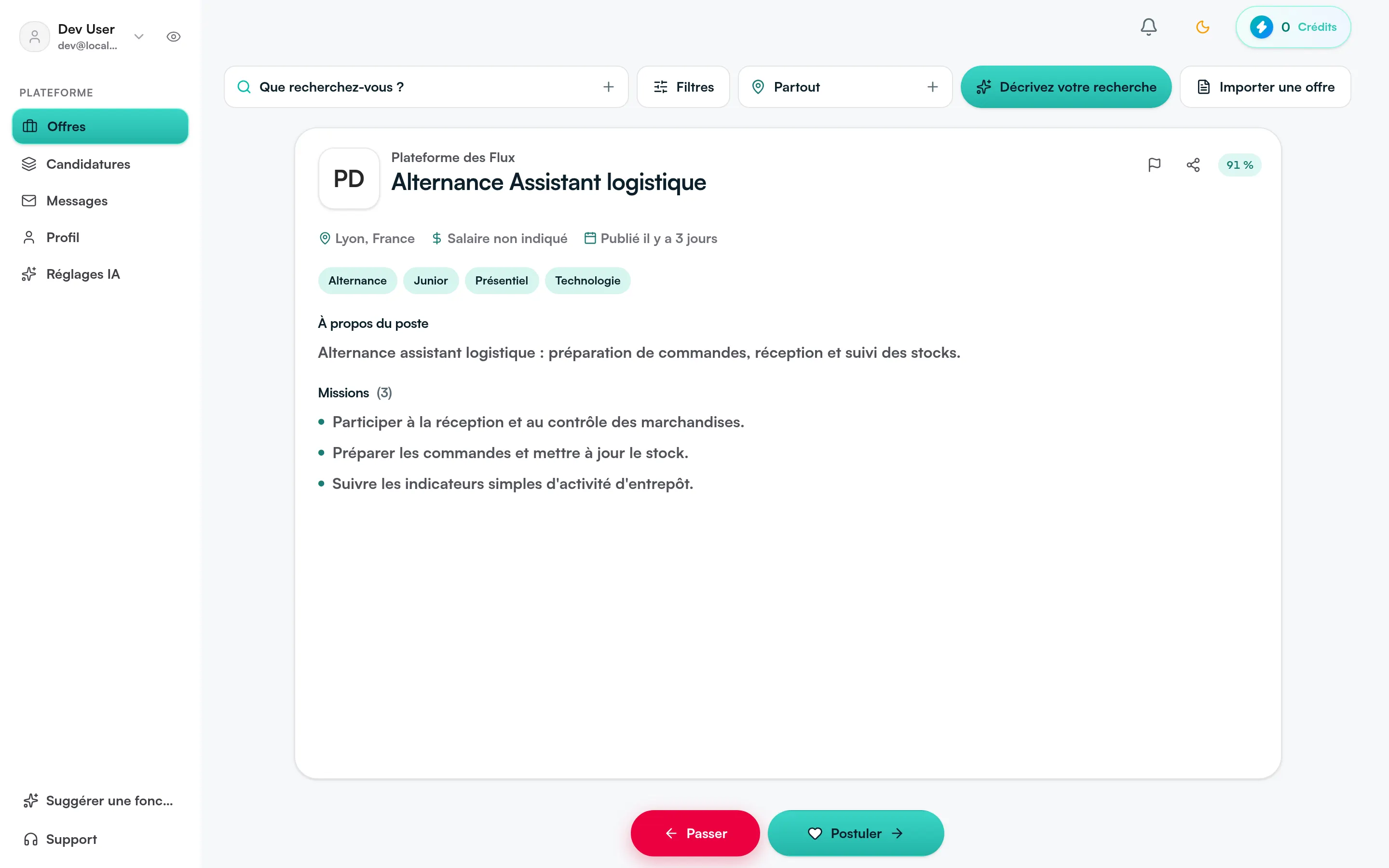
Find your logistics apprenticeship without spending your evenings filling in forms. Create your profile and start swiping. Try Jobshift for free
Related articles
FAQ
Which diploma should you prepare for a logistics apprenticeship?
It depends on the role you are aiming for. According to Onisep, the CAP opérateur logistique and the bac pro métiers de la logistique train people for warehouse roles (order picker, warehouse operative / forklift driver), while the BTS GTLA, the BUT MLT, the BUT QLIO and some professional titles lead to transport operations, stock management or freight forwarding. Master's degrees and specialist schools aim at steering the supply chain. Check that the apprenticeship route is open in the CFA you choose.
What is the difference between a logistics apprenticeship and a supply chain apprenticeship?
Logistics is mainly about stock and the warehouse: receiving, storage, picking and shipping. The supply chain covers the whole chain, from demand forecasting to procurement, planning and deliveries. In practice, postings often mix the two: read the list of duties to see whether the role is more shop-floor or more about steering the flows.
Do you need the CACES for a logistics apprenticeship?
It is not a prerequisite to apply. Many logistics courses include its preparation and the company can fund it. To drive a forklift, you still need a driving authorisation issued by the employer, and the INRS recommends the CACES (recommendation R.489 for rider-operated trucks) to check knowledge. CACES certificates are valid for 5 years.
What is the pay of a logistics apprentice?
On an apprenticeship contract, the legal minimum is a percentage of the Smic that depends on your age and the year of the contract: for example 43 % of the Smic in the first year between 18 and 20, 53 % between 21 and 25, and 100 % from age 26, according to Service-Public.fr. The collective agreement or the company may provide more. Jobshift's apprenticeship salary calculator gives an estimate for your situation.
Can you find a logistics apprenticeship with no experience?
Yes, that is the point of alternance. Highlight everything that proves rigour and reliability: student jobs in a shop, a warehouse or restaurants, course projects, volunteering. Phrase these experiences with concrete facts and reuse the keywords of the posting in your CV.
Which skills should you put on a CV for a supply chain apprenticeship?
Excel (pivot tables, lookup functions), basics of stock and procurement management, knowledge of a warehouse management system or an ERP if you have used one, English, and qualities such as rigour, organisation and the ability to handle unexpected problems. Only list what you can actually do.
Sources
- Logistics and transport: jobs, training, employment (Onisep)
- Which courses to work in transport and logistics? (Onisep)
- Order picker: job profile (Onisep)
- Warehouse manager: job profile (Onisep)
- BUT qualité, logistique industrielle et organisation, production management pathway (Onisep)
- Caces: the key points (INRS)
- Caces: the categories (INRS)
- Caces: driving authorisation (INRS)
- Apprenticeship contract (Service-Public.fr)
- Professionalisation contract (Service-Public.fr)
- Alternance (Onisep)
- La bonne alternance (public service)