Executive Assistant Cover Letter: The 2026 Complete Guide
October 26, 2026

You’ve found an executive assistant job that fits your profile. But when writing your cover letter, you end up repeating the same generic words everyone uses: organized, versatile, discreet. How can you demonstrate your skills without just copying your resume?
Your strongest points often lie in the behind-the-scenes work: resolving scheduling conflicts, preparing files ahead of meetings, or passing information to the right contacts. A convincing executive assistant cover letter highlights these concrete contributions without overstating your role or revealing confidential details.
Cover Letter Structure for an Executive Assistant
Cover letters are no longer mandatory. According to the 2024 APEC study on executive recruitment, 50% of companies hiring executives in 2023 requested a cover letter at least once during the year, while 71% used phone pre-screening interviews.
These trends mainly concern executive roles, not exclusively assistant positions. Still, they offer useful guidance: your letter should quickly convey what your resume cannot—your writing skills, judgment, and understanding of executive priorities.
Letter Sections and Their Purpose
Structure your argument around a hook, evidence, and a projection into the role. End with a simple closing without repeating your motivation.
| Section | Recruiter’s Question | Expected Content | Length |
|---|---|---|---|
| Hook | Why this role? Why you? | Connection to the company, department, or a specific job detail | 2 to 3 sentences |
| Evidence | Can you do what’s required? | Two or three relevant experiences with results or figures | 1 to 2 short paragraphs |
| Projection | What will you bring to the team? | Priorities you would address first and how you’d organize them | 2 to 3 sentences |
| Closing | Are you available and willing to discuss? | Availability, attachments, polite closing | 1 to 2 sentences |
These lengths serve as guidelines, not strict quotas. Strong evidence deserves more space than general background.
Clear and Reader-Friendly Formatting
Keep your letter to one page max, with balanced paragraphs and short sentences. Include your contact info, the recipient’s details, and a subject line referencing the job title before the main text. Avoid shrinking font size to fit unnecessary filler.
Before writing, jot down the key message you want the recruiter to remember. For example: you proactively manage executive deadlines without waiting for reminders.
Then, pick a real job posting to test your plan. If your main message doesn’t align with any job duties, choose a different angle rather than forcing a connection.
Turning Job Description and Skills into Verifiable Evidence
Treat the job ad as a specification sheet, not a list of adjectives to copy. France Travail recommends analyzing the ad point by point and structuring your letter around the "you, me, we" approach.
Start with Tasks, Then Find Facts
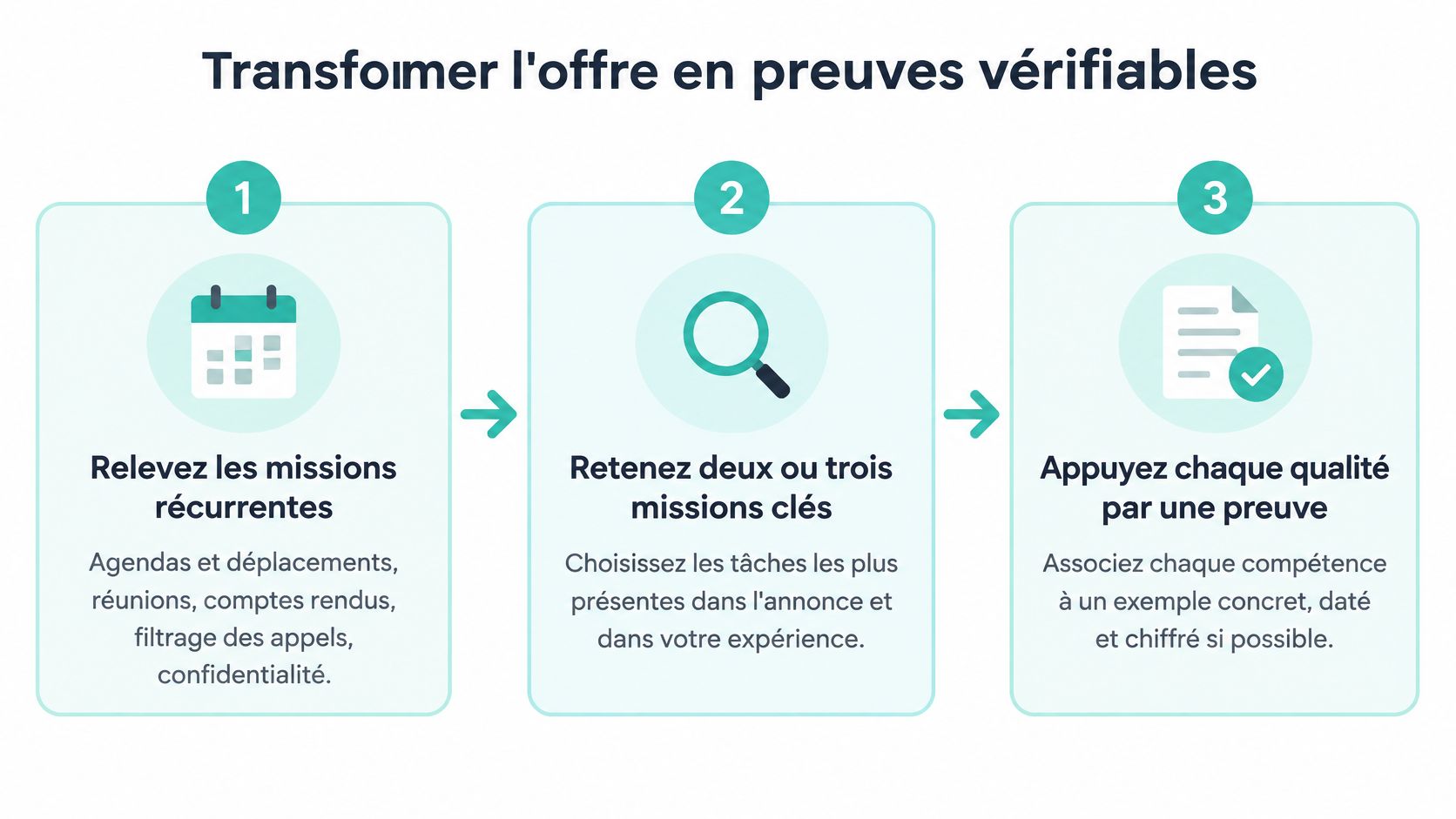
- Identify recurring tasks. Look for scheduling, travel, meetings, minutes, calls, and confidentiality requirements. Separate core duties from occasional tasks.
- Recall comparable experiences. Prioritize situations close to the target role, even if your previous title differed. Alternating coordination can be more relevant than long reception experience.
- Find proof for each skill. Note volume, frequency, deadlines, or deliverables. Without exact metrics, describe your method and observable results.
- Explain the benefit to the team. Show how your work ensures timely files, decision tracking, or smooth request handling.
The diagram below illustrates turning the job ad into solid arguments.
Common Tasks and Evidence to Highlight
| Job Task | Underlying Skill | Evidence to Highlight |
|---|---|---|
| Managing calendars and travel | Prioritization and anticipation | Number of executives supported and weekly appointments managed |
| Organizing meetings | Coordination and attention to detail | Meeting size, invitation lead time, agenda preparation |
| Writing minutes and summaries | Synthesis and writing skills | Number of meetings covered, turnaround time for minutes |
| Handling administrative and financial documents | Reliability and numeracy | Types of files prepared, volume or budget managed |
| Using collaboration tools (Teams, Outlook) | Digital proficiency | Daily tools used, shared calendars, managing shared inboxes |
| Maintaining confidentiality and screening calls | Discretion and judgment | Level of sensitive info handled, number of calls screened daily |
Expectations go beyond administrative tasks: a public sector job ad also mentions deadline planning, dashboards, and preparing executive files. Your letter should show how you make executive work more reliable.
Replace organized with managing calendars for [number] executives and [number] meetings monthly. Instead of rigorous, specify that you distribute minutes within [timeframe] after approval. For discretion, describe handling confidential HR or financial files without naming individuals.
Measurable doesn’t always mean numeric. A respected approval process or complete files ready before deadlines also count as proof. Avoid claiming time savings you haven’t measured.
Only mention Teams or Outlook if you use them daily. If a claim lacks solid examples, remove it rather than replacing it with an adjective.
If applying to multiple jobs, Jobshift can help create tailored bases for each ad; a manual working document works too. In both cases, complement with your facts and adapt your resume to the job posting for a coherent profile.
Unique Opening Sentences That Avoid Clichés
Currently seeking a new challenge speaks about you, not the employer’s needs. I am very organized states a quality without proof. And I am pleased to submit my application just delays your main argument.
A strong opening creates a clear link between the role and your background. You can start from the function, industry, or your career goals.
Focus on Role or Industry
For an executive office expecting rigorous meeting preparation, dive straight into the work:
Preparing the [committees mentioned in the ad] and managing the calendar of the [role] are tasks I currently handle at [organization]. I look forward to bringing this experience to your [department name] team.
For a consultancy or public agency, emphasize a real constraint you know:
Your firm seeks an assistant to coordinate communication between [contacts listed in the ad]. My experience in [sector] has taught me to prepare these exchanges and follow up until resolution.
Avoid calling an SME a "growing company" without verifiable facts. A specific reference to its activity is more impactful than a general compliment.
Explaining Career Changes
A career shift deserves a clear sentence, not a defensive justification:
After experience in [role], I am moving toward executive assistance to develop coordination tasks I already performed. Your position combines [task] and [task], which I practiced in [context].
The logic of a convincing cover letter remains the same: give the recruiter a concrete reason to keep reading.
If your first sentence could apply to any employer, add a detail specific to the ad or organization.
Adaptable Paragraphs Based on Your Background
Choose the context closest to yours, then replace each bracket with verifiable facts. These paragraphs are templates, not experiences to claim as your own.
Preparing your application requires sorting your evidence before crafting your wording.

Large Corporation or Executive Office
In my current role, I manage calendars for [number] executives and prepare [number] committees each quarter. I gather contributions, verify documents, and draft minutes within [timeframe], following the established approval process. This oversight ensures [observable result] while respecting the restricted distribution of files. I would apply this method to prepare your executive meetings.
The key is coordinating preparation, validation, and distribution. Avoid implying you set strategic priorities if you only organize their execution.
Small Business and Multitasking Roles
In a [number]-employee SME, I handle administrative follow-up, communication with [number] clients and suppliers, and maintain shared tools. I use [tool] to track deadlines and flag issues needing decisions. This organization achieved [verifiable result]. It meets your need for autonomy while keeping management informed of sensitive matters.
Autonomy doesn’t mean doing everything alone. Show you also know when to escalate decisions.
Public Sector or Regulated Environment
In a regulated setting, I ensured traceability of [type of files] and drafted summaries approved by [role]. I controlled required documents and tracked their transmission through [tool or procedure]. Files were thus [observable result]. This practice matches your department’s requirements for monitoring and formalization.
For tips on presenting your arguments verbally, you can also watch this video.
Entry-Level or Recent Graduate
During my internship, I organized [type of event] for [number] participants, from guest lists to minutes. I coordinated [contacts] and centralized confirmations in [tool]. This preparation resulted in [observed outcome]. I aim to apply this method to your executive meeting preparations.
Target paragraphs about six to eight lines depending on formatting, without filler. For unsolicited applications, adapt your argumentation accordingly with a speculative cover letter. For cover email writing, SpeakMeeters’ email templates provide useful guidance on subject lines, requests, and closings.
Proofreading and Checking Your Letter Before Sending
A well-written letter isn’t enough if you can’t explain it in an interview. For each achievement, prepare the context, your exact role, and the outcome. Distinguish your personal contribution from team efforts.
Content Check Before Formatting
Read your letter aloud to spot awkward phrasing. Also verify that mentioned tools match your experience: checking a shared calendar isn’t the same as managing team access rights.
Using AI doesn’t exempt you from this check: according to France Travail, 40% of French job seekers report using AI tools to write CVs or personalized letters. Follow the rule AI draft, human review: use AI to extract requirements or rephrase experiences, but never accept fabricated content.
Do not share client names, HR data, or internal financial documents with AI writing tools. Describe your experience anonymously.
Keep a concise version for online forms and customize more for trusted positions. Precision should be consistent across formats.
Sending Checklist
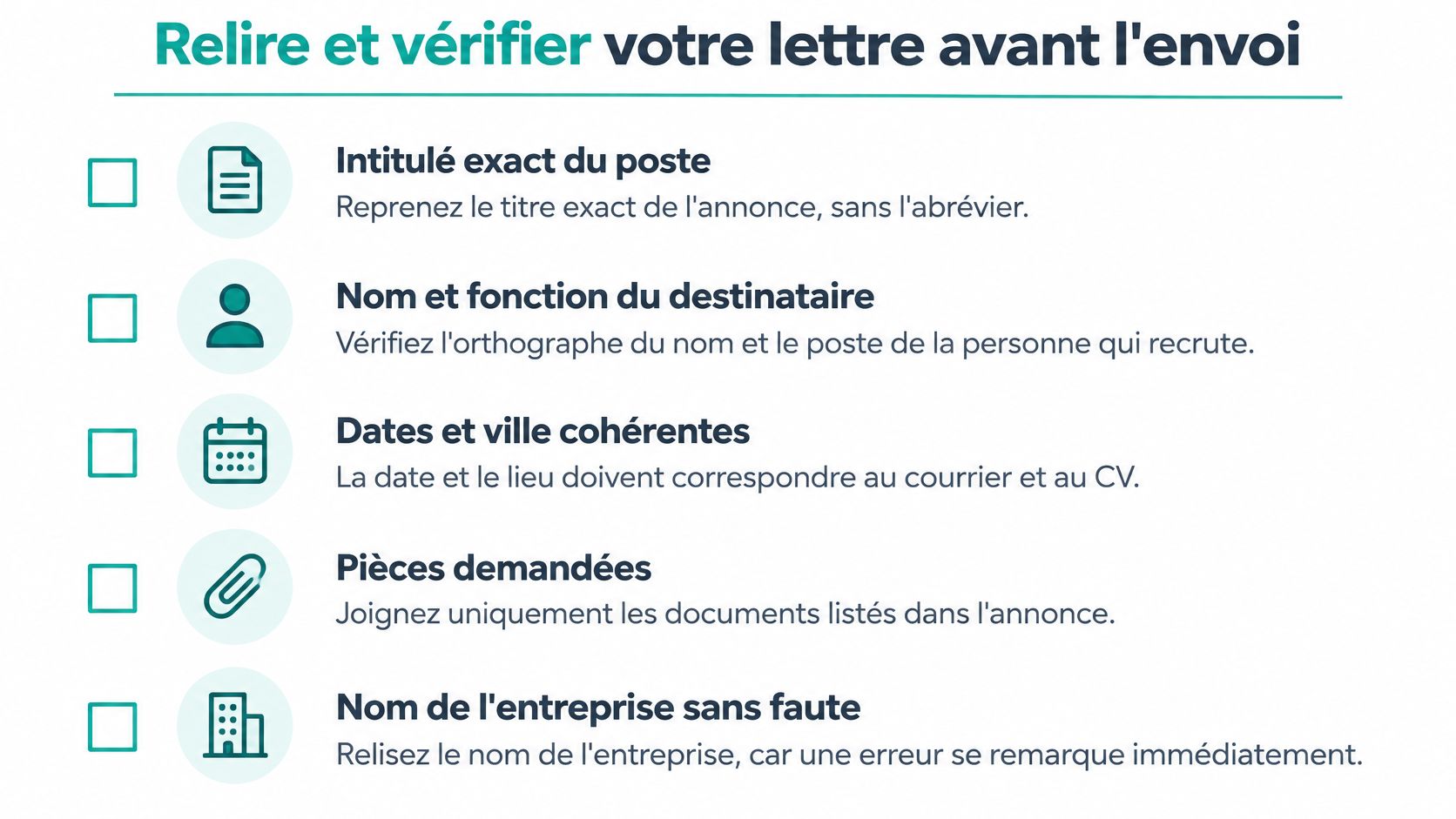
- Job title and recipient. Double-check the job title, name, and role of your contact.
- Consistency. Verify dates, location, and alignment with your resume.
- Attachments. Include requested documents and open each file before sending.
- Company name. Proofread it everywhere, including subject line and file name.
This visual check helps finish proofreading without missing administrative details.
Finally, keep a copy of your sent application. It will help you prepare examples for interviews.
Frequently Asked Questions About Executive Assistant Cover Letters
Should I Send a Cover Letter If Not Requested?
Only if it adds useful information: a precise match with tasks, a career change, or relocation to explain. The APEC highlights the decline of cover letters in recruitment ; a generic letter doesn’t add value beyond your resume and cover email.
Ideal Length for a Cover Letter
One page with short paragraphs and clear formatting. If you must choose, focus on one well-explained experience rather than listing qualities or summarizing your entire background.
Should I Include Salary Expectations?
No, unless the job posting explicitly asks. When required, state them clearly in the requested format without turning your letter into salary negotiation or confusing gross and net amounts.
Writing Without Direct Experience in Executive Assistance?
Use internships, apprenticeships, secretarial tasks, or events organized during your studies. Describe your real responsibilities: preparing agendas, coordinating invitations, and producing minutes are more convincing than vague job titles.
Can I Send a Cover Letter in English?
Yes, if the job ad is in English or the role requires bilingual skills, following application instructions. Maintain the same precision about your tasks and avoid translations you couldn’t confidently explain in an interview. Jobshift helps you find relevant job postings and tailor your resume and cover letter to each role’s requirements. Choose a real job, prepare your evidence, then visit Jobshift to build a targeted application you can review before sending.
À propos de l'auteur
Chris Massie, cofondateur de l'appli Jobshift. Il travaille sur l'outil depuis sa première version : analyse du CV face à l'offre, réécriture automatique des blocs faibles, candidatures envoyées en mode swipe. Profil LinkedIn